
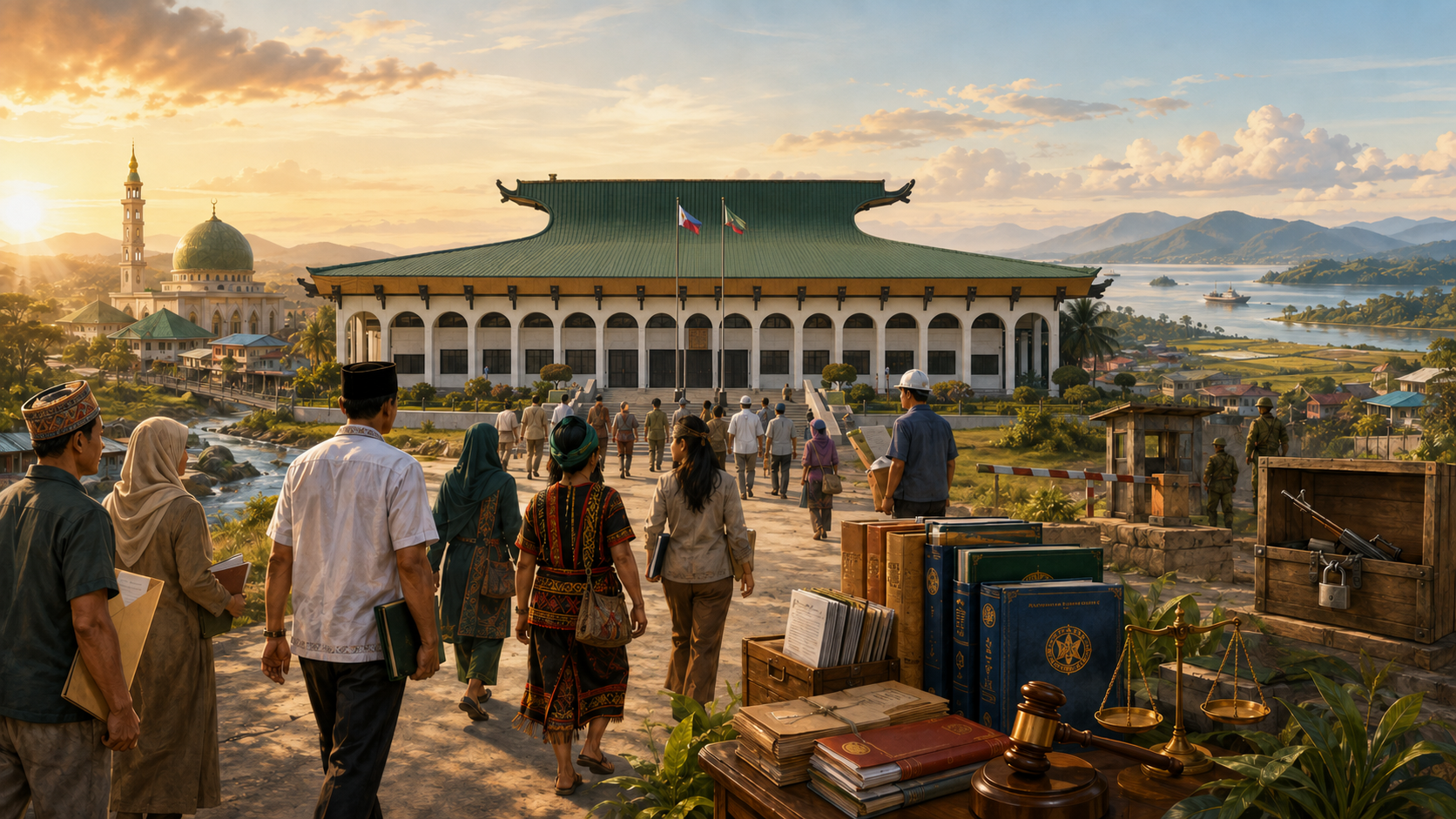
Does Bangsamoro Have Its Own Police or Military? — Where Authority Over Land and Currency Sits with the Central Government
In the previous installment, we looked at how the Bangsamoro Autonomous Region in Muslim Mindanao (BARMM) holds greater legislative and fiscal powers than an ordinary Philippine local government, including a mechanism under which it receives an annual block grant from the central government in addition to its share of national taxes collected within the region.
Does BARMM, then, have its own police force or military?
And does all state-owned land within BARMM automatically become the property of the BARMM government? Does the Philippine land registration system still apply as-is? Is the Malaysian ringgit, used in Tawi-Tawi Province, a second official currency of BARMM?
The short answer: BARMM has no autonomous police force, military, or currency of its own.
Institutions closely tied to national sovereignty — policing, the armed forces, land registration, and currency issuance — remain under the fundamental control of the Philippine central government.
That said, the BARMM government is granted a greater degree of involvement than an ordinary local government in matters such as consultation with regional police, land use, natural resources, and the rights of indigenous peoples.
BARMM Has No Independent Police Force
BARMM has no police force that the autonomous government itself recruits or commands.
Policing within the region falls under the Philippine National Police (PNP), a national organization. Within BARMM, policing is handled by the Police Regional Office Bangsamoro Autonomous Region, commonly known as PRO BAR.
The Bangsamoro Organic Law explicitly places PRO BAR under the direct operational control and supervision of the PNP.
The BARMM Chief Minister therefore does not have the authority to:
- Recruit police officers independently
- Establish a separate police rank system
- Organize an armed police force separate from the PNP
- Directly order investigations or arrests
- Unilaterally appoint or dismiss the regional police director
- Establish firearms or arrest procedures that differ from PNP national rules
The BARMM Regional Police Director is appointed in accordance with national law, following consultation with the Chief Minister.
The National Police Commission (NAPOLCOM) also maintains a regional office in BARMM, which investigates complaints against regional police, among other functions. However, this regional office likewise remains under the direct control of the national NAPOLCOM.
In other words, the BARMM Chief Minister can speak on regional security matters and take part in consultations, but is not the supreme commander of the police.
Republic Act No. 11054 — Bangsamoro Organic Law
Can Former MILF and MNLF Members Join the Police?
The Bangsamoro Organic Law includes special provisions allowing former members of the MILF and MNLF to join the PNP.
For a limited period, NAPOLCOM may relax recruitment requirements for:
- Age
- Height
- Educational attainment
This does not, however, create a system under which the MILF or MNLF maintains its own police force.
Those recruited become PNP officers and are subject to the same nationwide training, ranks, discipline, and chain of command as any other officer. They are not permitted to take orders from their former organization or former commanders.
No separate “Bangsamoro police force” made up exclusively of former MILF/MNLF members has been created — this is a transitional measure to integrate former combatants into the lawful national police system.
The BARMM Government Has No Military
The BARMM government has no military of its own.
The Bangsamoro Organic Law explicitly states that national defense and security in BARMM remain the responsibility of the Philippine central government.
All forces stationed within BARMM therefore belong to the Armed Forces of the Philippines, including the:
- Philippine Army
- Philippine Navy
- Philippine Marine Corps
- Philippine Air Force
Neither the BARMM Chief Minister nor the Bangsamoro Parliament can directly command these forces.
The BARMM government does not have the authority to:
- Organize its own military
- Recruit military personnel
- Order military operations
- Independently manage AFP bases
- Enter into its own military agreements with foreign forces
- Purchase weapons using the block grant
In fact, the Bangsamoro Organic Law explicitly prohibits using the annual block grant to purchase firearms, ammunition, weapons, or explosives.
How Many Troops Are Stationed in BARMM?
The Armed Forces of the Philippines does not publicly disclose the exact number of troops permanently stationed within BARMM at any given time. The number also fluctuates due to troop movements, operations, and election security deployments.
Based on publicly available unit assignments, the following forces are primarily deployed in BARMM:
- Two Maguindanao provinces, Cotabato City, and the Special Geographic Area: units under the Army’s 6th Infantry Division
- Lanao del Sur Province, Marawi City: Army 103rd Infantry Brigade
- Basilan Province: Army infantry brigade and special forces units
- Tawi-Tawi Province: Marine 2nd Marine Brigade, Naval task force
- Northern Maguindanao, around Cotabato City: units under the Marine 1st Marine Brigade
Based on these unit assignments, it is estimated that, under normal circumstances, BARMM hosts approximately:
- 5 to 6 major brigades
- The equivalent of roughly 18 to 22 combat battalions
- A total of roughly 10,000 to 14,000 personnel
may be deployed within the region.
This figure, however, is only a rough estimate based on publicly disclosed unit assignments, not an official troop count released by the military.
Ahead of the BARMM parliamentary election in September 2026, additional units — including the 28th Infantry Battalion, 75th Infantry Battalion, and 2nd Scout Ranger Battalion — have been deployed as reinforcements. The reinforcement is estimated at around 1,500 personnel, and troop levels are expected to be higher than usual during the election period.
Report on troop reinforcements for the 2026 BARMM election
Note that Sulu Province was excluded from BARMM by a 2024 Supreme Court ruling. As a result, the main body of the 11th Infantry Division, whose primary jurisdiction covers Sulu, is not included in the BARMM troop estimate above.
Will the Military Eventually Withdraw from BARMM?
The peace agreement between the MILF and the Philippine government includes the idea of gradually redeploying military forces away from conflict areas as the security situation normalizes.
This does not, however, mean the military will completely withdraw from all of BARMM.
The Philippine central government continues to bear responsibility for:
- National defense
- Counterterrorism
- Responding to armed groups
- Border and maritime security
- Responding to large-scale security crises
- Disaster relief
If MILF disarmament progresses and threats from groups such as the BIFF and Abu Sayyaf diminish, the deployment of frontline-type units may be scaled back or reorganized. However, the military itself — as the guarantor of national sovereignty — will not disappear from BARMM.
The Philippine Land Registration System Applies As-Is
The nationwide Torrens land registration system applies in BARMM just as it does throughout the Philippines.
The following therefore remain, in principle, governed by national law:
- Registration of land ownership
- Transfer Certificate of Title
- Original Certificate of Title
- The Registry of Deeds
- The Land Registration Authority
- Changes of ownership through sale or inheritance
- Registration of mortgages and other liens
- Court determination of ownership
The BARMM government cannot issue its own land titles to replace the nationwide Torrens registration system.
The Bangsamoro Organic Law also explicitly states that land titles issued by the central government under the Torrens system may not be invalidated.
Private land that was lawfully acquired and registered before BARMM’s establishment is therefore not automatically confiscated or invalidated simply because the autonomous government was established.
Not All Land Within BARMM Belongs to the BARMM Government
Simply being located within BARMM does not mean land automatically belongs to the BARMM government.
Land must be divided into at least the following categories:
- Registered private land: the registered owner
- Philippine state land: the Republic of the Philippines
- BARMM government-owned land: the BARMM government
- Land owned by provinces, cities, municipalities, or barangays: the respective local government unit
- Ancestral domain: indigenous peoples or communities with recognized rights
- Forests, mining areas, protected areas: the state or the relevant legal authority
Under the Philippine Constitution, public land and natural resources belong, in principle, to the state.
The BARMM government has been granted significant authority over matters such as agricultural land leasing, forest management, land use, and environmental conservation. This does not mean, however, that ownership of all state land within BARMM has been transferred wholesale to the BARMM government.
Land held by the central government, AFP facilities, and sites belonging to national agencies remain under central government ownership and management unless formally transferred.
Meanwhile, land, buildings, and facilities formally handed over from the former ARMM to the BARMM government do become BARMM government assets.
The Bangsamoro Parliament Can Manage Agricultural Land and Forests
The Bangsamoro Organic Law grants the Bangsamoro Parliament the authority, within the scope of its autonomy, to enact laws regulating:
- Leasing of agricultural land
- Land use permits
- Forest management
- Nature reserves
- Watersheds
- Coastal and marine resources
- Inland waters
It is necessary, however, to distinguish between different types of rights.
“The authority to issue use permits,” “the authority to manage,” and “the authority to lease” are not the same as “the authority to own the land itself.”
Even where the BARMM government can manage use permits or leases for state-owned agricultural land, underlying ownership may still remain with the Republic of the Philippines.
Ancestral Domain and the Torrens System: A Point of Conflict
One of the factors that complicates BARMM’s land issues is the relationship between ancestral domain and the modern land registration system.
Some Moro and non-Moro indigenous communities have used certain land for generations without holding a formal Torrens title.
In other cases, a Torrens title was issued to a different party through past resettlement policies or land disposition processes.
The Bangsamoro Organic Law recognizes:
- Indigenous peoples’ native title
- Customary land tenure
- Ancestral domain
- Past unjust loss of land
- Compensation for communities dispossessed of land
and requires the BARMM government to establish a system of transitional justice and compensation.
At the same time, however, it also states that title deeds already issued by the central government under the Torrens system may not be invalidated.
As a result, rather than unilaterally revoking existing titles, the paths available to the BARMM government include things such as:
- Compensation
- Buy-back of land
- Relocation to alternative land
- Boundary adjustment
- Mediation
- Litigation
- Shared-use arrangements
Land remains one of the most difficult policy challenges BARMM will continue to face.
BARMM Has No Currency of Its Own
BARMM’s legal tender is the Philippine peso, the same as in every other part of the Philippines.
The BARMM government is not permitted to:
- Issue its own banknotes
- Mint its own coins
- Create a “Bangsamoro dinar”
- Establish its own central bank
- Designate a currency other than the peso as legal tender
The Philippine central bank law provides that only the Bangko Sentral ng Pilipinas (BSP) may issue currency within Philippine territory.
No other entity, public or private, may issue or circulate banknotes, coins, or similar instruments as currency.
Republic Act No. 7653 — The New Central Bank Act
There is also no confirmed historical instance of the former ARMM, BARMM, MNLF, or MILF issuing their own banknotes or coins and circulating them widely as a general means of payment among residents.
The Malaysian Ringgit Is Also Used in Tawi-Tawi
While the peso remains the legal tender, the Malaysian ringgit is sometimes used in actual commercial transactions in southern Tawi-Tawi Province.
This is particularly true in areas such as:
- The Turtle Islands
- Sitangkai
- Sibutu
- Coastal areas that trade with Sabah
where both pesos and ringgit may be accepted.
The reason lies not in political autonomy but in geography and economics.
- Closer to Sabah than to Manila or Cebu
- Some food, fuel, and daily necessities enter from Sabah
- Remittances in ringgit from residents or relatives working in Sabah
- On some islands, banking services and peso cash supply are insufficient
- Cross-border maritime trade has continued for generations
In this sense, the ringgit functions in some areas as a de facto supplementary or secondary currency.
The ringgit, however, is not legal tender in the Philippines.
Taxes, administrative fees, government salaries, and government budgets are, in principle, calculated and paid in pesos. Shops are also under no legal obligation to accept ringgit.
Cash Is Also Used in “Barter Trade”
Trade between Tawi-Tawi and Sabah is generally referred to as barter trade.
However, not all of today’s barter trade consists of pure exchange of goods for goods.
In practice, actual transactions involve a mix of:
- Exchange of goods for goods
- Settlement in pesos
- Settlement in ringgit
- Netting by intermediaries
- Credit sales
- Deferred payment
It would therefore be inaccurate to assume from the name “barter trade” that cash or foreign currency is never used.
The Boundary Between Autonomy and National Sovereignty
BARMM holds substantial autonomy, but not all government functions have been transferred to it.
- Regional legislation and regional budget: BARMM government / Bangsamoro Parliament
- Police: PNP
- National defense / military: Philippine central government / Armed Forces
- Land registration: the nationwide Torrens system
- BARMM-owned land: the BARMM government
- State land: the Republic of the Philippines, in principle
- Land use, agricultural leasing, forest management: a degree of autonomy granted to BARMM
- Currency issuance: BSP
- Foreign affairs, nationality, immigration: the Philippine central government
BARMM’s autonomy does not mean sovereignty separated from the Philippine state.
It is a system in which the region holds broad policymaking authority over education, health, the economy, culture, land use, and natural resources, while remaining within national institutions for policing, defense, land registration, and currency.
Understanding this boundary is the key both to avoiding the misconception that BARMM is an independent state, and to distinguishing it from an ordinary local government.
Coming Up in Part 3:
Part 3 will look at firearms regulation in BARMM, private security companies, and the private armies maintained by politicians and clans.
Can former MILF/MNLF combatants, political bodyguards, or clan self-defense forces legally hold unregistered firearms? Is it true that security companies are really limited to 500 guards? We sort out the boundary between lawful security organizations and private armies.
*This article is based on laws and government materials confirmable as of August 2026. Military troop numbers are estimates based on publicly disclosed unit assignments, not official figures.

コメント