
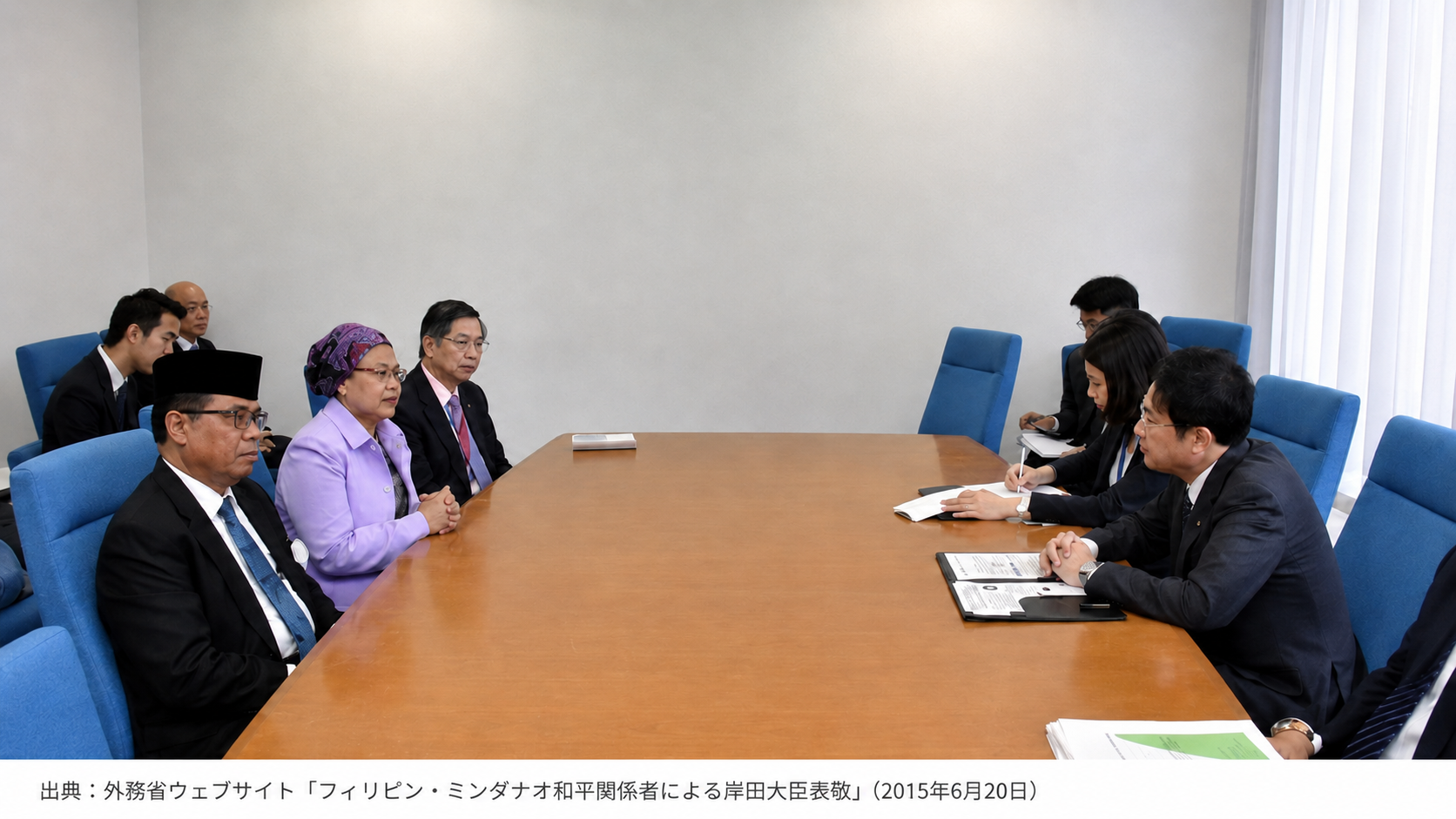
Sending Development Experts to the Ceasefire Monitoring Team — J-BIRD and “Unarmed Peacekeeping”
In 2006, the Japanese government launched J-BIRD (the Japan-Bangsamoro Initiatives for Reconstruction and Development).
That same year, Japan joined the International Monitoring Team (IMT), which oversees the ceasefire between the Philippine government and the Moro Islamic Liberation Front (MILF).
But what Japan sent was not a combat force armed to keep the two sides apart — it was socioeconomic development experts, including JICA personnel.
Japanese experts went into conflict-affected villages to assess the need for schools, health centers, water-supply facilities, and farm roads. They consulted with residents, local governments, the Philippine national government, and the MILF, coordinating so that assistance projects did not favor any single ethnic group, religion, or political faction.
What Japan brought to the IMT was not military force, but “development” as a means of sustaining the ceasefire.
Why Was an International Monitoring Team Needed?
The Philippine government and the MILF resumed peace negotiations in 2001 and agreed to a ceasefire.
But the mere existence of a signed agreement did not guarantee that the ceasefire would actually hold.
In areas where government troops and MILF forces operated close to one another, any shooting incident or dispute involving residents would prompt each side to accuse the other of violating the ceasefire. A small incident risked provoking retaliation and escalating into fighting across the wider region.
There was also the risk that incidents involving the private armies of local politicians, clan feuds, or criminal groups could be mistaken for fighting between government troops and the MILF.
In response, the International Monitoring Team (IMT), led by Malaysia, was established in 2004.
The IMT’s main roles were to monitor the ceasefire between the government and the MILF, investigate incidents suspected of violating it, and maintain communication and trust between the two sides.
Malaysia played the central role, with Brunei, Libya, and Indonesia also participating at various times. From 2006, Japan contributed experts responsible for the socioeconomic development component.
How Did Japan’s Participation in the IMT Differ from a Typical PKO?
The name “International Monitoring Team” might suggest an armed force similar to a United Nations Peacekeeping Operation (PKO).
But the IMT in Mindanao is not a UN PKO.
It is an international ceasefire-monitoring body established under an agreement between the Philippine government and the MILF, with Malaysia in the lead role. Japan’s participation, too, was not a deployment of its Self-Defense Forces.
The experts Japan sent were given diplomatic status by the Ministry of Foreign Affairs and worked within the IMT’s socioeconomic development component — a role linking JICA’s development assistance with the Japanese government’s peace diplomacy.
- Typical military ceasefire monitoring: verifying troop movements — Japan’s socioeconomic development support: assessing residents’ living conditions
- Typical military ceasefire monitoring: investigating ceasefire violations — Japan’s socioeconomic development support: identifying reconstruction and development needs
- Typical military ceasefire monitoring: coordinating contact between armed factions — Japan’s socioeconomic development support: connecting the government, the MILF, and residents through aid projects
- Typical military ceasefire monitoring: deterring a resumption of fighting — Japan’s socioeconomic development support: reducing the underlying causes of a return to fighting
- Typical military ceasefire monitoring: upholding the ceasefire chiefly from above — Japan’s socioeconomic development support: sustaining peace from the ground up, through residents themselves
Japanese experts had no authority to enforce the ceasefire itself by military means.
Instead, they used the time and space created by the ceasefire to advance regional development. The thinking was that if the ceasefire led to real improvements in residents’ lives, more people would support the peace process, making it harder for armed groups to resume fighting.
What Is J-BIRD?
J-BIRD is not the name of a single project limited to building schools or roads.
It is a comprehensive support framework bringing together multiple projects carried out by the Japanese government and JICA for peace, reconstruction, and development in Mindanao.
Its main objectives can be organized into three points:
- Reduce poverty in conflict-affected areas
- Develop basic social services that residents can use
- Cultivate the human resources who will carry forward future peace and self-governance
In concrete terms, the following kinds of projects were carried out:
- Building schools and classrooms
- Developing health centers and clinics
- Installing wells and water-supply facilities
- Small-scale infrastructure such as farm roads and bridges
- Promoting rice farming and agricultural techniques
- Supporting the processing and sale of agricultural products
- Training local government officials
- Supporting community-run project management
- Socioeconomic surveys of conflict-affected areas
According to JICA, over its many years of support for Mindanao, Japan has carried out approximately 650 small-scale community infrastructure projects and provided training to more than 25,000 people in conflict-affected areas.
Not all of this was accomplished immediately after 2006. It is the cumulative result of more than twenty years of effort following the launch of J-BIRD, carried out in step with progress in the peace negotiations and the establishment of BARMM.
Why Do Small Schools and Wells Help Achieve Peace?
Building schools and wells alone does not resolve an ethnic conflict.
The Bangsamoro conflict has multiple causes: loss of land, political marginalization, religious and cultural conflict, domination by local power brokers, and violence by government forces and armed groups alike.
But if the benefits of the state or of peace never reach residents’ daily lives, their reason to support a peace agreement grows weaker too.
In a village where fighting has destroyed the school, for instance, children cannot get an education. Without a well, women and children must walk long distances to fetch water. Without a farm road, harvested crops cannot be brought to market, and farmers’ incomes cannot grow.
If the government and MILF leadership announce a peace agreement under these conditions, ordinary residents may well see it as having nothing to do with their own lives.
If, on the other hand, schools, health centers, wells, and roads are built after the ceasefire, residents can feel concretely that peace brings real benefits.
This concrete benefit is the “peace dividend.”
Who Received the “Peace Dividend”?
Under J-BIRD, it was important that assistance benefit the entire population of conflict-affected areas — including Christians and indigenous peoples — rather than Muslims alone.
The Mindanao conflict is not simply a war of “Muslims versus Christians.”
Even among Muslims there are differences of ethnicity, clan, and political affiliation. Indigenous peoples have their own distinct land and cultural issues, and there are Christian residents, too, who were displaced by the fighting.
If Japan’s assistance were concentrated only in areas under MILF influence, other residents might well conclude that “only areas that joined the rebel side get help.”
Conversely, if aid went only to areas under Philippine government control, the MILF side might view it as government propaganda.
Japanese experts therefore selected project sites by taking into account each area’s ethnic and religious makeup, the extent of conflict damage, the level of poverty, local government capacity, and residents’ consent.
Carrying out aid fairly and transparently was, in itself, part of building trust.
How Did Japanese Experts Gain Access to the Conflict Zone?
For JICA personnel to operate in an area with unstable security, the Philippine government’s permission alone was not enough.
Moving from an area controlled by government forces into one under MILF influence required coordination and safety guarantees from both sides.
Japanese experts used their standing within the IMT to move between the national army, the MILF, local governments, and local communities.
On the ground, they carried out work such as:
- Hearing requests from village leaders
- Assessing the state of schools, clinics, roads, and water supply
- Investigating the history of fighting and displacement
- Explaining project details to both the government and MILF sides
- Confirming whether residents could maintain and manage the facilities
- Checking, after completion, whether projects were being properly used
Through this work, Japan was able to build relationships not only with the top-level peace negotiators, but with local commanders and ordinary residents as well.
Development projects were, at the same time, both assistance in their own right and a means of creating new channels of communication among the government, the MILF, and local communities.
The 2007–09 Socioeconomic Reconstruction Survey
Between 2007 and 2009, Japan carried out a large-scale survey on the socioeconomic reconstruction and development of conflict-affected areas.
This survey is generally known as SERD-CAAM.
It covered areas affected by fighting between the government and the MILF, surveying population, poverty, agriculture, roads, education, health, and water supply in each locality, and drawing up future reconstruction and development plans.
What matters is that this survey was not conducted by the Philippine government alone.
Japan also worked with the Bangsamoro Development Agency, a development body established by the MILF, using the survey — with an eye toward the post-peace future — as an opportunity for MILF-affiliated personnel to learn about development planning and local administration.
An armed organization may have the capacity to command troops, but it typically has little administrative experience in drafting budgets, planning roads, or delivering public services to residents.
Even before a final peace agreement was reached, Japan had already begun preparing the people and institutions needed for the possibility that the MILF would one day take part in governance.
2008: The Peace Talks Collapse
About two years after J-BIRD began, Japan’s support faced a major crisis.
In 2008, the Philippine government and the MILF were preparing a draft agreement, the Memorandum of Agreement on Ancestral Domain (MOA-AD), which would have defined the extent of the Moro people’s “ancestral domain” and their governing authority over it.
But local politicians and others opposed to the draft agreement filed suit with the Supreme Court, which ruled against allowing it to be signed.
The peace talks effectively collapsed, and fighting flared up again between government forces and some MILF units. Large numbers of residents were displaced, and the international ceasefire-monitoring framework was scaled back as well.
At this point, it would not have been surprising if Japan had concluded that the prospects for peace were gone and withdrawn.
But the Japanese government and JICA did not suspend their support altogether.
Why Didn’t Japan Withdraw?
One reason Japan stayed was that it saw development assistance as being for ordinary residents affected by the conflict, not only for the parties to the peace negotiations.
It is precisely when peace talks fail that displacement, poverty, disrupted education, and damage to agriculture worsen. If aid were withdrawn simply because negotiations had failed, it would be ordinary residents who suffered the most.
Second, Japan believed that even if the peace talks had failed for the moment, the government and the MILF would ultimately return to the negotiating table.
It would be difficult to eliminate the MILF through military force alone, while the MILF, for its part, had no realistic prospect of immediate independence from the Philippines. For both sides, renewed negotiation was ultimately the only path to a solution.
Third, Sadako Ogata, JICA’s president at the time, was strongly determined to continue Japan’s support.
The JICA Ogata Research Institute has assessed that Japan’s decision to continue its assistance in 2008, even as the peace process broke down and other supporting actors scaled back their activities, laid the groundwork for the trust it would later earn.
A country that shows up only when peace is going smoothly and leaves the moment a crisis hits cannot become a long-term mediator.
By staying through the difficult period, Japan demonstrated to both the Philippine government and the MILF that its engagement was not a temporary matter.
Continued Assistance Turned into Diplomatic Trust
After the 2008 collapse of the peace talks, Japan’s development assistance came to mean more than ordinary ODA.
Japanese experts kept up contact with the government, the MILF, local governments, and residents. As a result, even as the formal peace talks stalled, this helped prevent relations between the parties from being severed entirely.
The trust JICA earned through its work on the ground also came to serve the Japanese government’s diplomatic efforts.
Conversely, because the Japanese government provided political backing for the peace negotiations, JICA was able to continue its development projects even in areas with unstable security.
This is a defining feature of Japan’s support for Bangsamoro.
It was not simply a division of labor in which the Ministry of Foreign Affairs handled peace diplomacy and JICA handled regional development. Diplomacy and development formed a structure that mutually reinforced each other.
Japan’s Peace Support Develops into Three Functions
The Japanese government and JICA went on to develop their subsequent support for Mindanao into a combination of the following three functions:
- Peacekeeping — the International Monitoring Team (IMT): ceasefire monitoring and socioeconomic development
- Peacemaking — the International Contact Group (ICG): advising the peace negotiations and building trust between the parties
- Peacebuilding — J-BIRD: poverty reduction, regional development, and human resource development
Japan’s participation in the IMT and J-BIRD, beginning in 2006, was the first of these stages.
In 2009, Japan joined the International Contact Group, moving into a role of formally supporting the peace negotiations between the Philippine government and the MILF.
Then, in 2011, Japanese mediation made possible a historic meeting at Narita between President Benigno Aquino III and MILF chairman Murad Ebrahim.
Japan’s support, which began with local schools and wells, had grown into a diplomatic role connecting the President of the Philippines with the supreme leader of the MILF.
What “Unarmed Peacekeeping” Really Means
Japan’s participation in the IMT cannot be judged by the same standard as military ceasefire monitoring.
Japanese experts had neither the authority to arrest ceasefire violators nor the capacity to stop fighting by force.
Even so, development assistance had a different role to play:
- Letting residents feel the benefits of peace
- Reducing disparities in aid between different areas
- Enabling the government and the MILF to jointly address local problems
- Developing the people who would go on to run future administration
- Reducing the reasons young people and former combatants might rejoin armed groups
- Showing that the international community was watching over the peace process
Armed ceasefire monitoring suppresses the outbreak of fighting.
Peacebuilding through development reduces the political and social causes behind a recurrence of fighting.
The two are not in competition — they complement one another.
Conclusion of Part 2
Japan’s participation in J-BIRD and the IMT was different from ordinary official development assistance.
Rather than waiting to begin reconstruction work until after a peace agreement was reached, Japan entered the conflict zone while the government and the MILF were still maintaining a ceasefire and negotiating.
What Japanese experts did there was not simply build facilities.
They surveyed which areas needed assistance, confirmed fairness across ethnic, religious, and political lines, and built channels of communication and cooperation among the government, the MILF, local governments, and residents.
Even after the peace talks collapsed in 2008, Japan did not withdraw — it continued supporting residents and maintaining relationships. This continuity transformed Japan from a mere donor country into a trusted third party supporting the peace negotiations.
Japan’s “unarmed peacekeeping” is not simply a matter of substituting schools and wells for military force.
It was an effort, carried out through development assistance, to connect the government and the rebel organization, create an environment in which residents could support peace, and reduce the reasons to return to conflict.
Coming in Part 3
Part 3 will examine the process by which Japan moved from being a development-aid donor to becoming a mediator in the peace negotiations.
In 2009, Japan joined the International Contact Group, becoming involved as an official observer in the peace negotiations between the Philippine government and the MILF.
Then, in August 2011, Japanese mediation made possible the first-ever summit between President Aquino and MILF chairman Murad, held at Narita.
Why was the meeting held in Japan rather than in Manila or Cotabato? Part 3 will examine how the Narita meeting led to the 2012 Framework Agreement and the 2014 Comprehensive Agreement on the Bangsamoro.
*This article is based on materials from the Japanese government, JICA, the Philippine government, and other sources available as of August 2026.
Main Sources
- Ministry of Foreign Affairs, “Japan’s Seamless Efforts for Peacebuilding”
- JICA, “Peace and Development in Mindanao, Republic of the Philippines”
- JICA Ogata Research Institute — Japan’s Full-Scale Engagement in the Mindanao Peace Process
- JICA — Peace and Development Support in Mindanao
- Ministry of Foreign Affairs, “Japan’s Contribution to Mindanao Peace Process”
- JICA — Community Development Survey in Conflict-Affected Areas

コメント