
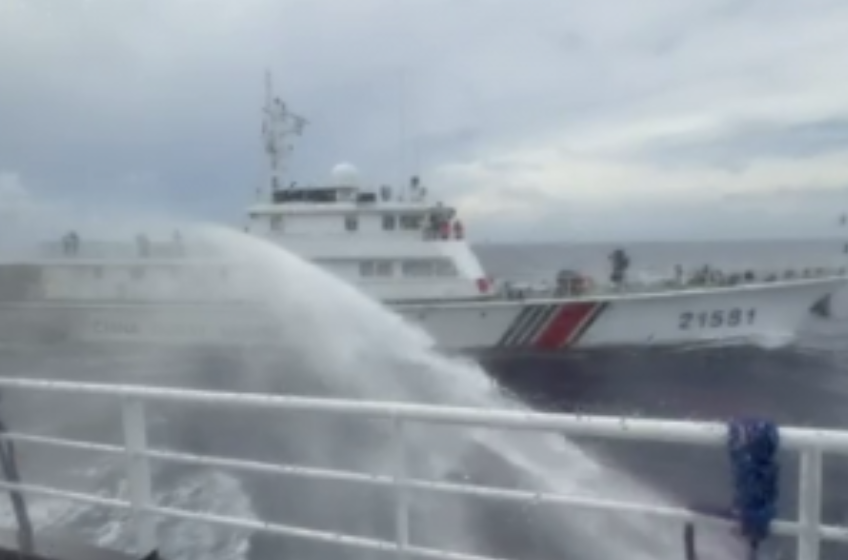
July 24: Third Clash of the Week, Amid Foreign Ministers’ Meeting
On Friday, July 24, China Coast Guard vessels fired water cannon at two fishery-related vessels of the Philippine Bureau of Fisheries and Aquatic Resources (BFAR) near Scarborough Shoal (known in the Philippines as Bajo de Masinloc) in the South China Sea. It was the third such clash that week, occurring just as the ASEAN Foreign Ministers’ Meeting was being held in Manila with the South China Sea as a major agenda item.
According to the Philippine Coast Guard (PCG), the China Coast Guard vessel maneuvered “recklessly,” closing to within just seven meters of the Philippine fishing vessel and creating a serious risk of collision. The PCG strongly condemned the move as “dangerous and unprofessional” and asserted that the shoal is “an integral part of Philippine territory.” The China Coast Guard, for its part, falsely countered that several Philippine vessels had engaged in “infringing and provocative” actions, insisting that its use of water cannon was a justified response.
There was also a clash that Monday at Second Thomas Shoal (Ayungin Shoal), where two Philippine soldiers were injured after being struck with wooden poles by China Coast Guard personnel. In response to this string of incidents, ASEAN foreign ministers said “significant progress” had been made in negotiations on a Code of Conduct meant to prevent large-scale armed conflict in the South China Sea, and reaffirmed their aim of concluding it within the year. U.S. Secretary of State Marco Rubio and Chinese Foreign Minister Wang Yi also met and both described Monday’s clash as risking “escalation.”
A History of Interference with Fuel-Assistance Operations
This latest clash occurred in the midst of the Philippine government’s Kadiwa ng Bagong Bayaning Mangingisda (KBBM) program — a fuel and food assistance effort for local fishermen. This kind of interference, in fact, is far from new.
- December 9, 2023: The China Coast Guard used water cannon to disrupt three government vessels delivering fuel and food to fishermen. The National Task Force for the West Philippine Sea (NTF-WPS) strongly condemned the interference with humanitarian assistance as “illegal and inhumane.”
- April 30, 2024: The BRP Bagacay (PCG) and BRP Datu Bankaw (BFAR) were both hit with water cannon while on a mission at Scarborough Shoal.
- June 20, 2025: While four BFAR vessels were distributing fuel assistance to more than 20 fishing boats, Chinese patrol vessels conducted “aggressive maneuvers”; one BFAR vessel was hit with water cannon and subjected to close-quarters maneuvering.
- July 23, 2026: The China Coast Guard fired water cannon at the BRP Datu Dumangsil for more than two minutes. There were no injuries and the mission was completed. Another BFAR vessel was also subjected to dangerous close-quarters maneuvering.
- July 24, 2026: For the second straight day, water cannon were fired at multiple BFAR and PCG vessels. Twelve China Coast Guard ships and three maritime militia vessels were observed in the area.
Looking back over this history, it becomes clear that fuel-assistance operations — a humanitarian, civilian activity in themselves — have repeatedly been targeted over the past several years.
Reactions from Other Countries and International Bodies
The Philippine government has lodged diplomatic protests with each successive incident. As of December 2024, it had reportedly filed 193 protests against China since the Marcos administration took office in 2022, 60 of them in that year alone. PCG spokesperson Jay Tarriela has repeatedly emphasized that Scarborough Shoal is “a traditional fishing ground for both Filipino and Chinese fishermen,” and that this right “cannot be legally obstructed by any foreign power.”
The U.S. government has also condemned China’s actions with each incident. Following the July 2026 clashes, the U.S. State Department called the moves “dangerous and aggressive,” a position Secretary Rubio echoed. From July 21 to 25, the United States also conducted a trilateral maritime exercise with the Philippines and Japan — the 17th Multilateral Maritime Cooperative Activity — aimed at strengthening interoperability amid the heightened tensions.
The Japanese government, too, has consistently stressed the importance of “the rule of law” in the South China Sea. Japan has been strengthening security cooperation with the Philippines, supporting freedom of navigation and adherence to international law in the region through the provision of patrol vessels and joint exercises.
On the question of international maritime law, the Permanent Court of Arbitration in The Hague ruled on July 12, 2016, in a case brought by the Philippines, that China’s claim to historic rights over nearly the entire South China Sea under its “nine-dash line” has no legal basis under the 1982 United Nations Convention on the Law of the Sea (UNCLOS). The ruling also found that Scarborough Shoal is a traditional fishing ground for Filipino, Chinese, and Vietnamese fishermen alike, and that no single country can claim exclusive sovereignty over it. The Chinese government has consistently refused to recognize the ruling.
Analysis: Repeated Faits Accomplis, and International Law Put to the Test
Nearly a decade after the 2016 arbitral ruling, China’s effective control over Scarborough Shoal remains unchanged. What this latest episode makes clear is that the target is not limited to standoffs between warships or coast guard vessels — it now extends to fuel-assistance operations for fishermen, an activity of clearly humanitarian character. Even where a ruling exists under international law, without enforcement power behind it, the steady accumulation of facts on the ground cannot be stopped. This is a structural challenge shared by many international disputes, not just the South China Sea.
At the same time, joint exercises with like-minded countries including the United States and Japan, and progress in ASEAN’s Code of Conduct negotiations, show that the Philippines is seeking to frame this situation not as an isolated bilateral dispute, but as a challenge for the region as a whole. The words of Philippine Foreign Affairs Secretary Theresa Lazaro — “peace is a daily choice” — seem to capture the essence of this long, drawn-out contest.

コメント