
Asahiko Yara
“An eye for an eye, a tooth for a tooth” (Code of Hammurabi)
This is the principle of “equivalent retaliation,” devised more than 3,500 years ago by wise men of the West to keep “excessive revenge” from laying society to waste.
“When you are wounded, returning the same pain to the other party” may indeed be justice. Yet it is difficult to measure out such retaliation, and so an exchange of reprisals leads to an accumulation of grudges, and the conflict is slow to end. The fighting between Hamas and Israel symbolizes that difficulty.
I believe that what the international community needs from now on is not “an eye for an eye, a tooth for a tooth,” but an idea that might be called (as I once saw in a gag manga) “eye drops for the eye, a toothbrush for the tooth.”
Just as we treat a sore eye and care for our teeth every day, is there not a way of responding, even to a conflict started by the other side, not with retaliation but with efforts to heal the other party and to prevent the harm and the conflict from recurring?
Originally, “an eye for an eye, a tooth for a tooth” was a principle that restrained unlimited revenge and sought a balance between injury and punishment. But when states and armed groups repeat their reprisals, that balance is lost, and the loss of life and the hatred pile up. If one side beats the other utterly into the ground, will a life of true peace of mind really follow?
Here I would like to compare the Japanese and the Jews. As everyone acknowledges, the two peoples have in common that they have handed down their traditions and valued education and intellectual effort. Both have produced outstanding scholars and many Nobel laureates. This is less a quality inborn in either people than the fruit of a culture and of efforts nurtured by families and communities.
On the other hand, there are great differences between their homelands and histories.
Japan has a history of 2,700 years since its founding, with the Imperial House’s “unbroken line.” It means a great deal that the Yamato people have maintained cultural and political continuity on the Japanese archipelago over so long a period. Living on the same land for generation after generation, and being able to foresee the future of one’s descendants, became a foundation for nurturing a society of coexistence and mutual prosperity.
The Jewish people, for many years, experienced dispersion, discrimination, and persecution. The Holocaust above all gave rise to a deep anxiety about entrusting their safety to the judgment of others. Behind the founding of Israel in 1948 lay the earnest wish to regain the land given by God. But the many Palestinians who had been living there were driven out and became refugees. The rebuilding of one people’s homeland brought about the loss of another people’s home.
While understanding Jewish history, I wish to question severely the stance of the Israeli government, which has given priority to strengthening its military power and applying pressure over a political solution leading to coexistence. In the West Bank, the expansion of settlements, violence by settlers, and situations in which residents are forced to leave their homes are causing heartache throughout the world. Moreover, military attacks on neighboring countries such as Lebanon are so grave a matter that they could develop into a third world war.
Terrorism by Hamas against Israeli civilians cannot be condoned, but retaliation and national security do not justify endlessly harming the lives, livelihoods, and dignity of others. Deepening the despair of those who have lost their families and homes also endangers future security. This is not a criticism of the Jewish people as a whole, but a question addressed to the violent policies of the Israeli government and their consequences.
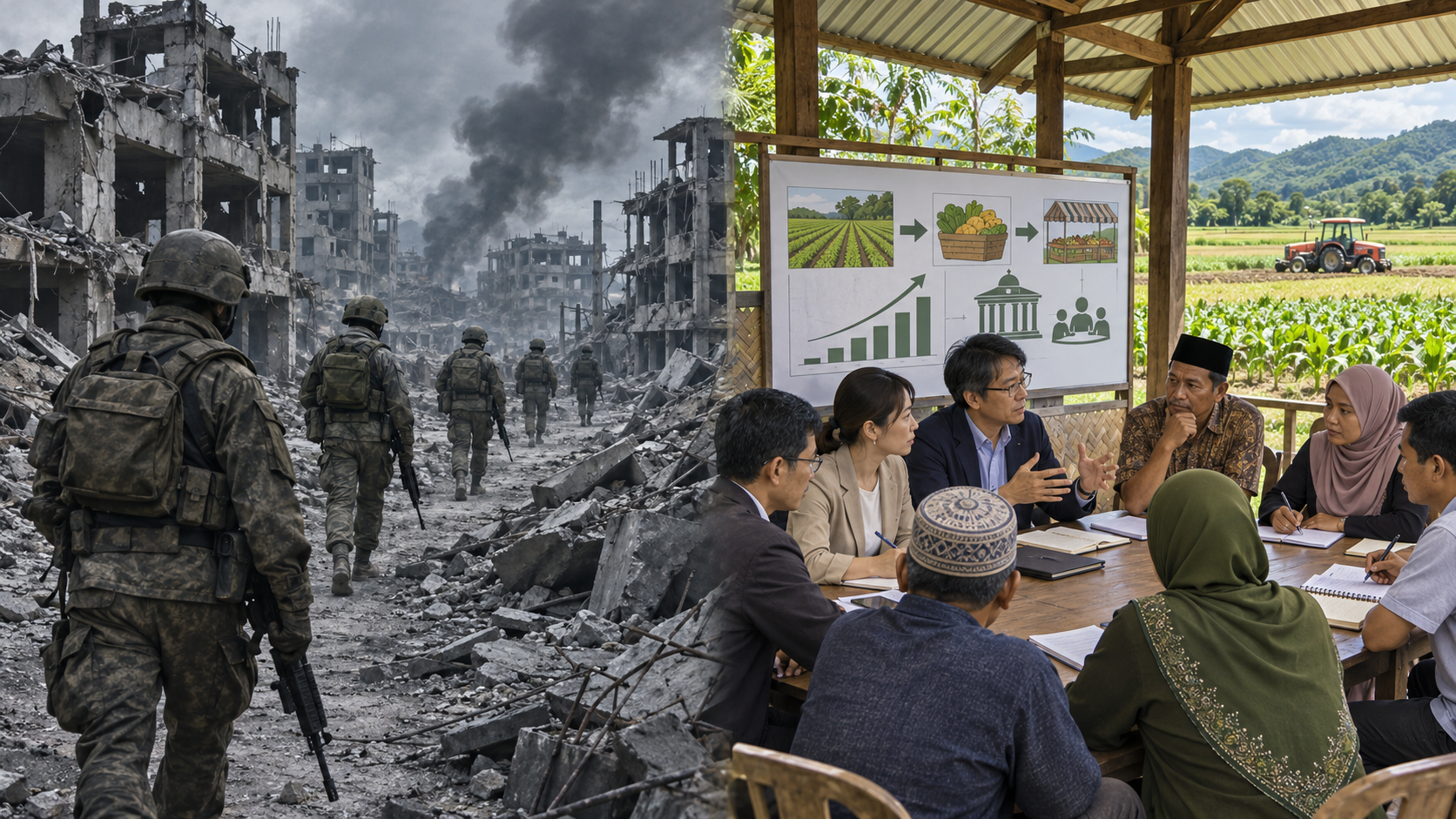
As a contrasting practice, I find value in Japan’s support for peace in Mindanao. The conflict in the southern Philippines is not a simple religious confrontation between Catholics and Muslims. It is a long armed conflict in which problems of land, poverty, political marginalization, and autonomy overlap.
Japan has supported peace efforts between the Philippine government and the Moro Islamic Liberation Front (MILF) and others, building up diplomacy and development cooperation. Under J-BIRD, which began in 2006, Japan has cooperated in building schools, clinics, and roads, in developing human resources, and in rebuilding livelihoods. It has also dispatched development experts to the International Monitoring Team. These are efforts to foster conditions in which residents can actually feel the benefits of peace.
In 2011, a meeting between President Aquino and MILF Chairman Murad took place in Japan. The trust cultivated through many years of support on the ground helped to advance political dialogue. Since then, Japan has continued to cooperate in peace and development, including improving the administrative capacity of the autonomous government and supporting elections. The main actors in these achievements are the parties concerned and the residents themselves; Japan has played the role of supporting their progress.
Israel, which is itself exposed to attack, and Japan, which supports peace as a third country, differ in position and circumstances. Even so, the choice of where to direct one’s efforts in order to reduce the roots of conflict can be compared. Stabilizing people’s lives and broadening political participation form a foundation for peace that military power alone cannot build.
Within Japan, too, there are experiences that should be shared. Universal health insurance, realized in 1961, is a system in which society shares the burden of illness. Long-term employment and human-resource development at companies also embodied the idea of linking an organization’s growth to the lives of those who work there. While we confront issues such as inequality and discrimination, this wisdom of mutual aid can also be of use in cooperation abroad.
Japan itself has experienced both inflicting and suffering the harm of war. It is precisely because we face that history squarely that there is meaning in aiming for a diplomacy that heals wounds rather than one that adds to them. For more than 80 years since the war, down to the present, the Japanese have not invaded other countries and killed people under the pretext of war. “We cannot become happy through profits gained by killing people” is, I believe, a feeling shared by the Japanese.
Rather than wounding the other in return, heal the other’s pain.
Do not wound others; do not earn their resentment; give aid to those who are exhausted. Do not kill. Killing darkens us. What matters is a “bright governance” like that of Japan, which does not kill. Hence “eye drops for the eye, a toothbrush for the tooth.” It is in this very idea that the peace diplomacy Japan should show the world is to be found. “Coexistence and mutual prosperity through bright governance.” I ask the leaders of powerful nations above all to keep this in mind as they conduct their politics and diplomacy.
コメント