
Pinoy-Hapon United Foundation (PHUF), a non-profit organization, Honorary Chairman Takeshi Asanuma
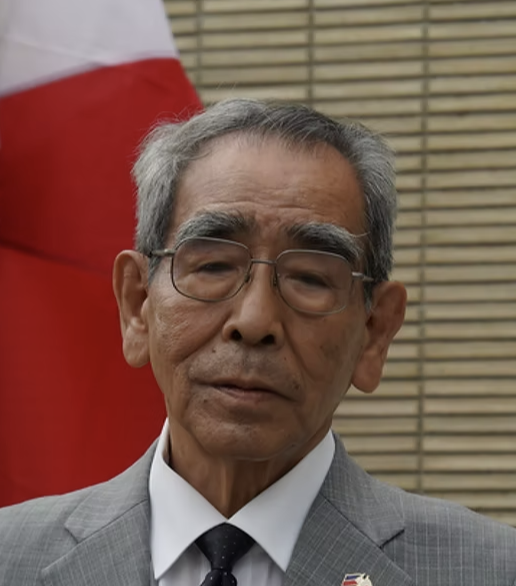
By the time I became aware of myself as an individual (1942–45), the Greater East Asian War was in full swing — and, moreover, a losing war. I fled here and there through bombs, incendiaries, and strafing attacks.
Before my young eyes, destruction and killing unfolded one after another.
Human lives vanished right before my eyes. I was powerless against it. What man builds, man destroys. Through the destruction of war, that karma of humanity seeped into my young heart — a sense of human powerlessness. The whole human world felt utterly empty. Carrying this hollow feeling within me, I grew into a detached person, with little appetite for material things or worldly success. I came to harbor the mindset of a “lost generation.”
In April of Shōwa 29 (1954), I entered high school, and in the spring of Shōwa 32, I sat for the entrance exam of a certain national university in Tokyo — and failed, spectacularly. So, what to do? I found the College of Art at Nihon University, which held its entrance exams later than most. I applied to its Department of Film and was accepted. My father paid the somewhat higher tuition.
I studied film direction and screenwriting. The methods of writing I learned back then still serve me today, and I read voraciously across all kinds of books. It was the era of the 1960 Anpo protests — the era of the student movement. I did not take part.
Great despair leads to great hope. The ultimate nihilism is romanticism. This is the understanding I came to hold.
Around the age of eighteen, I secretly resolved to live by “a man’s romance,” coming to believe that a man’s dream is to keep chasing romance and adventure. So even after finishing university, I did not go into the film industry, nor did I take a job at a company — or rather, I could not bring myself to.
I could speak English, poorly though it was. In my early elementary school years, the NHK radio program “Come Come English” began broadcasting, and I developed a strong interest in foreign languages. There were also occupation troops loitering around the neighborhood at the time. I listened to that program diligently, and attended a local English conversation school until sixth grade, taught by a man who worked as an interpreter at a U.S. military camp. Through junior high and high school, English was the one subject in which my grades were reasonably good. Nothing close to professional interpreting, of course, but I could get by.
I had a strong interest in foreign languages from childhood, and taught myself by ear; even now I can manage broken German and French. Spanish and Italian, too, at the level of basic greetings — all of it picked up by ear.
A relative on my grandfather’s side was a member of parliament for the Liberal Democratic Party, and through his introduction I became the private secretary in charge of public relations (1963–68) for a certain powerful LDP Diet member. I also helped with the fair-copying and proofreading of his written works, and accompanied him on several short overseas inspection trips.
In 1962, I married. I was twenty-four, my wife twenty. She passed away last year in Tokyo, having supported this ne’er-do-well husband of hers for sixty-three years. I offer my hands in prayer for her.
In 1964, I was involved, to a small extent, with the Tokyo Olympics — political work connected to the Japan Amateur Sports Association (today’s Japan Sport Association). During the summer breaks of 1965 and 1966, I toured various European countries for about a month each time. In June 1967, I was invited to the People’s Republic of China — then in the midst of the Cultural Revolution and without diplomatic relations with Japan — to observe the political situation there (accompanying the Diet member, for about a month). After returning home, I published an account of the visit in Iwanami Shoten’s magazine Sekai.
In the summer of 1968, I traveled by bus across the American continent from west to east, twenty-five days in all, at times following the old Route 66. All of this I owed to my boss, the powerful Diet member — but at the end of 1968, I resigned my post as private secretary. I set out to put the roughly six years of experience I had accumulated to use in a new challenge — in pursuit of romance and adventure!
コメント