
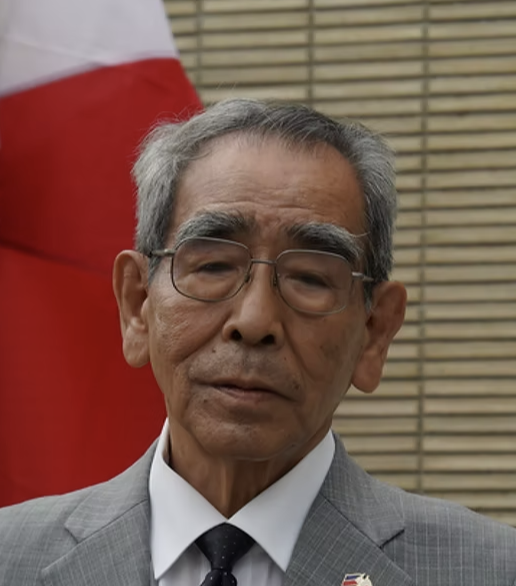
Pinoy-Hapon United Foundation (PHUF), a non-profit organization, Honorary Chairman Takeshi Asanuma
On December 8, 1941 (Showa 16), the “Empire of Japan” declared war on the United States, Britain, and the Netherlands, launched a surprise attack on Hawaii, and the “Greater East Asia War” broke out. At the same time, Japan bombed the American air bases on Luzon and seized air superiority, and on December 22 the “14th Army,” commanded by “Lieutenant General Masaharu Homma,” landed at Lingayen Gulf in northwestern Luzon and launched its offensive.
(*The declaration of war on the Netherlands came on January 11, 1942.)
On December 26, General Douglas MacArthur, commander of the local forces, issued a “declaration of Manila as an open city,” and concentrated his forces in the “Bataan mountains” west of Manila and in the fortress on “Corregidor Island” in Manila Bay, taking up a defensive posture. On January 2, 1942, the Japanese army made a “bloodless entry into Manila.”
Manuel Quezon, the local president, proposed to General MacArthur “the surrender of the local troops and the ‘neutrality of his government,'” but this was immediately “rejected.” On March 12, MacArthur, accompanied by Quezon, escaped from Corregidor by torpedo boat to Mindanao and then fled to “Australia” by aircraft, leaving behind the famous words “I shall return.” On April 9, after a general assault by the Japanese army, the “American-Filipino forces” surrendered.
The Japanese army had prepared its countermeasures on the assumption of about 25,000 surrendering American-Filipino troops, but the actual number was a huge “76,000 (of whom about 9,000 were Americans).” Moreover, after roughly four months of fierce Japanese attack, the prisoners included many wounded and many suffering from infectious diseases, and it is said that half of those who surrendered were barely able to stand on their own.
Even so, they could not be kept in the Bataan mountains. The Japanese army decided to designate a former Philippine Army facility (Camp O’Donnell) near Capas, in Tarlac Province about 120 kilometers to the north, as a prisoner-of-war camp, and to move the prisoners there. And so the infamous “Death March” began.
April and May are midsummer in this region. The march on foot was made in the early morning and evening, said to be 15 to 16 kilometers a day, for about 100 kilometers in all. About 40 kilometers were covered by freight trains packed tight with prisoners, and after leaving the trains they again went on foot to the camp. Given insufficient food and water and no medical care, the prisoners collapsed one after another. Even so, 54,000 reached “Capas,” and it is said that in all about 10,000 (of whom about 2,000 were American soldiers) lost their lives to wounds, infectious disease, and exhaustion, both during the transfer and after arriving at the camp, and that many others escaped. It was truly a “march through hell.”
There is a reason this “march” became a worldwide issue: the “massacre of prisoners.” Staff officer Masanobu Tsuji issued a “false order” — “shoot any prisoners who are defiant or unable to move” — directly to several field commanders, bypassing the “commanding general.” It was a “false order.” At the scene, it is said, several hundred Filipino soldiers were killed without trial. This became caught up in the postwar “war crimes trials.” Lieutenant General Masaharu Homma, who had been relieved as “14th Army commander” in May 1942 and sent home, and who was in the “reserve” when defeat came in August, was arrested, summoned to Manila, and became a “defendant before a military tribunal.”
Lieutenant General Homma had spent a total of eight years in London as a resident military attaché and in other posts. He spoke polished English, was a gentleman versed in waka poetry, and was an upright “warrior.” He apparently knew nothing at all of the “Bataan incident.” His wife, Fujiko Homma, called on General MacArthur, obtained permission to go to Manila, and appeared before the military tribunal in Manila in February 1946, where she defended him: “My husband is a man of character. I have a daughter too, and I would like to marry her to a ‘real man’ like him.” Even the young guards (American servicemen) were moved by the bearing of the “Lieutenant General” and his “wife.”
He hoped for “acquittal,” but in the end it was “death” after all. The Lieutenant General said: “I have no recollection of anything that would merit the death penalty, but as commanding general I bear responsibility, and I will accept the sentence. However, I ask that I be allowed to wear my ‘Lieutenant General’s’ uniform and be granted an honorable execution by firing squad. I am not a criminal. I am a warrior.” The presiding judge agreed. The sentence was carried out on April 3, 1946, and Lieutenant General Homma’s honor was preserved.
As for Masanobu Tsuji, the moment he heard the news of defeat, he fled and disappeared into Southeast Asia.

コメント