

MANILA NEWS DAILY
That War and Me (16) Where Is the “Voice of Watatsumi”?
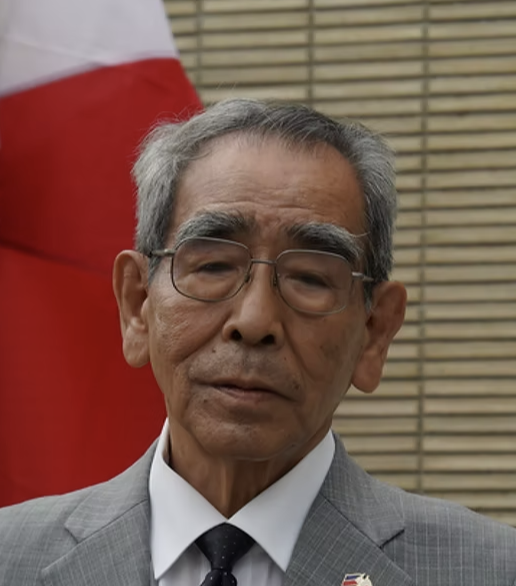
Pinoy-Hapon United Foundation (PHUF), a non-profit organization, Honorary Chairman Takeshi Asanuma
”Watatsumi” (the sea deity) has been the god of the sea of the “land of Yamato” since the age of the gods, the era of Izanami and Izanagi. Yet in the last war, as many as 500,000 “young men of Japan” departed for the realm of Watatsumi.
In the last “Greater East Asia War,” 2.3 million Japanese soldiers lost their lives, and of these, the “naval” personnel are said to number 400,000 to 500,000, though there is no definitive record. The war-time death rates are said to have been “Army 20%, Navy 16%, merchant seamen 43%” — how dangerous the sea was!
Our country’s sailing-ship technology, with a history of more than 500 years, reached out to Southeast Asia and brought wealth and information to Japan. For a time “national seclusion” halted this, but the Meiji Restoration opened the seas again, and Japan became a “maritime nation.”
To train “merchant marine officers,” the government established national “Higher Merchant Marine Schools,” one in “Tokyo” in the Meiji era and one in “Kobe” in the Taisho era. Both schools were “residential, with a three-year course,” and before graduation students undertook an “ocean-going training voyage” (about six months), training “officers” in the “navigation” and “engineering” tracks respectively. The entrance requirement was roughly graduation from an old-system middle school.
Handsome young men gathered from all over the country, and it is said that the song “♬ The merchant marine school students are…” was sung of them, and that the students in their uniforms were enormously popular. They were not military men, but on graduation they were also granted the qualification of “naval reserve officer candidate.”
But then the “Greater East Asia War” broke out. The Navy called up graduates of the two “Higher Merchant Marine Schools” one after another, placing them aboard combat vessels as “naval officers” and sending them to the front lines of the sea as “captains” of small patrol boats and the like. Many of these men were called away to “Watatsumi.”
It is recorded that during the war more than 1,500 young graduates of the two Higher Merchant Marine Schools (roughly equal numbers from each school) were killed in action.
According to figures released by the “Ministry of Health and Welfare” after the war, more than 60,000 “civilian seamen” died during the war, and “2,500 civilian ships, totaling 8.4 million tons” were lost. Among these victims were, it seems, senior officers who graduated from the two merchant marine schools. However, because they were not “military men,” they are not enshrined at “Yasukuni Shrine,” and the government has taken no measures of any kind for them.
In 1971 (Showa 46), at the call of Sasakawa Ryoichi, the “Foundation for the Erection of the Monument to Seamen Lost in the War” was organized, and a solemn “Memorial to War-Dead Seamen” was built at Kannonzaki in Yokosuka, Kanagawa Prefecture, overlooking the Pacific. On May 6, an unveiling ceremony was held quietly in the presence of the “Crown Prince (the present Emperor),” attended by various organizations, government representatives, and bereaved families. The “poems” of the “Emperor and Empress (now the Emperor Emeritus and Empress Emerita)” are also displayed at the site. A “memorial service” is held every May, and last year the “Emperor and Empress” attended.
After the war, in the “school reorganization,” the two honored “Higher Merchant Marine Schools” became the four-year “Tokyo University of Mercantile Marine” and “Kobe University of Mercantile Marine.” In March 2003 Tokyo University of Mercantile Marine merged with “Tokyo University of Fisheries” to become “Tokyo University of Marine Science and Technology,” and at about the same time Kobe University of Mercantile Marine was merged into “Kobe University.” It was abolished at the end of March 2004.
”Time” has flowed on. The age when “men of the sea” “challenged the rough seas” was an “age of dreams.”
”Watatsumi,” the “god of the sea” of the land of Yamato, must surely be holding their head in their hands.