

MANILA NEWS DAILY
That War and Me (11) The Aftermath of Defeat
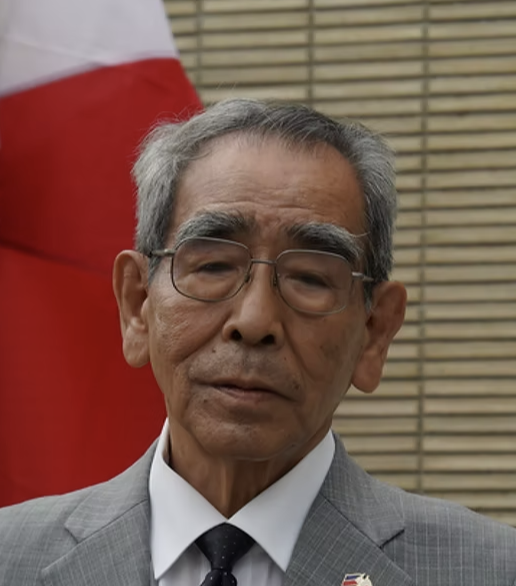
Pinoy-Hapon United Foundation (PHUF), a non-profit organization, Honorary Chairman Takeshi Asanuma
On August 15, 1945 (Shōwa 20), our country was defeated by the United States, but the American assault on the home islands had already grown ferocious from around March of that year. Saipan and Iwo Jima had fallen into American hands, Okinawa was near death, and the mainland was bombarded day and night. The Combined Fleet was wiped out. I later heard that the new “Shiden-Kai” fighter planes were putting up a fight, but it seems Japan had lost almost all control of the skies by then.
On March 10, the Great Tokyo Air Raid struck — even the Imperial Palace was hit — and an estimated 100,000 residents, mostly around the Sumida River area, lost their lives. On March 13, the Great Osaka Air Raid came, and our own house was burned out. On June 15, the Sakai and southern Osaka air raid followed. Around that same period, major Japanese cities such as Nagoya and Yokohama were reduced to burnt-out fields. On August 6, the atomic bomb was dropped on Hiroshima, and on the 9th, on Nagasaki — together claiming more than 200,000 lives — and the Soviet Union declared war on Japan. By the Emperor’s decision, Japan surrendered on August 15.
On September 2, Supreme Commander for the Allied Powers General Douglas MacArthur landed at Atsugi Airfield, and the occupation of Japan began.
On September 27, His Majesty the Emperor, without any guards at all and accompanied only by a single interpreter, visited Supreme Commander MacArthur at the U.S. Embassy in Akasaka for a meeting.
“The responsibility for this war rests entirely with me, as Supreme Commander. Both the military and civilian officials carried out policy and the war at my command, and the full responsibility is mine. I will submit to whatever decision you make. However, the people are suffering from a severe food shortage. I ask that you help them — I will pay the cost from my own personal assets.”
So it is said he spoke, and General MacArthur was deeply moved, remarking, “I have met a true gentleman.” When His Majesty arrived, MacArthur reportedly received him seated in his office, but when he departed, MacArthur went out of his way to see him off courteously all the way to the entrance.
MacArthur, who had assumed the Emperor would come merely to beg for his life, is said to have been deeply moved by His Majesty’s resolve and sense of responsibility.
At General MacArthur’s request, large quantities of food were soon sent from the United States and distributed to schools and individual households — the so-called LARA relief supplies. Of course, the United States did not charge for them.
It seems the two men built a relationship of trust from that point on. Calls within the United States and among some of the victorious powers to prosecute the Emperor as a war criminal were set aside on General MacArthur’s own recommendation. Records show that the two of them met more than a dozen times before MacArthur was relieved of his command and returned home in April 1951.
When the General returned home, the American public gave him a tremendous welcome. In New York, tens of thousands turned out for a victory parade, with confetti raining down from the skyscrapers. There was even talk of him becoming the next President, but when he was called before a Senate hearing, he testified that “the war just fought was not a one-sided war of Japanese aggression — it was a war of self-defense for Japan.” This is said to have turned American public opinion against him, and he faded from consideration as a presidential candidate. Was he not, after all, someone who truly understood Japan?
His own father, Lieutenant General Arthur MacArthur of the U.S. Army, had likewise, after serving as military attaché in Manila, crossed over to the continent during the Russo-Japanese War as a military observer attached to the Japanese Army’s positions. He received a large ceramic sake cup from Emperor Meiji as a gift, and the General is said to have displayed it in his office at the Manila Hotel — but it went missing when Japanese forces advanced into Manila in January 1942.
Soon after the defeat, the occupation forces requisitioned surviving buildings all over Osaka as well. The Japanese Red Cross Hospital in Shimoajihara-chō became a U.S. military hospital, and part of the former barracks of the 8th Regiment near Osaka Castle became another Japanese Red Cross Hospital. In February 1947 (Shōwa 22), I was in my second year of elementary school. I came down with a severe case of appendicitis and had surgery at this Japanese Red Cross Hospital, staying in the hospital for a full month. I was told my life was saved by penicillin my father managed to obtain on the black market. I still carry two large scars on my stomach to this day.
The True History of Philippine Independence (Part 1)
Nakahara Yoshinori
Nakahara Yoshinori (1888–1946), a researcher of the Philippines born in Okinawa. Over the prewar and wartime years he left behind numerous valuable works on Philippine settlement history, ethnography, and daily culture. He was the elder brother of Nakahara Zenchu, well known in Okinawan studies for his research on the “Omoro Soshi,” and after the war he was also involved in founding the Okinawan People’s Federation.
Preface I
On October 14, Showa 18 (1943), the Philippines declared its independence, and a ceremony marking the founding of the republic was held in the capital, Manila.
Looking back, one cannot help but reflect on how many long years, and how great a sacrifice, it took for the Philippines to win the honor of independence. Through four hundred years of rule by Spain and then the United States, it goes without saying that every struggle, riot, rebellion, and revolution waged in the name of the Filipino people was aimed at the single goal of independence. Many ardent patriots fell in that cause. Those who were exiled, banished, beheaded, or met violent deaths are beyond counting.
According to historical accounts, more than a dozen popular uprisings that might be called civil disturbances occurred during the era of Spanish rule. From this alone one can see how fervently the Filipino people longed for independence in the face of Spain’s tyrannical governance.
In 1898, when the Spanish-American War broke out, the patriots of the Philippine independence movement sought American support to achieve their long-cherished goal. The United States, for its part, responded to their wishes, and thus a joint military action to overthrow Spain came about.
Yet the course the United States subsequently took, under the guise of aiding independence, instead resulted in the seizing of Philippine independence for itself. For the independence party, this was like driving off the tiger at the front gate only to let in the wolf at the back. It was only natural that the patriots of the independence movement rose in indignation and declared war upon the United States.
Considered historically, relations between Japan and the Philippines are already of long standing, bound closely not only by geography and history but by still deeper ties of blood kinship. Indeed, in the Cagayan Valley to the north there is a settlement said to be descended from Japanese, and a similar legend exists in central Luzon as well, leaving no room to doubt the fact. In particular, in recent years, the opening of the Benguet mountain road and the development of Davao on Mindanao have made this relationship all the closer.
That relations between Japan and the Philippines are thus inseparably close in politics, economics, and even culture is attested to by a great many historical facts and documents. Yet it is clear that, through the long rule of the Philippines by Spain and then the United States, these historical facts were distorted or deliberately erased. That the military assistance rendered by Japanese patriots when the Philippine independence party declared war on the United States has gone almost entirely unrecognized is one such example.
Last autumn, when the ceremony establishing the Republic of the Philippines was held, I attended this great occasion as a representative of the Imperial Rule Assistance Association, and as I recalled the traces of the tireless efforts of so many comrades of that earlier time, I was moved by deep emotion.
After returning home, I attended the memorial service and the dedication of a monument to the late Captain Ishikawa Ushiro, master of the ship Nunobiki Maru, and offered a memorial address. In that address I wrote as follows.
It is our earnest wish to recall how, in years past, when the patriots of the Philippines rose to free themselves from Spanish rule, the rapacious nation of the United States seized the opportunity to indulge its greed, and in the end brought the Philippines under its own dominion.
Thereupon Generals Aguinaldo and Ricarte and others rose in indignation, resisted the United States, and sought to carry through their original goal of independence.
Even before this, forward-thinking men such as Yashiro Rokuro, Hirose Takeo, and Uchida Ryohei had come to believe that the Empire’s national defense should extend its front line to the Philippines and Malaya, and that by doing so the stability of East Asia could be secured; they devoted themselves to this design. At about that time, their comrade Nagano Yoshitora traveled to the Philippines himself, and, recognizing that the momentum toward independence was running strong, returned home to vigorously plan support for it, awaiting his opportunity.
In due course, in the summer of Meiji 31 (1898), Mariano Ponce, a representative of the Philippine independence movement, came to Japan, and through Sun Yat-sen, then living in exile in Japan, sought the assistance of sympathizers there. Through this, exchanges between the two sides grew very close.
Private citizens and patriots such as Hirayama Shu, Miyazaki Torazō, and Uchida Ryohei worked hard as intermediaries, while forward-thinking figures such as Toyama Mitsuru, Ōkuma Shigenobu, and Hiraoka Kōtarō likewise exerted themselves in support. At the same time, Chief of the Army General Staff Kawakami Sōroku and others quietly lent their strength and provided assistance behind the scenes.
In this way, by the following year, Meiji 32 (1899), the arms and ammunition that the Philippine independence army had requested were procured in Japan, and the steamship Nunobiki Maru was purchased to transport them to the Philippines. Captain Hara Tei and other chivalrous men gathered their own comrades separately and hurried on ahead to the Philippines.
The Nunobiki Maru, after secretly loading its cargo of arms and ammunition at Moji, sailed on to Nagasaki and from there set out on the long voyage to the Philippines. It departed on July 19, Meiji 32, and patriots supporting the Philippine independence army, including Nagano Yoshitora and Hayashi Masabumi, were also aboard. The spirits of the party ran high enough to pierce the heavens.
And yet, what bitter misfortune followed. The ship was caught in a violent typhoon in the East China Sea and was tossed about by raging waves. It was wrecked off the Pescadores near Taiwan, and, save for a few of the lower-ranking crew, everyone aboard, together with the vessel and its cargo, was buried beneath the sea.
Thus this grand plan to aid Philippine independence collapsed, and the independence army, though it fought bravely, could not secure victory and in the end was forced to submit to American forces. Ah, who, looking back on those events, could fail to feel bitter regret?
Two and a half years after the outbreak of the Greater East Asia War, the forty years of American rule crumbled in a single morning, and here, for the first time, the Philippines achieved its long-cherished wish of independence with Japan’s support. The joy and emotion of the Philippines’ eighteen million people can well be imagined.
One passage of the declaration of independence reads as follows.
“We hail this independence as a manifestation of divine will, which permits the peoples of all nations of the world to seek freedom and independence, and which allows every nation to attain the standing that is properly its own.”
It further states as follows.
“To build a republic founded on peace, freedom, and morality, and, as one link in the Greater East Asia Co-Prosperity Sphere, to contribute to the creation of a new world order.”
In these words we clearly see the Philippines returning to its true place within East Asia, and we see, as a member of the Greater East Asia Co-Prosperity Sphere, its earnest devotion to the revival of East Asia.
Now, at this dawn of the building of Greater East Asia, when all of Eastern history that has been distorted by heaven-defying forces is about to be fundamentally rewritten by our own hands, it is deeply significant that this book should be published.
I also have no doubt that this book, as its compiler hopes, will not merely stand as the true history and true biography of the Philippine independence movement, but will bring even greater benefit to the building of Greater East Asia.
This is because the true reality of what is called “East Asia as one family” and “Asia is one” is vividly shown in this book, and it is only through this that we can first grasp a part of that truth.
Having compiled this book, I am filled with deep emotion, and I have taken it upon myself to write this preface and recommend it widely to the world.
June 1, Showa 19 (1944)
Written by Kuzuu Yoshihisa
Preface II
The Philippines has at last achieved its independence.
That it has broken free of four hundred years of Western bondage, been restored to Asia, and taken its place as one wing of the Greater East Asia Co-Prosperity Sphere under the guidance of our great Empire of Japan is truly a cause for joy. This is, needless to say, none other than the result of the Emperor’s august virtue.
That the exchange between the Philippines and our Empire has an extremely long history is clear even from the accounts in the Nihon Shoki. Thereafter, however, relations became especially close in the Toyotomi era and, in particular, the Tokugawa era, and further, at the time of the independence movements of Aguinaldo and Bonifacio, patriots of our country rendered assistance, both material and moral, by every means available.
Of the circumstances of that assistance, aside from fragmentary records such as those concerning the Nunobiki Maru incident, little has been handed down to the world.
That the Philippines has come to achieve independence under the protection of the Empire may, depending on how one looks at it, be seen as the fulfillment of the aspirations of these departed patriots, and I think it may fairly be called a deep bond of fate.
This time, Mr. Nakahara has compiled Aguinaldo’s own memoir, “The True Story of the Philippine Revolution,” together with Mr. Hirayama’s writings concerning the Philippine and Chinese revolutions, and has made public to the world their hitherto hidden achievements.
This book is more than sufficient to convey the true circumstances of the Philippine war of independence of forty-five years ago, and to give us a glimpse of the role played, not so much by the Empire itself, as by the patriots of the Empire who took part in it.
I believe it will prove not merely of historical interest, but also an important reference in considering the future of relations between Japan and the Philippines.
September, Showa 18 (1943)
Homma Masaharu
“Great Men of the Philippines: José Rizal” (Part 30)
Yasotarō Mōri
Chapter Seven: His Noble Spirit Lives On Through the Ages
Immediately after Rizal’s execution, the Spanish authorities carried his body away to some undisclosed location, and kept the burial site a closely guarded secret. This was to prevent his relatives, friends, and admirers from moving the body elsewhere, or from carrying off any of his personal effects as relics of the great man.
His sisters rushed at once to the spot where Rizal had fallen, hoping to gather up the earth stained with his blood, but the groundskeeper turned them away, insisting no blood had been spilled there. They then searched the nearby cemetery for any freshly dug grave, and at last discovered one buried between the inner and outer fences of Paco Cemetery. The guard forbade them entry, but after explaining the circumstances they were let in, and, slipping the gravedigger some money for cigarettes, they removed some of the earth atop the grave and buried, together with the body, a small marble slab they had brought with them, engraved with Rizal’s initials reversed as “RPJ,” as a marker for later.
At the time, ordinary Filipinos, when speaking of Rizal, would never utter his name, referring to him simply as “the departed one.”
Twenty months after Rizal’s death, on August 13, 1898, the Spanish garrison in Manila raised the white flag of surrender to American forces. Rizal’s warning — that Spain would lose the Philippines unless it mended its ways — had, tragically, come true.
Upon hearing of Spain’s surrender, Rizal’s sister Narcisa, along with his lifelong comrade Higinio Francisco and two or three others, immediately opened Rizal’s grave, but found only his hat and shoes still holding their shape. Just to be sure, they examined the inside of the shoes once more, but found nothing at all in the end. They then placed his remains in a box and had them cremated.
With Spain’s defeat and the arrival of the Americans, Filipinos everywhere raised their voices, without any reservation, in praise of Rizal. The land across the lake that he had gazed at, endlessly, as a boy, became a newly established province and was named Rizal Province. When the Philippines’ national holidays were established, it was by the wish of the entire Filipino people that December 30 was designated a holiday — and, indeed, it is the holiday that Filipinos observe with the greatest devotion, the greatest solemnity, and the deepest meaning.
On the fiftieth anniversary of Rizal’s birth (1911), elementary schools across the country held special commemorative ceremonies — a fitting tribute, given that these very schools had been established on the basis of his ideals.
The site of his place of exile in Dapitan became Dapitan Park, and the town built a Rizal Elementary School and a Rizal Memorial Hospital. Places associated with Rizal now bear explanatory bronze plaques. In the town plaza of Dapitan stands a monument to Rizal, inscribed with an epitaph to the following effect:
“José Rizal lived in this place for four years as an exile (July 17, 1892 – July 31, 1896), and, in response to the social and economic needs of this region, willingly offered his abilities, his knowledge, and his means, together with his skills as an engineer, a farmer, a teacher, and a surgeon, for the benefit of this land. The Government of the Philippines, the Government of Moro Province, the Municipality of Dapitan, and the free and united Filipino people, who have lived to see ‘the dawn of a better day,’ have here established facilities to carry on the many works of practical public benefit to which Rizal devoted himself, as an enduring memorial that shall not forget ‘those who fell in the night.'”
On Rizal’s memorial day (December 30, 1905), William Jennings Bryan delivered an address on Rizal, in which he stated, in part:
“If I may draw a single lesson from Rizal’s life, it is that he stands as an example of a great man who gave himself for the happiness of his country. Rizal is dead — but he lives on as a standing rebuke to those self-serving scholars who, having fully enjoyed the privileges of education, refuse to share their learning with their fellow countrymen. His life is of the most precious value to the Filipino people, to the Filipino children who study him, and to men and women, young and old, alike.”
Once Spain suffered its crushing defeat at the hands of the United States, public opinion at home erupted, and voices grew louder insisting that a major cause of the loss of the Philippines was Spain’s failure to heed the warnings of patriots like Rizal, and its unjust execution of him. The Masonic headquarters in Madrid hung a plaque honoring Rizal’s virtue in its great hall. The street near the Barcelona military prison where he had been confined was renamed Rizal Street. Governor-General Polavieja, who had condemned Rizal to death by firing squad, was later
appointed mayor of Girona, whereupon pamphlets attacking him were distributed on all sides by unknown hands. They carried Rizal’s portrait and his final farewell poem, along with the charge that the loss of the Philippines was the result of Polavieja’s own failures. He was driven out by the citizens of Girona.
Among the world’s nineteenth-century figures, it is said that no one has had more monuments erected in his honor than Rizal. Even the poorest Filipino household, it is said, will have nothing else but a portrait of Rizal on its wall. The nation’s reverence for him has only grown deeper with the years, even taking on something of the character of idol worship, to the point that mystical rumors once circulated widely that Rizal, like Christ, would one day appear again.
Rizal’s father died in the year of the Spanish-American War. His mother lived to see her years of hardship rewarded, as her son came to be mourned and revered with deep affection both at home and abroad. The Philippine Assembly sought to compensate the Rizal family for at least their material losses, but his mother firmly declined to accept it. When she passed away in 1911, the whole nation went into mourning; the Governor-General of the Philippines, members of the Assembly, and high officials attended her funeral, and government offices closed for a day in a gesture of condolence.