

MANILA NEWS DAILY
Flooding Remains Near San Simon on NLEX, Causing Partial Traffic Restrictions and Congestion
On September 3, Metro Manila saw cloudy and rainy weather due to the southwest monsoon, and unsettled conditions continued across Luzon, including the capital region.
On the NLEX (North Luzon Expressway) in particular, two flooded sections remained around San Simon, and congestion stretching up to 10 km was reported. SUVs may get through, but for a low-slung sedan, it takes some nerve to drive through.
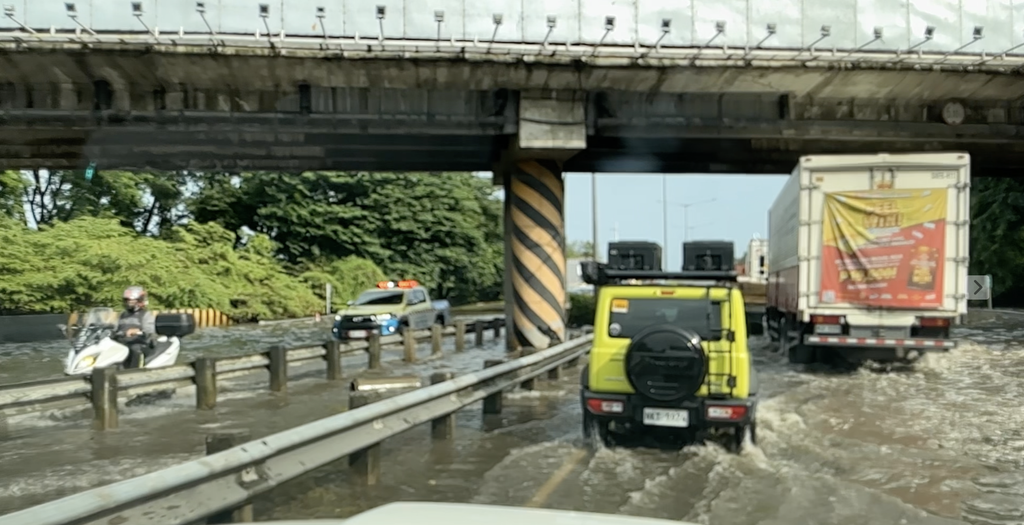
The effects of Habagat continued on the 4th as well, and at 11 a.m. PAGASA (the Philippine Atmospheric, Geophysical and Astronomical Services Administration) warned of heavy rain and flooding in areas including the Metro Manila region. Serious flooding is feared in parts of Bataan, Zambales and Pampanga in particular.
Metro Manila’s forecast high for the 4th is 29°C, with a low of 25°C. From the 5th to the 8th, highs of about 29–30°C and lows of about 25–26°C are expected, and conditions are likely to remain prone to rain and thunderstorms.
This rain is due more to the long-running tropical monsoon than to a typhoon itself. At the end of August, 186 mm of rain fell in Metro Manila over 23 hours, and in some areas the ground and river levels are already high.
According to PAGASA, there is also another tropical depression outside the PAR (Philippine Area of Responsibility) to the east of the Philippines, so its future track and its effect on Habagat also need to be watched.
Nepal Landslide: Death Toll Tops 1,250 — 20,000 Homes Need Rebuilding
More than a week after a massive landslide and flash flood struck northern Nepal near the Chinese border on August 26, the full extent of the damage still remains unknown.
1,252 Dead, More Than 4,200 Missing
According to Nepalese authorities, at least 1,252 deaths had been confirmed by September 3, with more than 4,200 people still missing. On the Chinese side, in the Tibet Autonomous Region, 21 people have died and the whereabouts of 541 others remain unknown.
Among those missing in Nepal, at least 583 are foreign tourists or pilgrims. The death and missing tolls could rise further as reports come in from remote areas and as the recovery of bodies continues.
Search Continues at Hydropower Plants
Rescue efforts are focused on hydropower facilities concentrated in Rasuwa and Nuwakot districts. Several facilities were buried under massive amounts of debris, and as many as 900 workers may have been trapped inside the facilities and tunnels.
The Nepalese army has deployed more than 9,300 personnel. Experts from India, China, and South Korea have also joined the effort, using heavy machinery, controlled blasting, and life-detection equipment to secure access points into the tunnels. However, mud, water, and rock have flowed into the interior, making the search extremely difficult.
So far, 279 people have been rescued from the power facilities, while as of September 2, at least 639 people were believed to remain trapped at the facility sites or inside the tunnels.
7,500 Homes Completely Destroyed
A preliminary survey by the Nepalese government found that approximately 7,500 homes were swept away or buried under debris and completely destroyed. Many of the remaining homes are also uninhabitable, and ultimately about 20,000 homes will need to be rebuilt in safer locations.
An estimated 2.2 million tons of earth, rock, and building debris has piled up in the disaster area. About 50 suspension bridges were also damaged, of which roughly 30 are expected to need replacement.
In addition, eight operating hydropower projects and four under construction were affected, impacting roughly 10% of Nepal’s total power generation capacity. Some facilities may prove impossible to repair.
Japanese Family of Five Still Unaccounted For
No confirmation has yet been announced regarding a Japanese family of five — parents and three children believed to be residents of Osaka. The children are reported to be aged 10, 6, and 3.
The family may have been caught in the landslide near the border checkpoint in Rasuwa district — an area that suffered catastrophic damage — while crossing into Nepal from the Tibet Autonomous Region. The Japanese government has requested that Nepalese authorities search for them and has dispatched emergency response personnel to the area.
Glacier and Bedrock Collapse Triggered the Disaster
This disaster differs from a typical flood caused by monsoon rains. Analysis indicates that the terminus of a glacier and the bedrock beneath it, at an altitude of roughly 5,200 meters, collapsed and fell into a valley about 1,200 meters below. Ice, rock, debris, and meltwater combined into a massive landslide that then flowed down the Bhote Koshi and Trishuli rivers.
The Nepalese government has indicated its view that the destabilization of Himalayan glaciers due to global warming lies behind the disaster. However, establishing a direct causal link between this particular collapse and climate change will require further scientific investigation.
Moving into the Recovery and Reconstruction Phase
China has provided tents, blankets, and satellite communication equipment, while India and South Korea have also dispatched rescue and forensic experts. Support pledged by countries around the world is reported to have exceeded $42 million by early September.
Meanwhile, at least 22,000 children are in need of safe drinking water and sanitation facilities, and schools have repeatedly been swept away or converted into evacuation shelters. The Nepalese government is preparing to open temporary schools in the disaster area and has designated September 7 as a national day of mourning.
The greatest challenge now is shifting toward where to relocate and rebuild the settlements that once stood along dangerous riverbanks and valleys, even as the search for the missing continues.
“Great Men of the Philippines: José Rizal” (Part 18)
Yasotarō Mōri
▲ Exile in Dapitan
Upon arriving in Dapitan, Rizal was informed, by way of a letter of introduction from Father Pastells of the Jesuits in Manila, that if he converted back to the faith he would be permitted to lodge in the house of Father Sánchez, who lived in the town; otherwise, he was to reside in the house of his guardian, Carnicero.
Rizal refused to convert, and so came to live in his guardian’s house. Here, just as elsewhere, Rizal’s noble character led his guardian to hold him in genuine respect, and Rizal was permitted to move about freely on his own, needing only to report in once a week.
Rizal made use of this privilege to roam the surrounding area, sometimes staying away overnight, yet — so as to keep his guardian entirely at ease — he is said to have kept mealtimes with the greatest punctuality whenever he was at home. His guardian, moved by Rizal’s character, repeatedly wrote to the Governor-General reporting that Rizal had nothing to do with any plan for an armed uprising, that what he hoped for was the realization of reforms for the Philippines, and that he was in fact a supporter of the Spanish government. The reform proposals Rizal presented to his guardian were as follows:
- End the friars’ interference in government and their control of land, and give Spanish and Filipino clergy equal treatment.
- Reform the machinery of government across every department.
- Promote primary education, remove the friars’ interference in it, and raise teachers’ salaries.
- Let every matter in the Philippines be handled by equal numbers of Spaniards and Filipinos.
- Make the administration more moral in character.
- Open schools of art and craft in every provincial capital with a population of 16,000 or more.
“If these reforms were realized,” Rizal confided with conviction, “the Philippines would become the happiest country in the world.” What Rizal most regretted at the time was the failure of his Borneo plan. As a second course of action, he considered summoning his parents, relatives, and others to Dapitan, so that they might enjoy a peaceful life there together. His guardian enthusiastically supported this plan and applied to the Governor-General for permission.
The guardian’s motive for supporting this kind of plan, however, lay elsewhere. While he had genuinely come to admire Rizal’s character, he was at the same time secretly acting on behalf of the government authorities and the friar faction, working to make Rizal abandon his former political views and cultivate friendly relations with the Spanish government and the Catholic clergy. He therefore advised the Governor-General to accommodate Rizal’s wishes as far as possible, to place him under obligation, and thereby weaken him, stating: “In this way we may win Rizal over to our side, and through him also discover who leads the faction plotting an armed revolution.”
That War and Me (6) The Town of Sakai
Pinoy-Hapon United Foundation (PHUF), a non-profit organization, Honorary Chairman Takeshi Asanuma
Sakai City lies just south of Osaka City. It was a port town historically tied to the old “Osaka,” yet it maintained its own political independence. The “Sakai merchants” cultivated a distinctive culture of their own, engaging in contact with foreign countries even before the Keichō era, and trade with overseas partners flourished right up until the country’s isolation policy took hold. Even afterward, people gathered there from all over for trade both large and small — and, it seems, firearms and other weapons were sometimes quietly traded as well. Unlike Osaka, which developed rapidly and politically after the Meiji Restoration, Sakai remained a provincial town with a settled, cultured atmosphere. During the Edo period, connoisseurs of refined pursuits such as the tea ceremony gathered there as well.
A famous antiwar poem from the Russo-Japanese War era, Yosano Akiko’s “Thou Shalt Not Die” — “You, child of a merchant house of Sakai, proud of its long-standing name, who are to inherit your parents’ name — you must not die… Even should the fortress of Port Arthur fall, what does it matter if it falls…” — captures the antiwar spirit of the people of Sakai. Yet as of May of Shōwa 20 (1945), Sakai itself had still not come under concentrated American bombing attacks. Even so, because naval-related facilities were located there, it had been subjected to single bombing runs and strafing attacks by carrier-based fighter planes.
In mid-May, our family of four (mother, older brother, myself, and younger sister) moved together with my uncle’s family of three from our grandparents’ house outside Nara to Yata Village, Naka-Kawachi District, Osaka Prefecture, just east of Sakai City (now Yata, Higashisumiyoshi Ward, Osaka City — still more than 12 kilometers from central Sakai). It was a quiet rural village about a 60-minute walk east from Suginomoto Station on the national railway’s Hanwa Line, and my brother (a third-grader) and I (a first-grader) transferred to the village’s national school. The villagers were all kind to us, and in particular there was a young man of 17 or 18 at our landlord’s house who taught me all sorts of things. It was he who taught me the names of the different types of American fighter planes.
Nara, where we had spent about two and a half months, had seen no air raids at all, but here — even though it was on the outskirts — it was still Osaka, and air-raid sirens often rang out, closing school for the day. At such times, my brother would often take me down to the early-summer waters of the Yamato River with a small fishing rod. It was there that I learned to swim — and to dive underwater, too. Later, as a junior-high student, I swam a full kilometer in a long-distance swimming class and earned a black stripe on my swim cap, and in high school I joined the swim team. It is the one and only accomplishment the war ever left me.
Even so, American fighter planes kept coming. They attacked Sakai on a regular basis — in broad daylight. Air-raid sirens would wail, and the roar of carrier-based aircraft would come rumbling in from the direction of Sakai. The American planes would attack Sakai, circle in the skies above Yata Village, and then head back toward Sakai again.
One day, an air-raid warning sent us home from school before noon. My brother and I, together with five or six neighborhood children, were walking along a path through the fields when suddenly an American fighter plane — probably a Grumman — came straight toward us overhead! All of us threw ourselves down flat in the field.
With a rattling da-da-da-da! of gunfire, a straight line of bullet holes was carved into the ground about 30 meters to our right, striking a farmhouse just beyond. The enemy plane climbed away in an instant and flew off toward Sakai. It was terrifying — I was shaking all over. I heard afterward that the household’s cow had been killed, its barn destroyed, and one family member wounded. There were no anti-aircraft guns or air-defense positions anywhere in the area — we were completely at the enemy’s mercy.
The next day, an upperclassman reported the incident at school, and it seemed some damage had occurred in the village as well, so the school issued an order banning the wearing of white clothing that would stand out from the air. My mother promptly dyed all of my and my brother’s open-collar shirts and white clothes a mouse-gray color. Even so, the “Rising Sun” headband we wore and the cloth name tag sewn onto our chests (bearing our name, address, school, grade, and blood type) remained white.
On June 15, Shōwa 20 (1945), in the middle of the day, a large formation of B-29s carried out wave after wave of attacks on Sakai City and the southern part of Osaka City, and a considerable portion of the historic town of Sakai burned to the ground.
A very sad event befell my own family as well.