

MANILA NEWS DAILY
That War and Me (5) National School
Pinoy-Hapon United Foundation (PHUF), a non-profit organization, Honorary Chairman Takeshi Asanuma
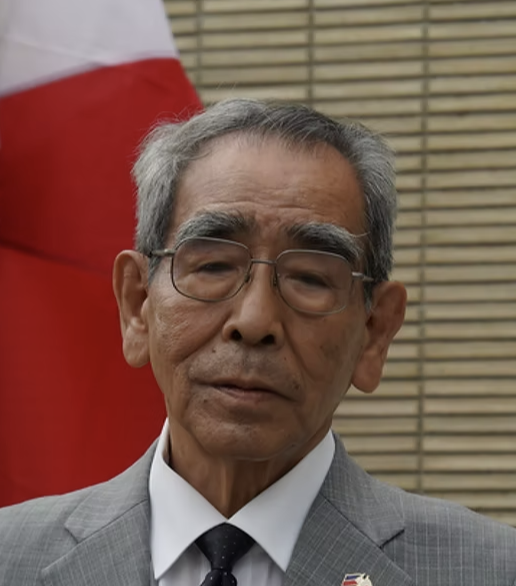
You are all, I imagine, “citizens of Japan.” In April of Shōwa 20 (1945), we were “subjects of the Empire.” I was one of the “young citizens defending the home front,” and on April 1 I entered “national school.” My textbooks, issued by the “Ministry of Education,” were hand-me-downs from my older brother. There was no such fashionable thing as a randoseru school satchel — I carried a cloth shoulder bag my mother had sewn herself. My clothes, too, were my brother’s hand-me-downs.
Burned out of our home in the Great Osaka Air Raid on March 13 of the previous month, we had fled to my grandparents’ house in Tobinomura (Tomio Village), outside Nara City, where four other families of relatives from Osaka had also taken refuge. On April 2, the very next day, my great-grandmother, aged 90, passed away. Amid all that chaos, there was now a funeral to hold — the neighboring villagers took charge of arranging it for us.
The villagers were all extremely kind to us. My grandfather, for some reason, was held in a certain respect by the villagers and was treated as something like the head of the local civil defense corps. Since few households in the village had a radio, one was set up in our gatehouse, and NHK news and other broadcasts were played there for everyone.
School began on April 8. Twelve children from the neighborhood walked to school together as a group, led by a fifth-grader serving as squad leader. To the right of the school’s main gate stood a “weekly duty” student — probably a sixth-grader — wearing a red sash, who called out “In step!” as our group passed through the gate. Four or five meters past the gate, on the left, stood the hōanden, a reinforced-concrete shrine about a meter and a half tall.
Enshrined within it were the Emperor’s portrait and the Imperial Rescript on Education. As we passed in front of it, the squad leader would call out, “Bow before the hōanden — salute!” and everyone turned their heads to the left and offered a salute. After passing the statue of Ninomiya Kinjirō about a meter further on, the command “At ease” would be given. From there, each grade lined up by class in the schoolyard — though half of the schoolyard had been turned into a sweet-potato field.
Once everyone had assembled, the principal would mount a platform at the front and give the command, “Bow toward the Imperial Palace — face east!” Everyone turned to face east and bowed in the direction of the Imperial Palace, and the school day began. Lessons were, of course, held at school, but the teachers would also launch into talk meant to bolster our fighting spirit.
The older students worked at clearing land for sweet-potato fields (the school also managed fields outside the school grounds) to mass-produce food. The younger students gathered pine resin, which we were told was for making aircraft fuel. Every day, we went up into the hills to collect the resin that had pooled in empty cans tied to the trunks of pine trees. I remember wondering, “Can something like this really make an airplane fly?” — but even so, I worked hard at it, “for the sake of the country.” After all, we were the “young citizens defending the home front.”
Even so, we were fortunate that Nara itself was never bombed. I heard later that although the American forces attacked and bombed all across Japan, they had deliberately excluded Nara and Kyoto — regions of traditional culture and history — from their target list. Perhaps that was America’s conscience at work.
April 29 was Tenchōsetsu, the Emperor’s Birthday. The principal, dressed formally in a “national uniform” (a style of formal wear resembling a military uniform), would put on white gloves and reverently take the Imperial Rescript on Education out of the hōanden, raise it above his head, and read it aloud before all the assembled children.
“We, the Emperor, contemplating the founding of Our Empire by Our Imperial Ancestors…”
“♬ Today is an auspicious day, the day the Great Lord was born, a fine day indeed…”
The whole school sang it together. Unfortunately, there were no red-and-white manjū handed out. Before the war, I’m told, red-and-white manjū were distributed to every child on this day.
By the middle of May, Shōwa 20, Okinawa had already fallen, and our country was, by then, likely being pressed hard by the United States. My family of four, along with my uncle’s family of three, moved from our grandparents’ house outside Nara City to Yata Village, at the southernmost tip of Osaka City. It was a quiet rural area that had not been subject to school evacuation, and my brother, now in third grade, and I, in first grade, transferred to the national school there.
There were no sweet-potato fields or pine-resin gathering there, and we were able to do a bit of actual studying, though school was called off whenever an air-raid caution or air-raid warning was issued. But before long, American fighter planes began appearing in this area too, and indiscriminate attacks began.
*From 1941 to 1947, elementary schools were officially called “national schools,” by order of the Ministry of Education.