

MANILA NEWS DAILY
In Rain-Soaked Manila, 35 Candidates for the 9th BatchC of Certified Care Worker Trainees Are Interviewed — Okinawa’s 8-Year Training Program
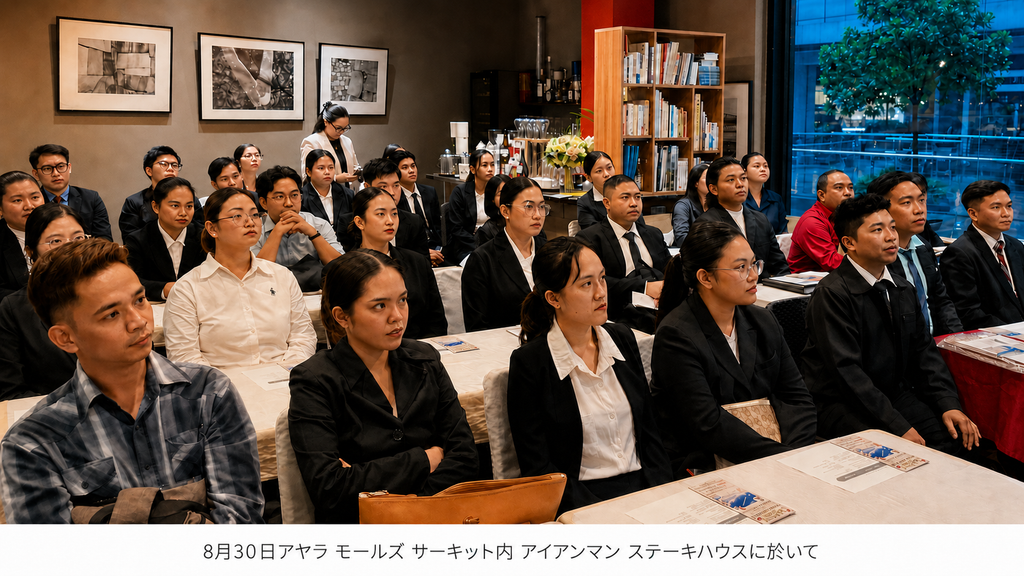
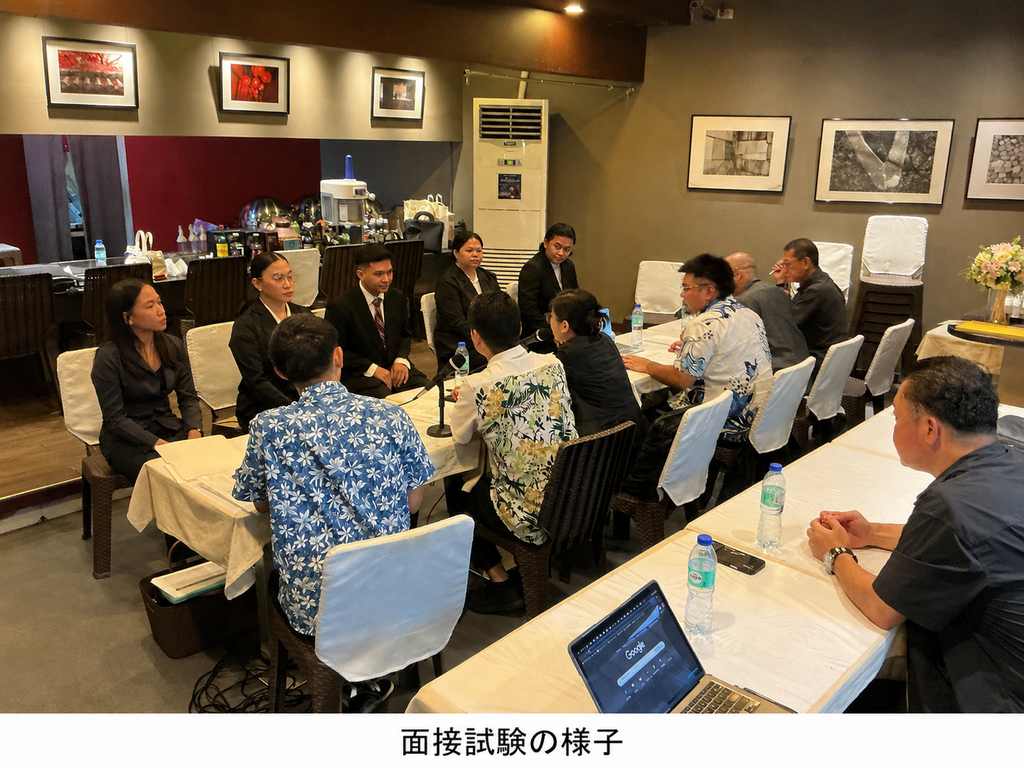
Amid continuing heavy rain caused by the southwest monsoon, known locally as “Habagat,” an orientation and interview session for Filipino candidates aspiring to become certified care workers in Okinawa Prefecture was held in Makati City on August 29. The interviews were conducted by the Okinawa Foreigners Caregiver Project Corporative Association (chaired by Yasushi Yonamine) and Step World Japanese Language Institute (Naha City; Vice Principal Kōichi Nakasuji). This year’s ninth cohort of the certified care worker training program drew more than 100 applicants, and 35 candidates who passed a rigorous document screening advanced to the interview stage.
Metro Manila had been hit by intermittent heavy rainfall since the previous day, raising concerns about flooded roads and disrupted transportation. Candidates’ attendance was therefore in doubt, but only one arrived late, with nearly everyone reaching the venue on time. The fact that so many candidates showed up despite the bad weather spoke to the depth of their enthusiasm for the program. The venue was attended by eight representatives of the cooperative, who had arrived in Manila the night before, along with three representatives from PJ LINK, which handles pre-departure Japanese-language instruction and on-site interpretation, and three representatives from its parent company, Withus.
The orientation was led by Secretary-General Motohiro Suzuki, with interpretation by Asahiko Yara. After a promotional video about Okinawa Prefecture and the cooperative was shown, Chairman Yonamine delivered opening remarks. Secretary-General Suzuki then explained the details of the program and its upcoming schedule.
The explanation covered upcoming procedures, including when interview results would be announced, moving into the dormitory, pre-departure Japanese language study, applying for and obtaining a Certificate of Eligibility and visa, and the planned departure for Okinawa in early April of next year. Careful explanations, in both Japanese and English, were also given regarding the costs required before departure, the status of residence after entering Japan, and working conditions such as salary and leave. The candidates listened intently, taking notes with serious expressions.
The interview examination that followed was conducted in groups of five candidates at a time. Six interviewers questioned each candidate individually about their motivation for applying, their experience studying Japanese, their experience with communal living, and whether they had obtained their families’ consent.
Though visibly nervous, the candidates answered the questions crisply and clearly. At times, a candidate’s amusingly imperfect Japanese drew laughter from the examiners. Even so, they approached the selection process for a program that would shape the course of their entire lives with evident seriousness.
Under the program, candidates spend their first three years working part-time at care facilities for up to 28 hours a week while studying basic Japanese at a language school and acquiring caregiving skills at a vocational welfare college. For the following five years, they work at care facilities under the same conditions as their Japanese counterparts, gaining practical work experience.
The cooperative covers the cost of pre-departure Japanese language study, dormitory fees, and travel expenses to Okinawa. It also advances the tuition for the Japanese language school and the vocational welfare college; under the program’s terms, this advance is forgiven once a candidate completes the full eight-year program. If a candidate withdraws partway through, however, they are obligated to repay the full amount of the advanced tuition.
To date, 67 Filipino candidates have gone to Okinawa through this program. Those who withdraw partway through — mainly due to marriage or illness — are said to account for only about 10 percent of participants.
Meanwhile, seven candidates have so far passed the national certified care worker examination. For people from a country where Japanese is not the native language and kanji is not used in daily life, this is regarded as a relatively strong result.
Chairman Yonamine, noting that the program will mark its tenth year since launch next year, expressed his intention to continue it going forward in order to address the ongoing shortage of certified care workers within Okinawa Prefecture. He also noted that Filipino caregivers are described as “cheerful and hardworking,” and are well regarded by both the receiving care facilities and their residents.
The candidates who passed this round of interviews will, after completing pre-departure Japanese language study and the procedures for obtaining their status of residence, depart for Okinawa as the program’s ninth cohort in early April of next year.
Embassy of Japan in the Philippines Holds Farewell Reception for Ambassador Endo
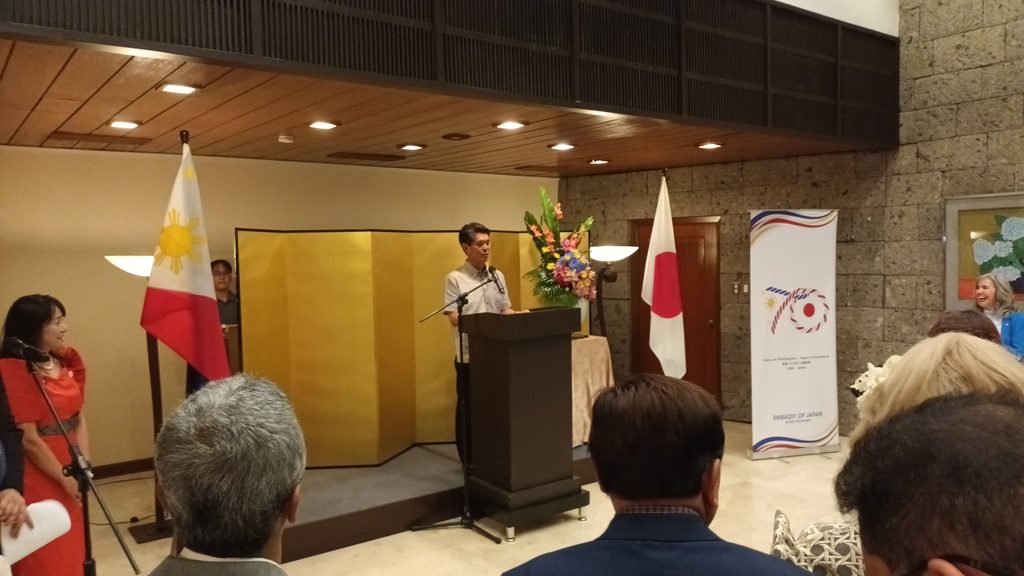
On August 26, 2026, a farewell reception for Ambassador Kazuya Endo was held at the Residence of the Ambassador of Japan in Forbes Park, Makati City, drawing a large gathering of guests from the Philippine political and business communities, staff from various embassies, Japanese community organizations, chambers of commerce, and more.
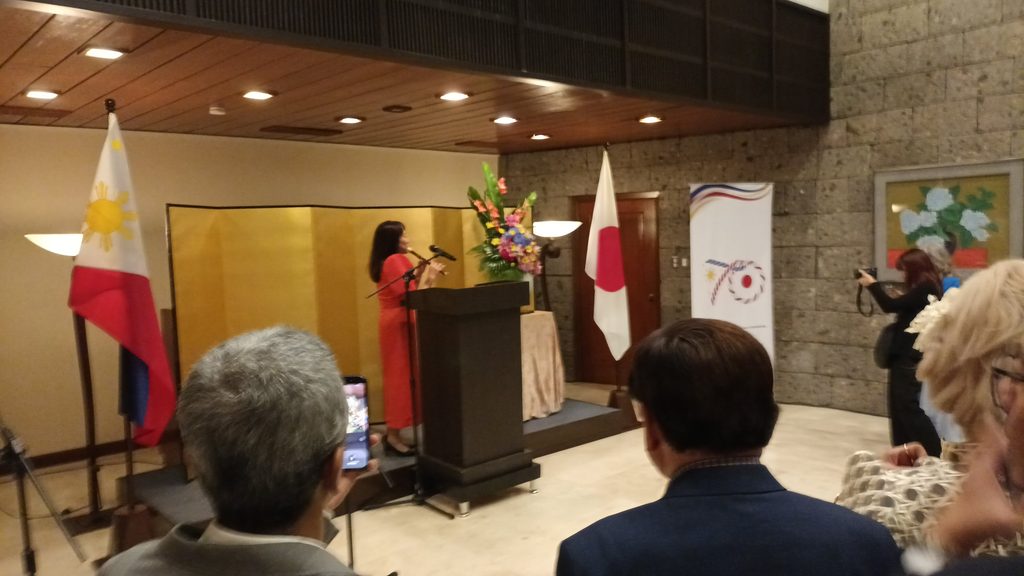
The reception opened with the singing of both national anthems, accompanied on the flute by Mrs. Akiko Endo, followed by remarks from Philippine Ambassador to Japan Mylene Garcia-Albano and others. Ambassador Endo then gave the closing address, reflecting on the events of his tenure and expressing his gratitude to the many people from all walks of life who had supported the development of Japan-Philippines relations.
Remarks of Ambassador ENDO Kazuya during His Farewell Reception
26 August 2026
Magandang gabi po sa inyong lahat. Good evening. Konbanwa.
Thank you for enjoying Akiko’s performance, and I would like to thank you all for being here this evening, despite this inclement weather.
I’d like to think that even the heavens are crying over Akiko’s and my departure.
I encourage everyone here to keep singing “Raining in Manila” and hum a tune once we leave.
It is fitting to see our Residence filled with the very people who have made it feel a remarkable second home all these years.
I wish this really were our home.
But for the past two and a half years, I have been privileged to be this house’s caretaker, using this venue to know you and this country more deeply.
I feel deep gratitude and a sense of pride for all we have accomplished together in that span.
Allow me to share three reflections that capture what this journey has meant to me.
First, the power of culture to bring people together.
Throughout my tenure, I was privileged to attend many events the Embassy organized or supported that brought us closer.
2026 was especially meaningful, as we celebrate the 70th anniversary of Japan–Philippines Friendship.
From jazz events and fashion shows to symphonies and academic dialogues, these occasions remind us that our people are at the heart of it all.
The simplest handshakes becoming partnerships. Gatherings turning into lifelong friendships.
Seeing them was the most rewarding part of my service.
Second, the growth of our ties into a truly strategic partnership.
Recently, our relationship officially advanced to CSP, Comprehensive Strategic Partnership.
And with it came a widening web of collaboration: across security, economy, infrastructure, disaster resilience, education and so on.
I was honored to witness and support many high-level exchanges that both embodied and propelled this momentum, including the highlight of my tour: President Marcos’s state visit to Japan in May.
Each visit had its own significance, but taken together they tell a clear story: our two nations are working more confidently, more creatively, and above all more closely than ever before.
That continuity gives me strong confidence in the future of our relations.
Third, the diversity of this country and the warmth of the people of the Philippines.
Each visit to Provinces offered a distinctly different, yet familiar face of the country, and everywhere, familiar warmth from local leaders, students, businesspeople and volunteers.
I saw first-hand the creativity of its youth, the richness of its traditions, and the resilience of its communities.
It was these encounters that imparted the true essence of bayanihan.
From state halls to barangay gyms, from boardrooms to classrooms, I was welcomed without fail by the warmth and generosity of Filipinos.
Even my first encounter with balut was met with encouragement, to which I learned to say: “sisiw lang yan.”
My time here has been as much of a learning experience as it was a working one.
You all have truly made Akiko and me feel at home.
Allow me now to extend my appreciation to everyone on this journey:
to our tireless national and local partners in the Philippine government;
to our leaders in business and finance;
to our scholars and educators;
to cultural institutions and sports groups;
to my friends in the diplomatic and consular corps;
to the NGOs and groups whose service inspires us all;
to the friends in the media;
to the Japanese community, whose dedication continues to be a cornerstone of our relations;
and to all our pure genuine friends, drinking buddies, golf partners and singers.
I am also deeply grateful to our entire Embassy team for working hard and managing the unexpected.
Any success we have achieved belongs to them.
Finally, on a personal note, I thank Akiko for being a charming and unwavering pillar of support.
She has been a true partner: steadfast, generous, and encouraging at every turn.
As I depart, I do so with confidence in the future of Japan–Philippines relations.
Our friendship rests on strong foundations and is animated by countless human connections.
The challenges of our time are real, but so are the opportunities.
Together, with mutual respect and shared purpose, I believe we will meet those challenges and seize those opportunities for the benefit of both Filipinos and Japanese.
My affection for this country and my commitment to our partnership will always remain.
I will always be a friend and advocate of the Philippines, wherever I may be.
Back in Tokyo, I will start my work as the Senior Deputy Minister for Foreign Affairs on September 1.
I might even be moving to some other overseas posting again in the future.
Nevertheless, I will not say “good-bye” but “see you later” as Tokyo and Manila are still so close.
Paalam at maraming salamat po.
Hangang sa muli, Pilipinas!
Ang pagkakaibigan natin ay tunay na walang hanggan.
Arigatō gozaimashita.
Source: Embassy of Japan in the Philippines, “Ambassador Endo hosts farewell reception”
“Great Men of the Philippines: José Rizal” (Part 15)
Yasotarō Mōri
▲ The Resolve to Boldly Face Death
At this, he resolved firmly to return to the islands, to see for himself whether he could truly accomplish anything there. Those around him were stunned, and tried to stop him. His relatives and friends in the Philippines, too, argued forcefully against his return, saying it amounted to courting death. But his mind was made up. Expecting death, he wrote out the two letters that follow (one addressed to his parents and friends, and one addressed to the Filipino people in general), appended to them the note “To be made public after my death,” and entrusted them to his close friend Dr. Marques. The substance of those letters is as follows.
To His Parents, Brother, Sisters, and Friends
“Whether the course I am now about to take was wise or not, only the future can judge, but the motive that has brought me to take it is the same affection I have always shown you all. Fate judges an action by its result, but whether that judgment proves favorable or unfavorable, I say only that it was my duty that commanded me to act as I have. And it is no matter to me even if, in obeying that command, it should cost me my life.
I know that you have all suffered greatly on my account. But I do not regret anything I have done up to now. If I were to begin it all again, I would do exactly the same, for it is my duty. I go willingly into danger — not to atone for any wrong of mine (in this matter, I believe I have done no wrong whatsoever), but in order to complete my work and to prove, with my own body, what I have always said.
A man ought to be willing to die for his duty and his convictions. I hold firmly to everything I have published concerning the present state and the future of our homeland. I die gladly for my country; and for the sake of defending justice and peace on your behalf, I die more gladly still.
I gladly lay down my life to save the many innocent people — nephews, nieces, and children among them — who have suffered on my account.
What am I, after all? A man with scarcely any family of his own, a bachelor who has come to know full well the disillusionments of life. I have often been deceived. The future that lies before me is dark, and it would be darker still were it not lit by the dawning light of my homeland’s future. At the same time, there are, no doubt, many people who will feel great happiness — indulging in their hopes and fantasies — when I die. It is my wish, then, that my enemies, once satisfied, will cease their persecution of innocent people. That they should hate me is, to some extent, reasonable. But to hate my parents and relatives is unjust.
If fortune does not favor me, my parents, relatives, and others will know, through my death, that their suffering has come to an end, and will know that I went gladly to my death. They may then return to our homeland and find happiness there.
Until the moment of my death, I shall think of you all, and I wish that every good fortune and happiness may come to you.”
To the Filipino People
The course I have taken (or am now about to take) is, without question, an extremely reckless one. That I have given this long and careful thought goes without saying. I know that almost everyone opposes this course. But I also know that almost no one knows what lies hidden within a man’s heart. I cannot rest easy knowing that so many people suffer unjust persecution on my account; I cannot go on living while I watch my brother and sisters and their families hunted down like criminals — I choose death instead. And I gladly offer up my life in order to save so very many innocent people from this unjust persecution. I know that, at present, the future of our homeland turns, to some degree, on me, and that when I die, there are many who will rejoice, and who are, for that very reason, waiting for my death.
What, then, should I do? I have a duty, above all else, to my own conscience, and I have an obligation to my suffering family, my relatives, and my aged parents, whose cries of grief pierce my heart. I know only that, by my death, I can let them return to our homeland, enjoy a peaceful household once more, and find happiness. I have only my conscience to answer to, but our homeland has many sons who can take my place — indeed, who are already, steadily, taking my place.
I wish, moreover, to show those who deny our patriotism how a man may die for his duty and his convictions. If a man dies for those he loves, for his homeland, and for those he holds dear, what is there in that death to fear?
If I imagined myself to be nothing more than a mere pillar of policy in the Philippines, and if I were convinced that my countrymen still needed my service to make it effective, I might perhaps hesitate to take this course. But there are many people who can take my place, and do so more effectively than I.
I have always loved our suffering homeland. Even if some people may treat me unjustly, I love my homeland to the very last. My future, my life, and all my joys have been offered up for my homeland’s sake. Whatever my fate may be, I die blessing my homeland, yearning for the dawning light of its resurrection.” The day after writing these two farewell letters (June 21, 1892), Rizal, accompanied by his sister Lucía, set sail from Hong Kong with a solemn resolve, and steadfastly made his way toward Manila.