

MANILA NEWS DAILY
Timeline of the Henoko Protest Boat Capsizing: From the Accident to the Criminal Complaint
In March 2026, a small-boat capsizing off Henoko in Nago City, Okinawa Prefecture, killed two people, including a high school student on a school trip, and has remained a major focus of Okinawa prefectural politics for nearly six months since. The boats involved were operated by a protest group opposed to the relocation of U.S. Marine Corps Air Station Futenma to Henoko. In July, the bereaved family filed a criminal complaint against a total of 11 people, including school officials and executives of the group. This article looks back at events in chronological order.
The Accident (March 16, 2026)
Two small boats capsized off Henoko in Nago City while second-year students and others from Doshisha International High School in Kyoto Prefecture were on a study trip. The boats were vessels used for protest activities against the construction of the new base at Henoko, and the students were taking part in a course that let them view the base from the sea.
After the first boat, the Fukutsu, capsized, the second boat, the Heiwa Maru, which had gone to help, capsized as well. A second-year student at the school, Ms. Takeishi (17), and the male captain who had been piloting the Fukutsu died. The captain is said to be the person who proposed this sea-viewing course.
The school has conducted visits from the Henoko beach as part of peace education since around 2015, and added a sea course in 2023.
Initial Response and the Question of Responsibility (March–April)
In the Prefectural Assembly immediately after the accident, opposition members, including those of the Okinawa Liberal Democratic Party and Independents caucus, raised doubts about the very nature of citizens’ protest activities. The member organizations of the protest group that operated the boats, the Council Against Helicopter Base Construction (Heli Kichi Hantai Kyogikai), decided in April to disband in the wake of the accident (with more than 500 members).
The Liberal Democratic Party headquarters’ education and science division also received a briefing from the government on the accident on April 2. Attending lawmakers raised not only the question of who was responsible for the accident, but also concerns that the aim may have been to mobilize students for political activity, and called for a thorough investigation of the background to how the students came to board the boats.
In mid-April, the Sankei Shimbun reported remarks on “compensation” by the council’s co-chair, Mr. Nakamura, but the council issued a statement asking for the facts to be corrected, saying that only part of the remarks had been emphasized and that his true meaning had been misunderstood.
The Education Ministry’s Finding and the Governor’s Rebuttal (May 22)
On May 22, the Ministry of Education, Culture, Sports, Science and Technology indicated its judgment that the school’s learning content violated the Basic Act on Education, which stipulates political neutrality. Its point was that students had been put on a protest boat and given education biased toward a particular viewpoint.
In response, Governor Tamaki again criticized the judgment on May 25 as “going too far,” stressing that Okinawa’s peace education as a whole is not biased. He expressed the view that the purpose of peace education is to foster students’ own ability to think from multiple perspectives, on a foundation of respect for life and individual dignity.
Subsequently, reporting by the Sankei Shimbun found that a person registered as a peace-learning advisor on a school-trip website operated under commission from the prefecture had also put students on protest boats at another private school where the person previously worked, in 2017 and 2018 and in 2024 and 2025. The Okinawa General Bureau had earlier stated that there were no other similar cases.
The Bereaved Family’s Appeal and Criticism of the Governor’s Answers (June–July)
After the accident, the bereaved family opened an account on social media called “Henoko Boat Capsizing Bereaved Family Memo” and has continued to post about how those involved have responded to the accident. At the end of May, the family posted a question asking how the governor would recommend that the Henoko relocation issue be handled if it is to be used as material for peace education.
In early June, when reporters asked Governor Tamaki about this post, he answered, “I haven’t seen it, but I have heard that there is such a thing,” which drew criticism. The governor later said he had read the family’s post and, on the question of how peace education should be conducted, said “it is as the bereaved family says,” and expressed the view that there should be an education program in which students themselves think and discuss from various perspectives.
In the general questions in the Prefectural Assembly beginning at the end of June, there were heated exchanges between the Tamaki administration and the opposition. Assembly member Shimabukuro of the Okinawa Liberal Democratic Party and Independents caucus called the very practice of protest activities at sea “nonsense” and argued that they should stop. The governor merely stated his view that various actors, including government bodies and private organizations, are making efforts to convey historical facts, and avoided assessing the protest activities themselves. The assembly member also sharply criticized the governor’s conduct of prefectural administration to date.
In the same session, Assembly member Shimajiri touched on the fact that the bereaved family feels the accident during a school trip is being “used for political activity,” and asked whether it was pitiful that it was being used politically. Governor Tamaki replied that the family’s true feeling is probably that they want “things to be kept as quiet as possible,” and said that, given that an investigation is under way, those involved should keep calm. This answer spread on social media from mid-July, and criticism followed one after another because it conflicted with the fact that the family had in fact repeatedly called for the truth to be uncovered on note, a blogging platform.
In a note post on July 10, the family revealed their anxiety that, four months after the accident, the memories of those involved and the records were being lost as time passed, and public interest was fading.
Criminal Complaint (July 13)
Against this background, the bereaved family filed a criminal complaint for professional negligence resulting in death and injury and other offenses against a total of 11 people: four school officials, including Doshisha International High School Principal Nishida, and seven executives of the Council Against Helicopter Base Construction, which had operated the two capsized boats. The complaint, dated July 13, was accepted by the Nakagusuku Coast Guard Office.
On that same day, July 13, Governor Tamaki told reporters, regarding the onboard security-camera footage from the time of the accident that the family had made public, that he questioned its release, saying, “Is it even appropriate for this to come out? It is evidence for the investigation.” At his regular press conference on the 17th, he again expressed the view that the security-camera footage could become important evidence in the investigation and inquiry.
The family had decided to release the footage in order to uncover the truth, as material for examining how those involved responded after returning to port following the accident and how the injured students’ safety was checked and rescue provided. The mother is said to have expressed the view that the release was of great social significance.
On July 28, the council’s co-chair, Mr. Nakamura, responded to an interview with the Sankei Shimbun and said that, since the complaint came from the bereaved family, he intended to cooperate fully with the investigation.
On July 30, the family held a press conference and explained how they came to file the criminal complaint, seeking to establish the true cause of the accident and to prevent a recurrence. On the same day, the council also released a statement of apology and on its response.
The School’s Third-Party Committee Report and the Governor’s Comment (August 3)
A special investigation committee (a third-party committee) established by the Doshisha educational corporation released a report on the accident. In response, Governor Tamaki said on August 3 that he “keenly felt that this must never happen again,” and indicated that he intends to advance safety and security efforts in cooperation with those concerned.
However, when a reporter asked where the prefecture’s responsibility lies, he avoided giving a clear answer, saying only, “I think the bereaved family has many feelings, so I would like to take those feelings on board firmly.”
Ahead of the Gubernatorial Election (August 1)
With the Okinawa gubernatorial election coming in September, a large rally was held on August 1 in front of Camp Schwab at Henoko by the “All Okinawa Conference,” which works with the protest group, with about 590 participants according to the organizers. While some participants called for the governor’s re-election, the Council Against Helicopter Base Construction itself declined to take part in the rally.
At a policy announcement for the gubernatorial election, when asked about a remark by a Liberal Democratic Party prefectural assembly member that “what supports Mr. Tamaki is an ultra-left violent group,” Governor Tamaki clearly denied that any such people are among his supporters. On the protest movement itself, however, he said only that he would work to prevent a recurrence through exchanges of views with the board of education and tourism-related organizations, and avoided going further.
What to Watch Next
In the Prefectural Assembly, the Liberal Democratic Party side has called for a prefectural investigation of its own and for the establishment of a special committee to examine the accident, but this has not materialized. For now, the focus is likely to be on the investigating authorities’ clarification of criminal responsibility and on whether the Henoko issue and the handling of the accident become election issues in the September gubernatorial race.
Do EVs Disappear From the Streets of Metro Manila During Heavy Rain?
When heavy rain hits Metro Manila, the EV taxis that normally run through the city suddenly disappear from sight. It is not clear whether this is because companies have ordered operations suspended, because drivers are waiting out the floods to avoid getting stuck, or because of measures to protect charging facilities.
The same is probably true not just of EV taxis but of EVs in general.
The reason EVs vanish from the roads in torrential rain is that operators and drivers see very real risks in flooding: breakdowns, occupants struggling to escape, battery fires after submersion, and the loss of the vehicle’s value.
Take my advice: when it rains, head out in an “all-weather” car, that is, a gasoline or hybrid vehicle.
Flood Risks Facing EVs in Manila’s Rainy Season
During the rainy season in Metro Manila, downpours flood roads in many places within a short time. When an electric vehicle (EV) drives onto such a road, the problem is not just a breakdown. Several issues that affect the occupants and people nearby are conceivable: the risk of the vehicle being swept away, windows and doors failing to operate after a loss of power, and ignition of the traction battery after submersion.
That said, it is not accurate to assume that “EVs are vulnerable to water and will immediately cause electric shock or fire when flooded.” Today’s EVs are designed on the premise of a waterproofed high-voltage battery, leakage monitoring, and power cutoff in the event of an abnormality.
What matters is to distinguish between the direct dangers while a vehicle is in floodwater and the battery fires that can occur some time after submersion.
The Problem of Doors That Won’t Open Is Not Unique to EVs
The main reason the doors of a flooded car will not open is the water pressure outside the vehicle. This applies not only to EVs but also to gasoline and diesel cars. However, at the depth of ordinary road flooding, water pressure does not need to be considered. Even in a power loss, there is no problem if the car has a safety design that allows the doors to be opened manually.
Check in Advance Whether Your EV Has a Manual Door Release
EVs with electronic doors are generally also equipped with a mechanical manual release. However, its location and operation differ by model.
On the Tesla Model 3, for example, the front doors have a manual release lever near the window switch, while in the rear you remove a cover inside the door pocket and pull a release cable. The structure may differ depending on the model year and specifications.
The problem is that if you look for the release for the first time in an emergency, you may not be in time.
Not only owners of private EVs but also taxi companies, whose vehicles are used by many drivers in shifts, need to train drivers on the following for each model:
- How to release the front and rear doors manually
- The escape procedure while the power windows still work
- Where the on-board escape tools are kept
- Criteria for deciding not to enter flooded roads
- Conditions under which a car must not be restarted or charged after flooding
- The procedure for evacuating passengers safely
Simply leaving a manual in the car is not enough. Every driver who might drive during heavy rain should check the release locations on the actual vehicle.
EV Fires After Submersion Confirmed in Florida
Now, many cases of EVs catching fire after submersion have already been confirmed overseas.
When Hurricane Ian struck the U.S. state of Florida in 2022, EVs affected by seawater from the storm surge caught fire one after another after the water receded.
According to the Associated Press, the batteries of up to about 5,000 EVs were affected, and 36 of them caught fire. Not every flooded EV burned; only some did, but the episode revealed a new problem: fires that break out well after the submersion.
The reported fires included the following:
- Ignition while parked after the water receded
- Ignition while being transported on a tow truck
- Ignition several days after flooding
- Re-ignition of a battery after the fire had once been extinguished
- Ignition inside a garage, spreading to the building
In Hurricane Helene in 2024 as well, there were reports of a flooded Tesla catching fire in a garage and destroying a home. No casualties were reported in that case, but it renewed attention to the danger of keeping flooded vehicles inside a house or near buildings.
Why Do Fires Start After the Water Recedes Rather Than Underwater?
An EV’s traction battery consists of many battery cells and high-voltage components. If the battery case is damaged, or if moisture gets inside past the seals, an internal short circuit can occur as time passes.
Seawater in particular contains salt, which conducts electricity easily. If seawater enters the battery and the salt remains after the moisture evaporates, a path for electricity can form.
As a result, a fire can develop through a sequence like the following:
- Seawater or dirty water enters the battery
- Salt and corrosion cause an internal short circuit
- Some cells overheat abnormally
- The heat spreads to adjacent cells
- Thermal runaway occurs
- Flammable and toxic gases are released and ignite
While submerged, the battery may be cooled by the surrounding water, but its temperature can rise after the water recedes or after the vehicle is pulled out. Because internal corrosion takes time, it cannot be ruled out that a fire may break out suddenly hours or days later.
The U.S. National Transportation Safety Board (NTSB) warns that damaged lithium-ion batteries retain stored energy and pose risks such as thermal runaway, re-ignition, and electric shock to rescue and maintenance personnel.
Freshwater and Seawater Flooding Should Be Distinguished
The Florida cases cannot simply be applied to every flood in Metro Manila.
The problem in Hurricane Ian was mainly submersion in salt water from the storm surge. Compared with freshwater flooding, which is mostly rainwater, salt water conducts electricity more easily and also accelerates corrosion inside the battery.
Even so, it is not appropriate to regard Manila’s floodwater as completely fresh. Water on flooded roads may be mixed with sewage, mud, oil, metal fragments, and chemicals from the road surface. Along the Manila Bay coast, storm surge and salt-laden water may also flow in.
Therefore, even if a car runs normally after flooding, it should not be judged “safe because it did not break down.”
The Possibility of a Fire Inside the Vehicle While Submerged
In theory, an accident in which an EV’s battery ignites immediately after the vehicle enters a flooded road and the occupants are burned to death cannot be ruled out. However, most submerged-EV fires widely confirmed so far occurred after the water had receded, while the vehicle was parked, being transported, or in storage.
The dangers that generally threaten occupants soonest in floodwater are not fire or electric shock but the following:
- The vehicle is swept away by the current
- It falls into a hole in the road, a gutter, or an open manhole
- Water pressure keeps the doors from opening
- A power failure leaves the windows and locks inoperable
- Water enters the cabin and the occupants drown
An EV battery fire is a serious danger, but it is not necessarily the “first danger” that delays the decision to escape during flooding.
Manila’s EV Taxis Need Special Measures
EV taxis are increasingly being introduced in Metro Manila, and some operators now have many drivers sharing the same model in shifts.
EV taxis run for longer hours than ordinary private cars and are more likely to carry passengers even in heavy rain. And because the drivers do not own the vehicles, they may not fully understand the manual door release or what to do after flooding.
Operators should be required to take at least the following measures:
- Show flood-prone areas on the dispatch system
- Stop dispatching to hazardous areas when flood warnings are issued
- Clearly give drivers the authority to detour or suspend service
- Conduct training in manual door release and passenger evacuation
- Equip every vehicle with escape tools and inspect them regularly
- Do not return flooded vehicles to ordinary charging sites
- Isolate flooded vehicles, keeping them away from buildings and other vehicles
- Set up a system for inspection by specialized battery technicians
- Record flood depth and driving history
If drivers’ sales targets or performance evaluations are too strict, they could become an incentive to enter flooded roads despite knowing the danger. A system is also needed so that suspending service for safety does not lead to pay cuts or discipline for drivers.
What to Do When Flooding Begins
If you cannot tell how deep the water ahead is, the rule is not to enter. Even if the car in front got through, that does not mean your own car can pass safely.
If water begins to enter the cabin, you need to move to a safe place at an early stage, while the car still moves and the windows still work. Even if you try to open the doors after the water level has risen, water pressure may keep them shut.
In preparation for an emergency, it is also advisable to check the following about the car you drive in advance:
- The location of the manual door release
- How to escape manually from the rear seats
- The type of window glass
- The location and use of escape tools
- The manufacturer’s instructions for after flooding
Equipment and structure differ by model, so rather than relying on a one-size-fits-all method, be sure to consult the owner’s manual.
Do Not Restart or Charge a Flooded EV
An EV that has been deeply flooded should not be restarted or charged, even if it looks normal on the outside. In particular, if any of the following signs appear, stay away from the vehicle and contact the fire department or a specialist:
- White smoke or steam coming from near the battery
- Hissing or crackling sounds
- A pungent or sweet chemical smell
- Bubbles continuing to come from under the vehicle body
- The area near the battery is abnormally hot
- Smoke that stopped once and then appeared again
Moving a flooded car to a home garage, an underground parking lot, a charging facility, or a spot next to other vehicles is dangerous. Follow the instructions of the manufacturer and rescue agencies, keep the vehicle away from buildings and combustible materials, and have it inspected by specialists. Tesla has also published dedicated guidance for vehicles that may have been submerged.
The Risk of Buying a New EV in Metro Manila: The Fear of Zero Resale Value
Taking all this into account, even buying a new EV carries another risk: the risk that its value on the resale market falls to virtually zero.
With used EVs in Metro Manila, it is hard to judge from the exterior any past flood history or internal battery damage. Even if a car runs normally after flooding, corrosion may be progressing inside the battery or the high-voltage terminals.
The danger of charging problems, insulation degradation, breakdowns, or fires after purchase cannot be ruled out. Before buying, it is necessary to check the battery’s state of health, insulation resistance, and accident history, but in the first place there is no obligation to submit documents on flood history or failure records.
The cost of replacing the battery after the warranty ends can even exceed the market value of the used car. There is also the possibility that, due to technological progress, new-car price cuts, parts shortages, or a manufacturer’s withdrawal, a car can no longer be repaired and ends up scrapped.
When it comes to resale, an EV is no different from a used large household appliance. That being the case, the very decision to buy an EV calls for careful thought.
S Division Criminal Case: Trial Nears Final Stage, Some Defendants Already Given Prison Sentences
The criminal case surrounding S DIVISION HOLDINGS (SDH), a Philippines-based financial company, is proceeding through trial before the 6th Criminal Division of the Tokyo District Court. Among the defendants is Hajime Sumi, described as the company’s de facto manager.
What was sold in this case were foreign bonds and privately placed bonds issued by SDH and its affiliated companies. In 2023, Japan’s Securities and Exchange Surveillance Commission found that SDH had raised more than ¥15 billion from roughly 2,340 people, while the affiliated STEP CAPITAL MANAGEMENT had raised more than ¥5.2 billion from a cumulative 2,001 people. Subsequent investigative reporting has suggested the total amount solicited could reach as much as ¥46 billion.
Key Court Dates Confirmed So Far
According to information released by victims’ lawyers and a victim information-sharing site, the criminal trial has proceeded as follows.
- December 23, 2025
First hearing in the Financial Instruments and Exchange Act violation case against Sumi and other defendants, held in Courtroom 725 of the Tokyo District Court. - February 20, 2026
Second hearing in the fraud case against Aoi Ikeda, former president of SDH. - March 26, 2026
Second hearing in the fraud case against Chikashi Kotani. - April 13, 2026
The Tokyo District Court handed down a two-year prison sentence to Aoi Ikeda. - April 24, 2026
Second hearing in the Financial Instruments and Exchange Act violation case against Sumi, Tatsuo Umetani, Haruyuki Tokito, and Toyomi Hashimoto. - June 23, 2026
Third hearing for the related defendants; questioning of the defendants and witness examination centered on Tokito. - July 2, 2026
Questioning of Sumi himself took place; prosecutors requested a five-year prison sentence and a fine of ¥3 million. - July 24, 2026
Questioning of defendant Hashimoto and witness examination. - August 5, 2026
Closing arguments were presented for Umetani, Tokito, and Hashimoto.
As of this writing, there has been no official announcement or major media report confirming a verdict for Sumi himself. According to information released by victims’ lawyers, Sumi was released on bail on December 25, 2025, and there is no information indicating he remains in detention.
Some Defendants Have Already Received Prison Sentences
While the case as a whole remains before the courts, verdicts have already been handed down for some of those involved.
For Aoi Ikeda — former president of SDH and also a former president of the Nikkan Manila Shimbun — the 6th Criminal Division of the Tokyo District Court handed down a two-year prison sentence on April 13, 2026, according to reports from victims’ lawyers and an information-sharing site.
However, this verdict applies only to Ikeda’s individual fraud case, not to the Financial Instruments and Exchange Act violation case involving Sumi and the other defendants as a whole. Because the charges, indictments, and hearing schedules differ from defendant to defendant, each case needs to be considered separately.
Commentary — Tracking the Money Matters as Much as the Verdicts
The biggest unresolved question in this case is where the enormous sums of money that were raised ultimately went.
At the time funds were solicited, investors were told the money would be used for financial, real estate, and BPO businesses in the Philippines. Some reports say approximately ¥5.5 billion in interest was paid to investors, but it remains unclear from public information whether this came from actual business earnings or from funds collected through later bond sales.
Likewise, the full picture has not been made public regarding the total amount remitted from Japan to the Philippines, how much was invested in local subsidiaries or real estate, commissions paid to sales agencies, transfers to individuals connected with the case, or any assets that may have been seized.
The handing down of prison sentences for some defendants shows that criminal accountability is moving forward. But for victims, what matters most is not only punishment but tracing the funds and securing recoverable assets. How far investigators can untangle the bank accounts, corporate entities, real estate, and changes of ownership spanning both Japan and the Philippines will be the central issue going forward.
▶️ Information on the damage caused by this case and on the progress of the trial is also compiled and published on the S Division Related Victim Information-Sharing Site. The site accepts reports of damage and other relevant information from victims.
Anyone who has been affected, or who holds useful information, is encouraged to contact the site through its dedicated contact point.
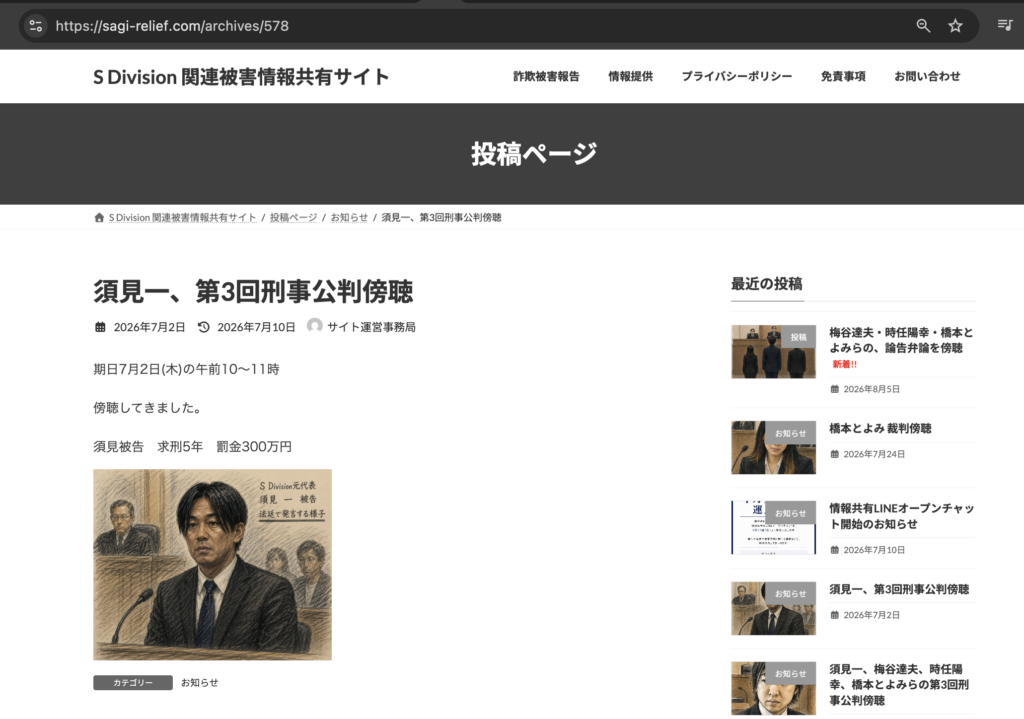
Sources: Securities and Exchange Surveillance Commission, S Division Related Victim Information-Sharing Site, report on Sumi’s July 2 hearing, Fujimori Katsumi Law Office