
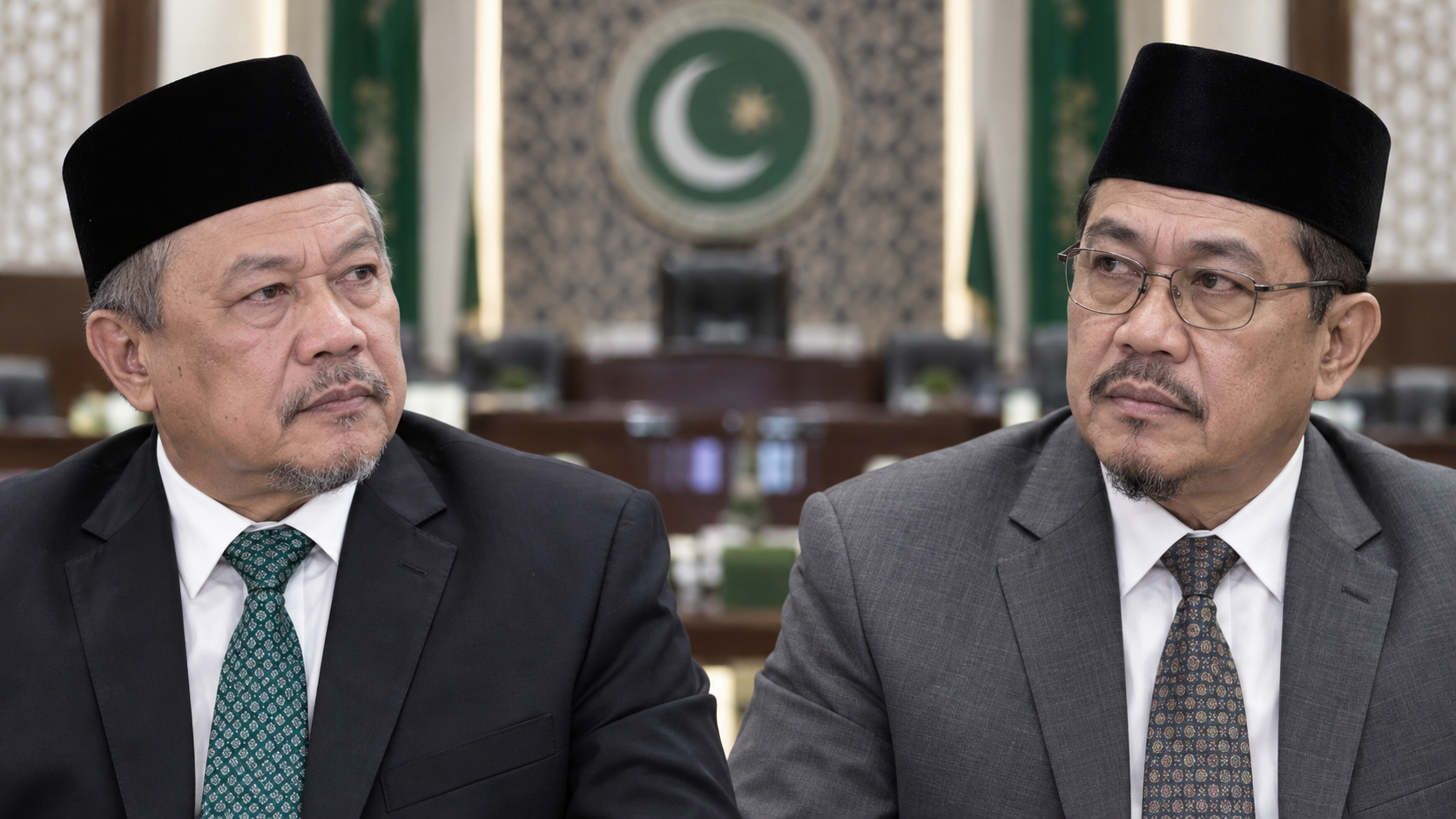
1. Bangsamoro Federal Party (BFP)
The BFP, centered on interim Chief Minister Abdulraof Macacua, became the largest party with 31 seats.
However, it falls 10 seats short of the 41 needed for a majority. It therefore appears to currently be exploring
- Cooperation with third-force blocs such as the BARMM Grand Coalition
- Bringing in district representatives and sectoral representatives
- A “former-MILF grand coalition” with the UBJP
one of these paths.
Macacua currently holds the office of Chief Minister and controls the administrative apparatus, giving him something of an edge in the selection process. At the same time, since he was originally appointed interim Chief Minister by President Marcos, he is seen as “the candidate closest to the national government.”
2. United Bangsamoro Justice Party (UBJP)
The UBJP, led by MILF Chairman Al Haj Murad Ebrahim, holds 30 seats — just one behind the BFP.
The UBJP is the mainstream MILF-descended party that concluded the 2014 peace agreement, and it is expected to place
- Full implementation of the peace agreement
- Decommissioning and reintegration of MILF combatants
- Strengthening Bangsamoro autonomy
at the center of its coalition talks.
The UBJP is also 11 seats short on its own. It will therefore need either a coalition with a third force or reconciliation with the BFP. There has been no official announcement yet as to whether Murad himself will stand as the Chief Minister candidate or whether the UBJP will put forward a different member.
3. BARMM Grand Coalition (BGC)
The BGC won roughly 20.5% of the party-list vote and is currently the most closely watched bloc, holding what amounts to the deciding “swing vote.” If the BGC backs the BFP, a continuation of the Macacua administration becomes the likely outcome. If it sides with the UBJP, the Murad camp could reverse the balance and take power.
That said, the BGC is a coalition that includes influential local politicians and traditional political clans, so its members are not necessarily unified as a single bloc. The allocation of posts — Chief Minister, Deputy Chief Minister, Speaker, and key ministries — is expected to be a central point of negotiation.
The Three Most Likely Scenarios at This Point
- A BFP + BGC-led coalition
Macacua would likely remain Chief Minister, and a stable relationship with the national government could be maintained. - A UBJP + BGC-led coalition
The mainstream MILF would reclaim power, forming a government that places strong emphasis on the peace agreement and the decommissioning issue. - A BFP + UBJP grand coalition
This could heal the rift within the former MILF and would be the most desirable outcome for the stability of the peace process — though negotiations over the Chief Minister, Speaker, and cabinet posts would be extremely difficult.
If scenario 3 — a grand coalition between the Bangsamoro Federal Party (BFP) and the United Bangsamoro Justice Party (UBJP) — comes to pass, peace in this region will be sustained, and the Government of Japan and JICA will be able to continue their support at every level, just as they have done to date.
コメント