
— Why Double-Selling Is Difficult in the Philippines —
Introduction
Anyone involved in Philippine real estate transactions — condominiums in particular — frequently feels how different the system is from Japan’s land registration system. The Philippine registration system, known as the Torrens System, is built on a fundamentally different concept from Japan’s: the Certificate of Title itself carries extremely strong legal force. This article lays out the features of the Torrens System in contrast with Japan’s registration system, and also discusses the practical operation of foreign ownership restrictions and recent legislative developments.
What Is the Torrens System? — How It Differs from Japan’s “Perfection Requirement” Approach
Japanese real estate registration is legally based on a concept known as the “perfection requirement” (taikō yōken shugi). Registration is merely a means of asserting ownership — already established between the parties — against third parties; even if the register’s contents diverge from the true state of the rights, the state does not guarantee their accuracy (there is no “public faith,” or kōshinryoku). Put in extreme terms, in Japan there remains, in theory, a possibility that a transaction made in reliance on the register could later be overturned by the emergence of the true rights holder.
The Philippine Torrens System, by contrast, is one in which the state guarantees that the registered rights holder is the true rights holder. Once registered as a Torrens title, that right is, in principle, indefeasible, and cannot be lost through adverse possession. In other words, a third party who transacted in reliance on the register (and the Certificate of Title) is, in principle, protected. This high degree of trust placed in registration is the concept underlying Philippine real estate transactions, in stark contrast to Japan’s system.
The Certificate of Title as a “Security Document”
In Japan, the contents of a real estate registration can be obtained by anyone at any time as a Certificate of Registered Matters (a copy of the register) — it is, in a sense, merely a “copy of information.” There is no physical “certificate” that embodies the right itself.
In the Philippines, on the other hand, the Registry of Deeds issues an Owner’s Duplicate Certificate of Title — an official document issued by the Land Registration Authority (LRA). This is not merely a copy of a certificate but a document with the character of a security instrument that embodies the right itself, and presenting and safekeeping the original is treated as critically important in transactions and when setting up loan collateral. The sense that “whoever holds the title certificate is the rights holder” is a concept largely absent from Japanese registration practice.
The Title Chain — A Structure That Discourages Double-Selling
This is where the existence of the title certificate comes into play, through what is known as the “title chain.” In the Philippines, when registering a transfer of real estate ownership, the original Owner’s Duplicate Certificate of Title held by the previous owner must be submitted to the Registry of Deeds and formally cancelled before a new certificate in the buyer’s name — a Transfer Certificate of Title (TCT), or a Condominium Certificate of Title (CCT) for condominiums — can be issued.
In other words, the system strictly maintains a single unbroken chain: no new certificate can come into existence unless the previous one is invalidated first. This makes it structurally difficult for so-called double-selling to occur — where multiple valid certificates exist simultaneously for different buyers of the same property. Unlike Japan’s system, where registration is essentially just a matter of rewriting an entry in the register, the Philippine process involves physically recovering and invalidating the certificate itself, making it a design that more readily ensures the uniqueness of the right.
That said, this is the system’s theoretical design, and cases of forged title certificates or fraudulent registrations involving Registry of Deeds staff are not unheard of. In practice, obtaining a Certified True Copy from the Registry of Deeds and individually verifying the authenticity of a property’s title certificate remains an indispensable step.
A Condominium Has Only a Single Title Certificate
In Japanese condominium registration, even though the registration of the exclusively-owned unit and the registration of the land-use right (the shared interest in the land) are treated together in practice through a mechanism called “land-rights unification” (shikichiken-ka), the system itself is structured as a combination of two separate rights: the sectional ownership of the building and the right to use the land.
In the Philippines, this is simplified. Once registration of a sectional ownership interest is complete, the Land Registration Authority issues a single Condominium Certificate of Title (CCT) per unit — and only one. This single CCT consolidates and represents both the right to the exclusively-owned unit and the equivalent shared interest in the land and common areas held through the Condominium Corporation. It can be described as a simple structure in which the title certificate is not split across multiple documents.
The Concept of a “Condominium with Land Attached”
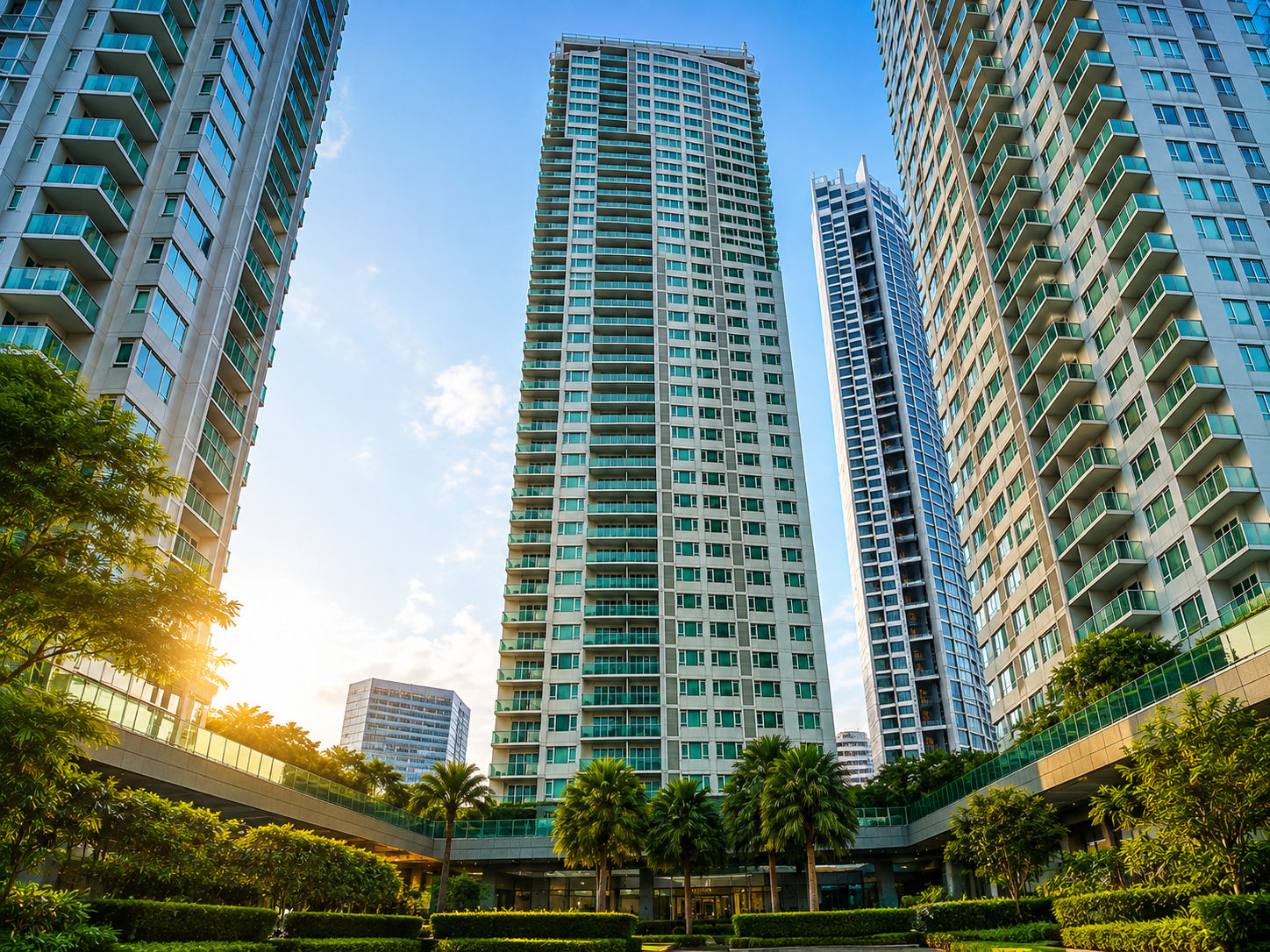
It may come as a surprise from a Japanese perspective, but a Philippine condominium is, by legal design, real estate “with land attached.” Despite the constitutional restriction that foreigners cannot directly own land as individuals, foreign ownership of condominium units is permitted because the condominium as a whole (the building and its land) is treated as a single “juridical entity” — the Condominium Corporation — and a foreigner’s holding of a share in that corporation (i.e., sectional ownership of each unit) is treated as falling outside the land-ownership restrictions under the Constitution and foreign investment law.
Holding a CCT, therefore, is not merely an exclusive right to a volume of space in legal structure — it means holding a right integrated with the land itself, carrying a shared interest in the underlying property. One cannot own the land directly, but does hold a right indirectly connected to the land through the Condominium Corporation — this is the concept underlying the Philippines’ scheme for foreign real estate ownership, and it needs to be understood accurately.
The Balcony as Exclusively-Owned Space
Another point that surprises those accustomed to Japanese condominium practice is the treatment of balconies. Under Japan’s Act on Building Unit Ownership and standard management regulations, a balcony is legally a “common area,” and unit owners are granted only an “exclusive-use right” over it. Because balconies also function as emergency evacuation routes, unauthorized renovations or the installation of storage units are restricted and require approval from the management association — for this same reason.
In Philippine condominiums, by contrast, the balcony is generally treated as private area. It is customarily included in the unit’s Net Saleable Area and is subject to the buyer’s full ownership and use. The absence of Japan’s intermediate concept — “common area, but exclusive use is permitted” — with the balcony instead simply treated as “one’s own,” can be said to symbolize the difference in how the two countries conceive of sectional ownership.
The “Official Rule” of the 40% Foreign Ownership Cap and the Reality of the Secondary Market
The Condominium Act (Republic Act No. 4726) restricts foreign ownership in a single condominium building to less than 40% of the total floor area. This restriction is applied relatively strictly at the pre-selling (new-build) stage. Developers manage the foreign sales quota, and compliance with the 40% cap is checked both when registering with the Housing and Land Use Regulatory Board (now under the DHSUD) and when registering a transfer of title with the Registry of Deeds.
The problem lies in the secondary (resale) market. Expert analysis has pointed out that “enforcement gaps” exist in tracking and managing foreign ownership ratios, particularly in unregistered provincial projects or properties where the Condominium Corporation’s own management is weak. In older buildings, or properties where the management association’s (Condominium Corporation’s) record-keeping is sloppy, it is not uncommon for the current foreign ownership ratio to be inaccurately tracked. As a result, even though the 40% rule nominally exists, how strictly it is actually enforced varies from property to property — this is the practical reality on the ground. Of course, deliberate circumvention using dummy (nominee) arrangements is a serious offense subject to criminal penalties under the Anti-Dummy Law, and must be clearly distinguished from this issue. This should instead be understood as an operational challenge — namely, that a gap tends to emerge between the system’s official rule and actual management practice at older properties.
For buyers, the remaining foreign quota on a new-build property can be confirmed directly with the developer, but when purchasing a resale unit, individually verifying the current foreign ownership ratio through the Condominium Corporation (management association) or a broker becomes even more important than it is in Japanese resale condominium transactions.
Recent Changes in Real Estate Law — Extended Land Lease Terms for Foreigners
Finally, a word on recent legislative changes. Under the Investor’s Lease Act (Republic Act No. 7652), foreign investors leasing private land in the Philippines were previously limited to an initial lease term of 25 years in principle, up to 50 years even with investment registration, and a maximum of 75 years total including renewal.
This changed significantly in 2025 with the amendment of the Investor’s Lease Act under Republic Act No. 12252. For approved and registered investment projects, lease terms of up to a total of 99 years are now permitted. A period of 99 years effectively enables asset management spanning three generations; while direct land ownership remains impossible, the aim is to offer foreign capital de facto stability of land use approaching that of a very-long-term surface right.
Alongside this, related legislation has been enacted in quick succession, including the ARROW Act (Accelerated and Reformed Right-of-Way Act), which speeds up the process of acquiring land for public works, and the Real Property Valuation and Assessment Reform Act (Republic Act No. 12001, 2024), aimed at fair market valuation. These reflect the government’s evident intent to shore up an office and condominium market that had languished amid the pandemic and the withdrawal of POGOs (Philippine Offshore Gaming Operators). It should be noted, however, that all of these reforms enhance the stability of leasing and using land — the fundamental principle set out in the 1987 Philippine Constitution, prohibiting outright land ownership by foreigners, remains unchanged.
Conclusion
A powerful title certificate grounded in the Torrens System, prevention of double-selling through the title chain, and a condominium system built on the concept of being “attached to land” — all of these are constructed on a logic different from Japan’s registration system, which is based on the perfection-requirement principle. This is a field where bringing in Japanese assumptions unchanged can easily lead to misunderstanding, and careful, property-by-property verification is essential, particularly on points prone to a gap between the system’s official rule and actual practice, such as foreign ownership ratios in resale condominiums. Understanding the institutional features of Philippine real estate correctly — while also taking account of recent legislative developments such as the 99-year lease — can be said to be the first step toward a safe transaction.
Sources: Philippine Supreme Court jurisprudence (Matthews v. Taylor, Hulst v. PR Builders), Republic Act No. 4726 (Condominium Act), Republic Act No. 7652 (Investor’s Lease Act), Republic Act No. 12252, Republic Act No. 12001 (Real Property Valuation and Assessment Reform Act), the Land Registration Authority, Japan’s Ministry of Land, Infrastructure, Transport and Tourism “Overseas Construction and Real Estate Market Database,” Mercury General Law Office, One Asia Lawyers, and various industry commentary.
コメント