
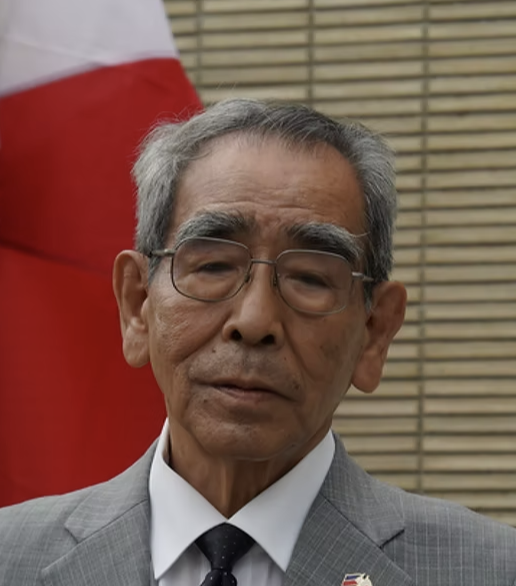
Pinoy-Hapon United Foundation (PHUF), a non-profit organization, Honorary Chairman Takeshi Asanuma
On August 15, 1945 (Shōwa 20), our country was defeated by the United States, but the American assault on the home islands had already grown ferocious from around March of that year. Saipan and Iwo Jima had fallen into American hands, Okinawa was near death, and the mainland was bombarded day and night. The Combined Fleet was wiped out. I later heard that the new “Shiden-Kai” fighter planes were putting up a fight, but it seems Japan had lost almost all control of the skies by then.
On March 10, the Great Tokyo Air Raid struck — even the Imperial Palace was hit — and an estimated 100,000 residents, mostly around the Sumida River area, lost their lives. On March 13, the Great Osaka Air Raid came, and our own house was burned out. On June 15, the Sakai and southern Osaka air raid followed. Around that same period, major Japanese cities such as Nagoya and Yokohama were reduced to burnt-out fields. On August 6, the atomic bomb was dropped on Hiroshima, and on the 9th, on Nagasaki — together claiming more than 200,000 lives — and the Soviet Union declared war on Japan. By the Emperor’s decision, Japan surrendered on August 15.
On September 2, Supreme Commander for the Allied Powers General Douglas MacArthur landed at Atsugi Airfield, and the occupation of Japan began.
On September 27, His Majesty the Emperor, without any guards at all and accompanied only by a single interpreter, visited Supreme Commander MacArthur at the U.S. Embassy in Akasaka for a meeting.
“The responsibility for this war rests entirely with me, as Supreme Commander. Both the military and civilian officials carried out policy and the war at my command, and the full responsibility is mine. I will submit to whatever decision you make. However, the people are suffering from a severe food shortage. I ask that you help them — I will pay the cost from my own personal assets.”
So it is said he spoke, and General MacArthur was deeply moved, remarking, “I have met a true gentleman.” When His Majesty arrived, MacArthur reportedly received him seated in his office, but when he departed, MacArthur went out of his way to see him off courteously all the way to the entrance.
MacArthur, who had assumed the Emperor would come merely to beg for his life, is said to have been deeply moved by His Majesty’s resolve and sense of responsibility.
At General MacArthur’s request, large quantities of food were soon sent from the United States and distributed to schools and individual households — the so-called LARA relief supplies. Of course, the United States did not charge for them.
It seems the two men built a relationship of trust from that point on. Calls within the United States and among some of the victorious powers to prosecute the Emperor as a war criminal were set aside on General MacArthur’s own recommendation. Records show that the two of them met more than a dozen times before MacArthur was relieved of his command and returned home in April 1951.
When the General returned home, the American public gave him a tremendous welcome. In New York, tens of thousands turned out for a victory parade, with confetti raining down from the skyscrapers. There was even talk of him becoming the next President, but when he was called before a Senate hearing, he testified that “the war just fought was not a one-sided war of Japanese aggression — it was a war of self-defense for Japan.” This is said to have turned American public opinion against him, and he faded from consideration as a presidential candidate. Was he not, after all, someone who truly understood Japan?
His own father, Lieutenant General Arthur MacArthur of the U.S. Army, had likewise, after serving as military attaché in Manila, crossed over to the continent during the Russo-Japanese War as a military observer attached to the Japanese Army’s positions. He received a large ceramic sake cup from Emperor Meiji as a gift, and the General is said to have displayed it in his office at the Manila Hotel — but it went missing when Japanese forces advanced into Manila in January 1942.
Soon after the defeat, the occupation forces requisitioned surviving buildings all over Osaka as well. The Japanese Red Cross Hospital in Shimoajihara-chō became a U.S. military hospital, and part of the former barracks of the 8th Regiment near Osaka Castle became another Japanese Red Cross Hospital. In February 1947 (Shōwa 22), I was in my second year of elementary school. I came down with a severe case of appendicitis and had surgery at this Japanese Red Cross Hospital, staying in the hospital for a full month. I was told my life was saved by penicillin my father managed to obtain on the black market. I still carry two large scars on my stomach to this day.
コメント