
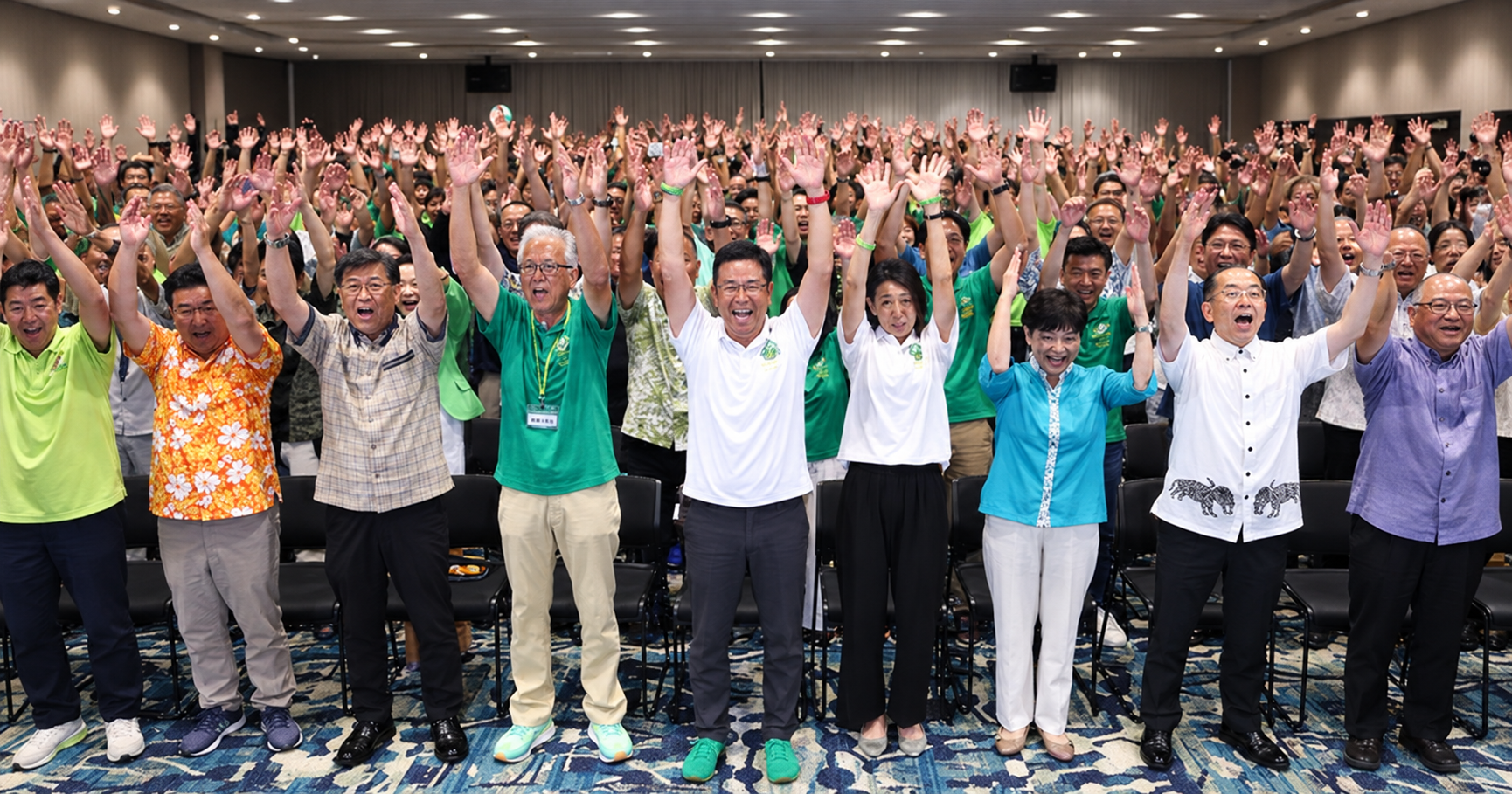
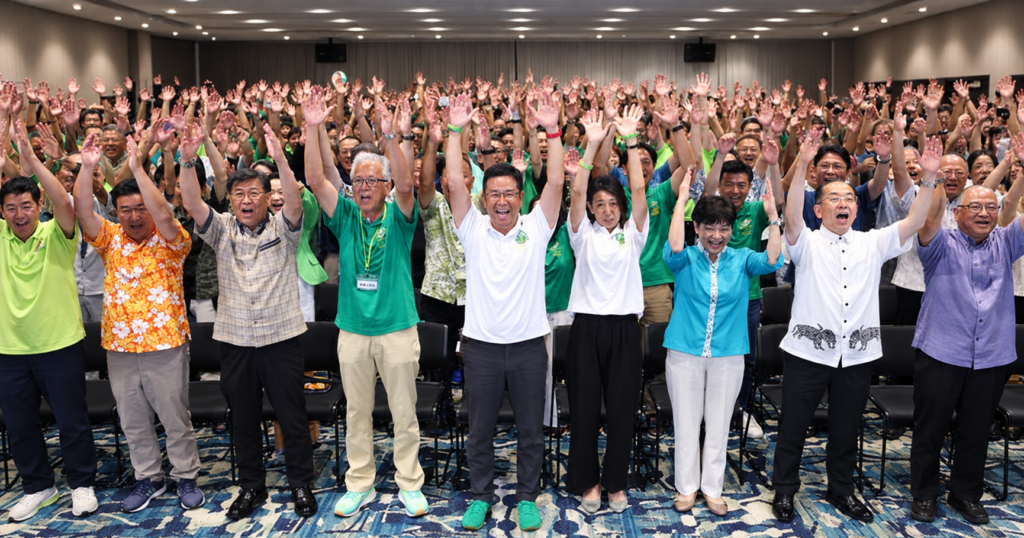
Voting and vote-counting for the Okinawa gubernatorial election, held upon the expiration of the incumbent’s term, took place on September 13. Genta Koja (42), an independent newcomer and former deputy mayor of Naha, won his first term with 423,124 votes. Incumbent Governor Denny Tamaki (66), who was seeking a third term, garnered only 276,060 votes, a gap of roughly 147,000 votes. Koja’s share of the vote was 59.42%, against Tamaki’s 38.77%.
The other candidates received the following totals: Shun Kaneshima, 4,657 votes; Takashi Higa, 3,542 votes; Chosuke Yara, 2,467 votes; and Masahiro Sueyoshi, 2,270 votes. Koja finished first in all 41 municipalities, making it a landslide victory in the truest sense. The total number of valid votes was 712,120. Voter turnout was 61.57%, up 3.65 points from 57.92% in the previous election in 2022.
Koja was endorsed by the Liberal Democratic Party, the Japan Innovation Party, the Democratic Party for the People, Sanseito, the Japan Conservative Party, and the Okinawa Prefectural chapter of Komeito. His victory was declared virtually the instant polls closed at 8:00 p.m. — a so-called “zero-count” call — settling the outcome before vote counting had even begun.
This election result went beyond a simple rebuke of the incumbent; it amounted to a clear verdict from Okinawan voters against the “All Okinawa” coalition government that had held power since 2014. It marks the first time in twelve years that a conservative-aligned candidate has taken the governorship, and signals a shift in Okinawan prefectural politics — away from a stance centered on confrontation with the national government, and toward a course of cooperation aimed at economic promotion and reducing the burden of U.S. military bases.
The first reason cited for Koja’s victory is that he successfully shifted the election’s focus from the base issue to daily life and the economy. Koja pledged to “double per-capita prefectural income within ten years” — income that currently ranks among the lowest in the nation — and put front and center policies such as industrial promotion in partnership with the business community, expanding tourism spending, fostering digital and AI industries, and doubling support for child-rearing.
Pre-election surveys conducted by the Ryukyu Shimpo and other outlets likewise found that 46.9% of voters ranked “the economy, employment, and measures against rising prices” as the policy area they cared most about, far outstripping the 16.6% who prioritized “the base issue and security.” It is believed that the demand for solutions to problems bearing directly on daily life — rising prices, low wages, child poverty, chronic traffic congestion — translated into support for Koja.
The second factor behind his win was the unification of the conservative vote. In the previous gubernatorial election in 2022, two conservative-aligned candidates, Atsushi Sakima and Mikio Shimoji, both ran, splitting the vote. This time, Shimoji withdrew from the race and threw his support behind Koja, allowing conservative and centrist forces to consolidate.
Mid-campaign polling by the Okinawa Times and others found that Koja had already secured roughly 80% of LDP-affiliated voters, and had made inroads among supporters of Komeito and Sanseito as well. A separate Okinawa Times survey of the mayors of all 41 municipalities in the prefecture found 29 in support of Koja and only 6 in support of Tamaki — evidence that a broad support network among local leaders and the business community had formed at an early stage.
Third, voters responded well to Koja’s youth and his administrative experience. After graduating from the University of Tokyo, Koja joined the Ministry of Internal Affairs and Communications, where he served in posts including chief of the finance division of Nagasaki Prefecture. Having also gained experience in local government as deputy mayor of Naha, he campaigned as a hands-on, practical candidate capable of bridging the national government, the prefecture, municipalities, and the business community, promising to reform prefectural governance. He made active use of social media, broadening his support beyond the traditional conservative base to include younger voters and independents as well.
Tamaki, for his part, campaigned on his eight years of experience across two terms and his name recognition, maintaining his firm opposition to the new base construction at Henoko. However, as construction work on the Henoko relocation has continued to advance, it has become increasingly difficult to unify Okinawan voters around the base issue alone. The capsizing accident involving a protest boat off Henoko in March, which prompted a reconsideration of how the anti-base movement should conduct itself, may also have affected Tamaki’s base of support.
The Ryukyu Shimpo reported that this was the first time the “All Okinawa” coalition, formed in 2014, had been defeated in a prefecture-wide election, including a gubernatorial race. The Yaeyama Nippo, framing the result as “conservative prefectural government reclaimed after twelve years” and “a landslide win by a margin of roughly 150,000 votes,” characterized the outcome as the end of the “All Okinawa” administration. Though the two papers differ in their political leanings, they agree that the framework of Okinawan politics that had persisted for twelve years has now fundamentally changed.
After his victory was confirmed, Koja declared his resolve “to take in the full range of feelings held by Okinawa’s 1.46 million residents, and to move Okinawa forward by overcoming conflict and division.” Going forward, he will need to advance the Okinawa promotion budget and the reuse of former base land through cooperation with the national government, while also remaining mindful of the roughly 280,000 voters who opposed the Henoko relocation.
Doubling prefectural income, the goal he campaigned on, is not an easy target that prefectural government can achieve on its own. Whether he can translate tourism revenue into household income, raise the productivity and wages of small and medium-sized enterprises, and narrow regional disparities, including those affecting the outlying islands, remains to be seen. Having won a substantial political mandate through his landslide victory, Governor-elect Koja now bears the responsibility of turning his campaign promises into concrete results.

コメント