
Pinoy-Hapon United Foundation (PHUF), a non-profit organization, Honorary Chairman Takeshi Asanuma
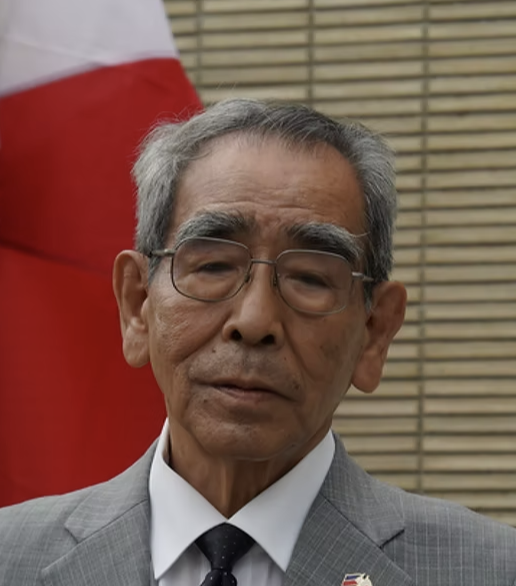
On June 15, Shōwa 20 (1945), my brother died in an American bombing raid during the Greater East Asian War. He was a third-grader at national school, nine years old. It happened right before my eyes. I was seven, a first-grader, at the time. Eighty-one years have passed since then, and now, at eighty-eight, I find myself dwelling deeply on the short years I spent with my brother.
My brother entered kindergarten in April of Shōwa 17 (1942), when I was four. I remember my mother taking me along to attend his entrance ceremony. Looking back on it now, ours was a short time together as brothers.
From as early as I can remember, I tagged along after my brother and he would play with me. Our family was a large household at the time: my great-grandmother, grandparents, parents, and two boys, with a baby sister born in October of Shōwa 17 (1942), plus two live-in maids — quite a number of people altogether — living in Ikutama-maecho, Tennoji Ward, Osaka City. We had a proper gated entrance, a front and back garden, and a two-story house. Next door was a temple called Eigen-ji, where a family had two brothers — a second-year junior-high student and a fifth-grader at national school — but they were somewhat older than us, and with no children our own age or cousins nearby, I always relied on my brother to play with me.
My mother’s constant refrain to my brother was, “Look after your little brother.” The two of us used to catch bugs in the back garden and dig holes to play at being soldiers.
My brother was clever, and seems to have done well once he started school; he taught me all sorts of things. After he entered kindergarten in April of Shōwa 17, he taught me, one after another, the nursery songs he had learned there — “Rain, Rain, Fall, Fall,” “A Secret Story,” “Why Does the Crow Cry,” “Mr. Seagull Sailor,” “The Cradle Song,” and more. At the time, both on NHK radio and among the adults around us, it was military songs, patriotic anthems, and morale-boosting war songs that filled the air — so even to my child’s ear, the nursery songs my brother sang for me stayed pleasantly with me, and I often hummed them to myself.
My brother was quiet and self-reliant, while I was something of a mischievous child, but whenever I got into trouble he always stood up for me — I have no memory whatsoever of the two of us quarreling.
On the afternoon of June 15, the great air raid struck Sakai and southern Osaka, with wave after wave of B-29 bombers. Our home was in the countryside, about 12 kilometers from that area, but even so, incendiary bombs occasionally fell on nearby fields and roads and started fires. Some incendiaries apparently even punched through roofs, but since the area wasn’t densely built up, no major fires broke out.
In a field near our house, my brother took a direct hit from an incendiary bomb. It pierced through from his back to his abdomen, his internal organs spilled out, and his body was bent double. My mother, rushing to him, called his name, and he is said to have faintly opened his eyes — but he was, in effect, killed instantly. My mother, trying to save him, was herself burned, and followed my brother in death about two months later. They were both victims of that Greater East Asian War.
Now, having reached old age in a foreign land, I find myself dwelling deeply on my gentle mother, and on my brother as a small child, singing “The Cradle Song” together with me.
コメント