

MANILA NEWS DAILY
That War and Me (25) Santo Tomas University
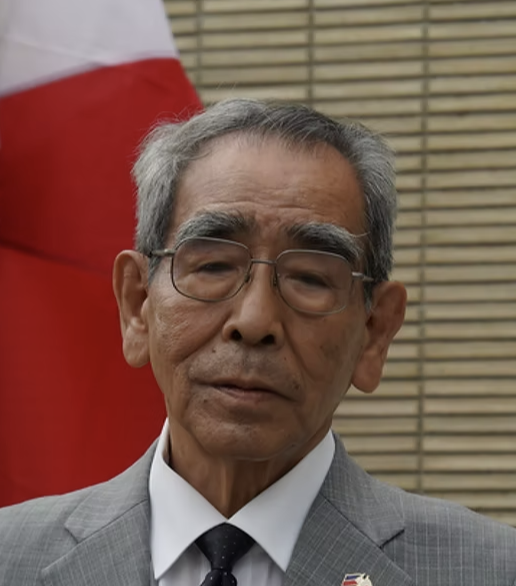
Pinoy-Hapon United Foundation (PHUF), a non-profit organization, Honorary Chairman Takeshi Asanuma
From December 1941 until August 1945, the “Imperial Japanese forces” and the “American forces” fought fiercely on this “island of Luzon and the surrounding islands (present-day Republic of the Philippines).” It is said that “520,000 Japanese army and navy personnel” died in battle and “1,000,000 local people” were caught up in it and lost their lives, while “American” deaths are put at about 30,000. Why did such a huge difference arise?
I suspect there is some exaggeration in the figure of “1,000,000,” but it is a fact that a great many lives were lost and that the “old city of Manila,” once called the “Pearl of the Orient,” was destroyed.
Between the “Japanese and American forces” there was a large “gap” in the “view of soldiers’ lives” and in “equipment (destructive power).” “Not to live to suffer the shame of capture” was the basic belief of the “Japanese military,” whereas the “American forces” placed the highest priority on “the lives of their own soldiers.” In equipment too, the Americans held an overwhelming advantage in both quality and quantity. This was especially evident in the “Battle of Manila.”
The “American forces” avoided close combat as far as possible, emphasizing aircraft and artillery, and sent tanks ahead for close fighting. “Local guerrillas,” acting in concert with the Americans, made “hit-and-run attacks” from behind and from the flanks on the “Japanese forces” dispersed throughout Manila, throwing their defenses into confusion; but because the fighting was at close quarters, “prisoners,” including the wounded, kept appearing. The “Japanese forces” did not recognize them as “regular troops” and “disposed of” them after “improvised military trials” or sometimes without any “trial” at all, and these acts were treated in the postwar “war crimes trials” as “mistreatment of prisoners and murder of civilians,” for which many “Japanese officers and men” were condemned.
The “American forces” that pushed into the city closed in on “old Manila” and the adjoining commercial district, but the “Japanese forces” barricaded themselves in the stone government-office district and nearby concrete buildings and resisted fiercely. If the Americans spotted even a few Japanese soldiers, they did not attack at close range but destroyed the buildings completely with air raids and artillery, ignoring the presence of local people living in them, and many “residents” were caught up and lost their lives. Was this “white supremacy” that looked down on “people of color”? . . . The “old city area” was completely destroyed.
”Rear Admiral Sanji Iwabuchi, commander of the Manila Defense Force,” sent a “farewell telegram” on February 25 and took his own life. The Japanese garrison on Corregidor, having lost its command structure, was also nearly annihilated, and the “remnant soldiers,” said to number more than 5,000, each escaped toward the “southeast of Manila.” The “naval landing force” on the “Corregidor fortress” was also wiped out. “General MacArthur” declared the “liberation of Manila” on March 3.
Now, to “Santo Tomas University.” In January 1942, the “Japanese military headquarters” that had occupied “Manila” requisitioned the “university” located north of the city and made it a facility for interning civilians, such as “Americans and British,” holding about 4,000 people in all (including women and children) as the “Santo Tomas Internment Camp”; as space ran short, tent facilities were also set up on the school grounds.
”General MacArthur,” who landed at “Lingayen” in January 1945, ordered part of the “American forces” advancing south to go ahead to the “Santo Tomas camp” and free the “internees” as quickly as possible.
A company guided by “guerrillas” reached the “university’s main gate” on the evening of February 3. A tank broke through the iron main gate, but a Japanese officer resisted and was killed. The “commander,” having confirmed that a considerable number of “guards” were present, gave priority to the safety of the “American and British civilians” and halted the attack. On the 4th he negotiated with the “Japanese commander, Lieutenant Colonel Toshio Hayashi.” They agreed on the “release of the internees” and the “withdrawal of the Japanese soldiers, lightly armed.” On the 5th the “internees” were freed.
Under the Lieutenant Colonel’s command, several dozen of the “guards” formed an armed column and left through the main gate. American soldiers guaranteed their safety and accompanied them, and about one kilometer on, the “Japanese soldiers” withdrew to the south, but Lieutenant Colonel Hayashi was later killed in an engagement with guerrillas.
A photograph survives of the “Japanese guard unit” leaving the “Santo Tomas camp” in orderly fashion.