
Why Did Japan Engage in the Bangsamoro Peace Process? — From the MNLF Peace Agreement to the Launch of J-BIRD (Japan-Bangsamoro Initiatives for Reconstruction and Development)
Why did the Japanese government come to be so deeply involved in the Mindanao conflict, which lasted more than 40 years in the southern Philippines?
Japan was not a party to the fighting between the Philippine government and the rebel groups. It had no treaty obligation to defend the Philippines, nor did it deploy its Self-Defense Forces to Mindanao to suppress armed groups.
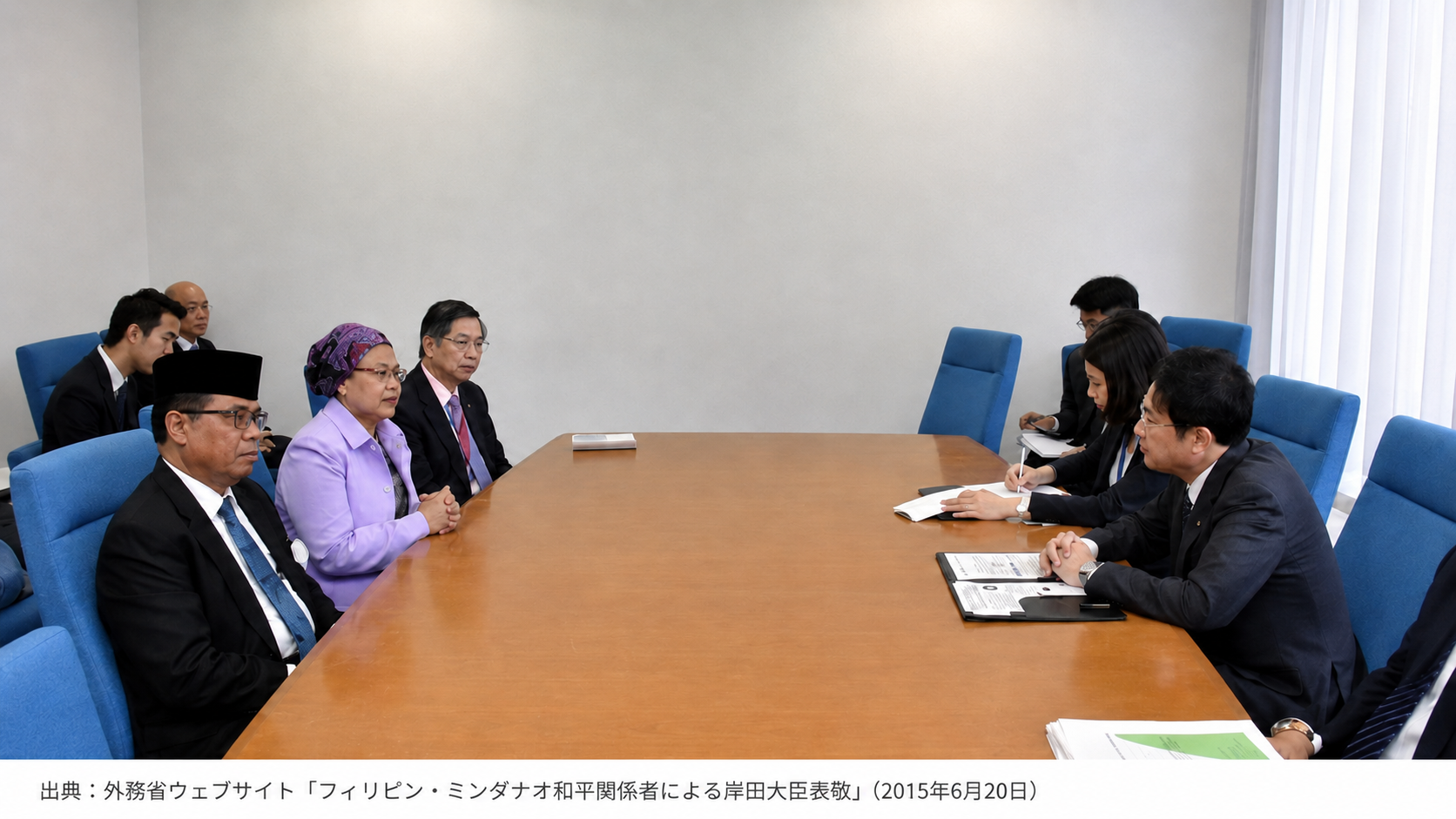
And yet, the Japanese government and the Japan International Cooperation Agency (JICA) entered the conflict zone even before peace negotiations were complete, building schools, health centers, wells, and farm roads. They also made contact with both the Philippine government and the Moro Islamic Liberation Front (MILF), and later became involved in ceasefire monitoring and the peace negotiations themselves.
Behind this lay not only humanitarian concern but also Japan’s national interests: stability in Southeast Asia, diplomatic relations with the Philippines, Japan’s sea lanes, and preventing the spread of Islamist extremism.
The method Japan chose was not military intervention, but “human security” — reducing the reasons people return to conflict through development assistance.
What Was the Bangsamoro Conflict?
Bangsamoro refers to the historical and political community centered on the Muslim population of the southern Philippines.
In western Mindanao and the Sulu Archipelago, Islamic political communities such as the Sultanate of Sulu and the Sultanate of Maguindanao existed even before Spanish colonial rule of the Philippines.
However, from the period of American colonial rule through the years after Philippine independence, the land system and population composition changed dramatically.
As Christian settlers migrated from Luzon, the Visayas, and elsewhere, Moro residents and indigenous peoples who could not adapt fully to the modern land registration system lost the land they had traditionally used.
Compounded by political marginalization, poverty, religious and cultural conflict, and human rights abuses by government troops and militias, the Moro nationalist movement escalated into armed struggle from the late 1960s.
The first large-scale armed organization was the Moro National Liberation Front (MNLF), led by Nur Misuari.
The MILF later split off from the MNLF and continued fighting the Philippine government. The conflict is estimated to have killed roughly 150,000 to 160,000 people and displaced a cumulative total of more than two million.
Japan’s Involvement Began After the MNLF Peace Agreement
The first opportunity for the Japanese government and JICA to become involved in the Mindanao peace process came with the 1996 Final Peace Agreement between the Philippine government and the MNLF.
Under this agreement, the mainstream MNLF shifted from armed struggle to political participation and took part in governing the former Autonomous Region in Muslim Mindanao (ARMM).
Japan was one of the countries that supported post-agreement reconstruction and regional development at an early stage.
The 1996 agreement, however, did not end the Mindanao conflict as a whole.
The MILF, having split from the MNLF, continued its armed struggle against the government. Supporting peace with the MNLF alone would not bring peace to the region as a whole if fighting with the MILF continued.
The Japanese government gradually came to believe that supporting reconstruction only after a peace agreement was concluded was not enough, and that it needed to engage in regional development even while peace negotiations were still ongoing.
Timeline to the Start of Japan’s Involvement
- 1996 — Government and MNLF sign the Final Peace Agreement / Japan joins reconstruction and development assistance
- 1997–2000 — Fighting with the MILF continues / Japan surveys Mindanao’s poverty and conflict structure
- 2000 — The Estrada administration launches a major offensive on MILF strongholds / The limits of a military solution become clear
- 2001 — The Arroyo administration and the MILF resume peace talks / Japan introduces the “Mindanao Support Package”
- 2002 — Peace talks proceed under a ceasefire / JICA begins full-scale peace and development support
- 2003 — After clashes between the military and the MILF, the ceasefire is rebuilt / Japan emphasizes continuity across humanitarian, reconstruction, and development aid
- 2004 — The International Monitoring Team (IMT) is established / Japan considers joining the ceasefire monitoring effort
- 2006 — The international framework for peace support expands / Japan launches J-BIRD and sends development experts to the IMT
Support from the Japanese government and JICA began incrementally in 1996, intensified in 2001–02, and by 2006 had grown into comprehensive peace support combining diplomacy and development.
Why Did Japan Get Involved in a Domestic Philippine Conflict?
To Prevent Instability Across Southeast Asia
The Japanese government has explained that peace and stability in Mindanao are essential not only for the Philippines but for the peace and prosperity of Southeast Asia as a whole.
Mindanao and the Sulu Archipelago sit in the waters linking the Philippines, Malaysia, and Indonesia.
Weak governance in a conflict zone makes cross-border movement of weapons, personnel, illegal drugs, and contraband easier. It also raises the risk that kidnapping gangs and extremists can operate by moving between the islands.
Since the September 11, 2001 attacks in the United States, attention has also grown on the links between Islamist extremists active in Southeast Asia and international terrorist organizations.
For Japan too, the waters around the Philippines are a vital sea lane supporting trade and energy shipments.
Instability in Mindanao also affects ASEAN’s economic growth, Japanese corporate investment, maritime logistics, and the safety of Japanese nationals.
Japan’s involvement in the Bangsamoro peace process therefore also had the aim of protecting Japan’s own security and economic interests through regional stability.
Because the Philippines Was an Important Diplomatic and Economic Partner for Japan
Japan and the Philippines share the grave history of the Japanese military’s occupation during World War II.
After the war, Japan rebuilt its relationship with the Philippines through reparations, economic cooperation, and official development assistance.
Japan went on to become one of the Philippines’ largest ODA donors, supporting the development of roads, railways, ports, electricity, and water systems over a long period.
To the Philippine government, Japan came to be seen not as a country that projects military power, but as one that continuously supports administration and infrastructure development.
Japan’s involvement in the Mindanao peace process was an extension of this long-standing Japan-Philippines relationship.
It was precisely because of this trust with the Philippine government that Japanese experts were permitted to enter a conflict zone with unstable security and make contact with the MILF side.
Sadako Ogata and “Human Security”
One figure essential to understanding Japan’s engagement with Bangsamoro is Sadako Ogata, who served as JICA’s president from 2003 to 2012.
Drawing on her experience as UN High Commissioner for Refugees, Ogata placed importance on “human security” — protecting each individual person, not just the state, from threats such as conflict, poverty, disease, and disaster.
Traditional security thinking centers on borders, territory, government, and the military.
But for the people of Mindanao, security meant more than that.
Even if the fighting stopped, life would not be stable without schools to attend, drinking water, roads to carry crops to market, or roads to reach a hospital.
Young people and former combatants who lost their livelihoods and could not sustain themselves risked rejoining armed groups.
Ogata’s approach was not to “begin development once a ceasefire is reached,” but to improve residents’ lives even during peace negotiations and build the social foundation that sustains peace.
In 2006, according to JICA records, Ogata told both the Philippine government and the MILF leadership that “development has a role to play in achieving peace in Mindanao.” JICA, “Peace and Development in Mindanao”
“Aid After Peace Is Reached” Comes Too Late
Ordinary reconstruction aid normally begins after a war or conflict has ended.
But the approach Japan took in Mindanao was different.
Even before a final peace agreement existed between the government and the MILF, Japan carried out the following projects in conflict-affected areas:
- School construction and repair
- Health center development
- Wells and water-supply installation
- Farm roads, minor roads, and bridge development
- Agricultural technical support, including rice farming
- Training for local governments and community leaders
- Participatory community development
This assistance had two purposes.
The first was to improve the lives of residents affected by the fighting.
The second was to give residents concrete proof that “life improves as peace progresses,” building support for the peace process.
The Japanese government thought of this as a “peace dividend.”
Even if peace negotiators draft an agreement, support for peace remains weak if ordinary residents feel no benefit from it. Conversely, once schools, wells, roads, and health centers are completed, residents can see that the ceasefire is relevant to their own lives.
Development assistance thus became a mechanism that supported the peace negotiations from below.
Why Was Japan Also Accepted by the MILF?
For JICA to operate in the conflict zone, it needed not only the Philippine government’s cooperation but also the understanding and security cooperation of the MILF.
The following factors are thought to explain why Japan earned a degree of trust from the MILF side:
- Japan was not a direct party to the fighting in the Moro conflict
- Japan did not get involved with the aim of militarily defeating the MILF
- Japan’s assistance covered Christians and indigenous peoples as well as Muslims
- Japan showed it was not siding solely with the government or the MILF
- Japan carried out projects, however small, that residents could use directly
- Japan continued its support over a long period
Japan did not recognize the MILF as the representative of an independent state.
At the same time, it did not dismiss the MILF as a mere criminal organization either, engaging with it instead as a party to the peace negotiations and a political organization with the potential to lead a future autonomous government.
Maintaining this delicate position was a distinctive feature of Japan’s approach.
Japan’s Wartime Responsibility Must Not Be Forgotten
In explaining Japan’s support for the Philippines, simplistic claims such as “Japan was trusted because it never colonized Asia” should not be used.
The Japanese military occupied the Philippines during World War II, and large numbers of civilians were killed in Manila and elsewhere. Mindanao was no exception.
Japan’s trust with the Philippines, therefore, did not exist from the start — it was rebuilt after the war through reparations, diplomacy, ODA, and people-to-people exchange.
For the Japanese government, cooperation with the Philippines was also part of improving relations with Southeast Asia and of its postwar diplomacy.
Support for Bangsamoro was not built by ignoring the past relationship between Japan and the Philippines — it was cooperation built over a long period on top of that history.
The 2001 Mindanao Support Package
In 2001, when peace negotiations between the Philippine government and the MILF resumed, the Japanese government introduced the “Mindanao Support Package.”
This marked a shift in which Japan began treating the Mindanao peace process as a whole, not just individual reconstruction projects, as a subject of its ODA policy.
From 2002, JICA also began in earnest to provide support with peace and development as explicit goals.
At this point, today’s BARMM did not yet exist. The old ARMM’s administrative capacity was weak, and there was no guarantee that peace between the government and the MILF would succeed.
Japan did not join in only after the outcome was assured.
It began its long-term involvement at a stage when peace still risked collapsing again.
2006: J-BIRD Begins
2006 was the year Japan’s involvement changed significantly.
That year, the Japanese government launched the “Japan-Bangsamoro Initiatives for Reconstruction and Development,” known by its acronym J-BIRD.
J-BIRD is a comprehensive framework bringing together the Japanese government and JICA’s projects to support peace and development in the Bangsamoro region.
It rested on three main pillars:
- Regional development — schools, health centers, water supply facilities, roads, and more
- Human resource development — training for local government officials, agricultural workers, and community leaders
- Poverty reduction — improving agriculture, livelihoods, and local industry
At the same time, Japan dispatched experts in socioeconomic development to the International Monitoring Team (IMT), which monitored the ceasefire between the Philippine government and the MILF.
Through this, Japan moved from being merely a funding country to a participating country supporting peace on the ground in the ceasefire zone.
Rather than carrying weapons to stop the fighting, JICA experts surveyed needs in the conflict zone and connected residents, local government, the Philippine national government, and the MILF.
This marked the true beginning of Japan’s “unarmed peacekeeping.”
Do Japan’s National Interest and Humanitarian Aid Conflict?
Japan’s support for Bangsamoro cannot be explained by pure goodwill alone.
Japan had national interests at stake: strengthening ties with the Philippines, ASEAN stability, counterterrorism, the security of its sea lanes, and the investment environment for Japanese companies.
But the presence of national interest does not negate the value of the assistance as humanitarian aid.
What matters is that Japan sought to advance its own interests not through military expansion, but through improving local residents’ lives, supporting peace negotiations, and building administrative capacity.
If the people of Mindanao can live safely, the regional economy develops, and political demands can be voiced in parliament rather than through weapons, it benefits the Philippines, Southeast Asia, and Japan alike.
This was a diplomacy that sought to align Japan’s interests with those of the Bangsamoro people.
Conclusion of Part 1
There is no single reason why the Japanese government came to engage with Bangsamoro.
- Conflict with the MILF continued even after the 1996 MNLF peace agreement
- Military force alone could not resolve the conflict
- Poverty and a lack of public services sustained the armed struggle
- Instability in Mindanao affected Southeast Asia as a whole
- The Philippines was an important diplomatic and economic partner for Japan
- Japan incorporated human security into its ODA policy
- Development assistance could be used as Japan’s own distinctive tool for peacebuilding
Japan did not choose to be a country that merely provided reconstruction funds after a peace agreement was completed.
It entered the ground even at a stage when negotiations might still fail, improving residents’ lives and building trust with both the government and the MILF.
That accumulated effort led to the launch of J-BIRD and participation in the International Monitoring Team in 2006.
Coming in Part 2
Part 2 will examine why Japan sent development experts, rather than military personnel, to the International Monitoring Team.
What were JICA experts doing in the conflict zone? Why does building schools, wells, health centers, and farm roads help sustain a ceasefire? And why did Japan not withdraw even after the 2008 collapse of peace talks and the resumption of fighting?
Part 2 will focus on J-BIRD and the “peace dividend” to examine Japan’s unarmed support for the ceasefire.
*This article is based on materials from the Japanese government, JICA, the Philippine government, and other sources available as of August 2026.
Main Sources
- JICA, “Peace and Development in Mindanao, Republic of the Philippines”
- JICA — Peace and Development Support in Mindanao
- Ministry of Foreign Affairs, “Japan’s Seamless Efforts for Peacebuilding”
- Ministry of Foreign Affairs, “Japan’s Contribution to Mindanao Peace Process”
- JICA Ogata Research Institute — Japan’s Engagement in the Mindanao Peace Process
- JICA — Comprehensive Capacity Development Project for Bangsamoro
コメント