
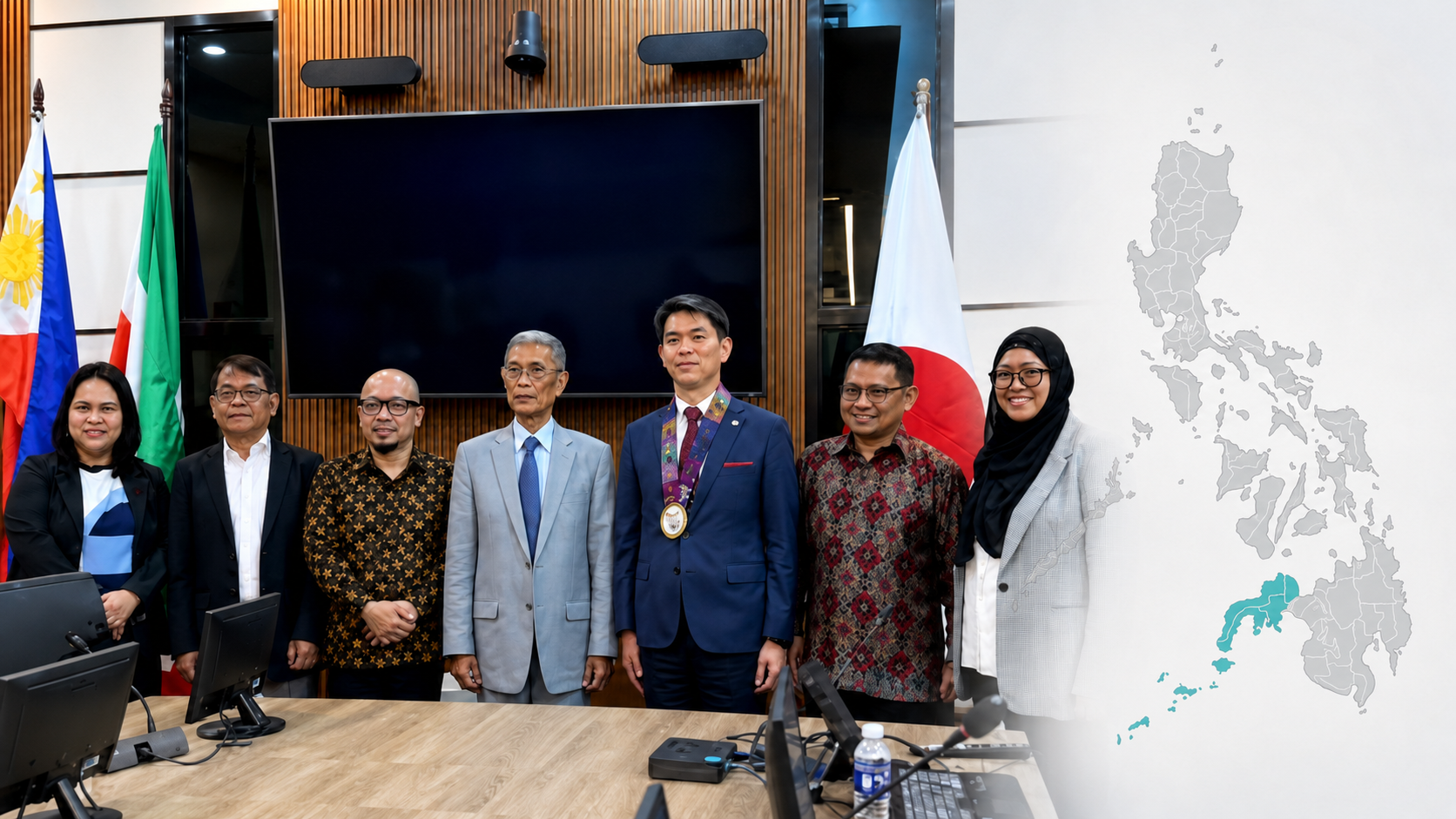
On September 14, 2026, the Bangsamoro Autonomous Region in Muslim Mindanao (BARMM), located on the island of Mindanao in the southern Philippines, will hold the region’s first-ever parliamentary election. After more than 50 years of conflict, roughly 12 years since the 2014 Comprehensive Agreement on the Bangsamoro, and about 7 years since the 2019 establishment of the Bangsamoro Transition Authority (BTA), a formal autonomous government directly elected by residents is finally set to be established. The road here has seen no fewer than four delays, and Japan’s International Cooperation Agency (JICA) has been deeply involved in the peace process for years in the role of “advisor.”
Delay After Delay — The Long Road to the Election
The election was originally scheduled for May 2022, but has since been postponed four times, as follows.
• First delay (2022 to 2025): The COVID-19 pandemic delayed enactment of the Bangsamoro Electoral Code, which was to define the electoral districts. Then-Interim Chief Minister Murad argued that three years was insufficient to restructure the autonomous government and led the push for postponement. Then-President Duterte signed the postponement bill in October 2021.
• Second delay (October 13, 2025 to undetermined): In September 2024, the Philippine Supreme Court ruled that Sulu province does not belong to the Bangsamoro Autonomous Region. This left the seven seats allocated to Sulu in limbo and necessitated redistricting. The Commission on Elections (COMELEC) decided to postpone the election to October 13, 2025, but enactment of the redistricting law continued to be delayed.
• Third delay: In September 2025, the Supreme Court issued an injunction against the new redistricting law (Bangsamoro Autonomy Act No. 77). Then, on October 1, the Court ruled both that law and the preceding BAA No. 58 unconstitutional, effectively voiding the election plans. The Supreme Court ordered COMELEC to hold the election by March 31, 2026.
• Fourth delay (March 30, 2026 to September 14): After a special session that ran late into the night, the Bangsamoro Parliament passed a new redistricting law comprising 32 electoral districts on January 13, 2026 — but it missed the deadline required under the voter registration law, which mandates that districting be finalized no later than 120 days before the election. COMELEC announced on January 28 a postponement of the March 30 election date. Senator Zubiri filed a bill calling for the election to be held on September 14, and on March 25, 2026, President Marcos signed Republic Act No. 12317, formally confirming the election schedule.
The terms of winning candidates will begin at noon on October 30, 2026, and run through June 11, 2031. Future elections will be synchronized with national and local elections.
JICA’s Role — Deep Involvement as an “Advisor”
In this election and the process of establishing the autonomous government, Japan’s International Cooperation Agency (JICA) has played an extremely important role as a “catalyst for dialogue” that goes well beyond mere financial assistance.
• JICA official Naoyuki Ochiai, who previously served as Senior Advisor to the International Monitoring Team (IMT) in Mindanao, now serves as Advisor to the Chief Minister of the Bangsamoro Transition Authority (BTA). He is described both within and outside JICA as someone who has quietly and persistently built dialogue among the complex array of stakeholders on both the Philippine government and Moro Islamic Liberation Front (MILF) sides, earning trust on the ground.
• JICA began supporting the peace negotiations in the early 2000s, while the situation was still unstable, under then-President Sadako Ogata. From the signing of the peace agreement to the current work of building the “foundations of peace,” JICA has walked alongside both the Philippine government and the BTA.
• Today, JICA supports mechanisms for sustained dialogue and trust-building among BARMM residents, the BTA, and the Philippine national government, by strengthening the BTA’s public financial management and administrative capacity. In parallel, JICA is also advancing infrastructure cooperation such as road-network development, aiming to strengthen governance while supporting economic development.
• On March 4, 2026, JICA signed a Record of Discussions (R/D) with the BARMM government on strengthening road-network maintenance capacity. In August of the same year, JICA held a symposium commemorating the 10th anniversary of the peace agreement, continuing its support toward the milestones of the election and the launch of the autonomous government.
As for international monitoring and assessment of the election process itself, the Asian Network for Free Elections (ANFREL) and the National Democratic Institute (NDI) have jointly dispatched a Technical Assessment Mission (TAM), examining barriers to political participation faced by vulnerable groups — including women, youth, non-Moro indigenous peoples, persons with disabilities, and internally displaced persons — as well as risks of election-related violence.
Parliament Composition and Number of Candidates
The Bangsamoro Parliament is composed of 80 seats, broken down as follows.
• Party-list seats: 40 seats (proportional representation)
• District seats: 32 seats (direct election across 32 electoral districts)
• Sectoral seats: 8 seats (2 non-Moro indigenous peoples, 2 settler communities, 1 women, 1 youth, 1 traditional leaders, 1 Ulama — each sector selects its representative through its own assembly rather than by ballot)
Approximately 2.3 million voters are registered for the election. During the candidacy filing period (May 5–7, 2026), 176 candidates filed for office. By region, Lanao del Sur had the most filers with 33, followed by Basilan with 17 and Maguindanao del Sur with 16. Thirteen regional parties are contesting the election, and incumbent Chief Minister Abdulraof Macacua is running independently in the 3rd district of Maguindanao del Norte.
Toward a Peaceful Election — Implementation of the Gun Ban (“Gunban”)
The gun ban took effect on July 16, 2026, with checkpoints set up across 105 municipalities and 3 cities. COMELEC Chairman George Garcia is overseeing enforcement, building on the precedent set during the 2025 election. The ban also applies to Isabela City in Basilan, an enclave that lies outside BARMM.
Twelve municipalities have been flagged as “Red Areas” due to their history of conflict, and on July 16, 2026, local Sultans signed a formal pledge for a peaceful election.
Conclusion
With the four delays now finally resolved, this election marks a historic milestone symbolizing the end of more than 50 years of conflict. JICA’s unusually direct role as an “advisor” has been a distinctive feature of the process. The September 14 vote and the October 30 launch of the parliament will serve as tests of whether peaceful, democratic consolidation can truly take hold in the Bangsamoro region.
Sources: Wikipedia, “2026 Bangsamoro Parliament election”; JICA official website and blog; Rappler; Manila Times; BusinessMirror; Philstar; BARMM official website (bangsamoro.gov.ph); peace.gov.ph (announcements from March–July 2026)

コメント