
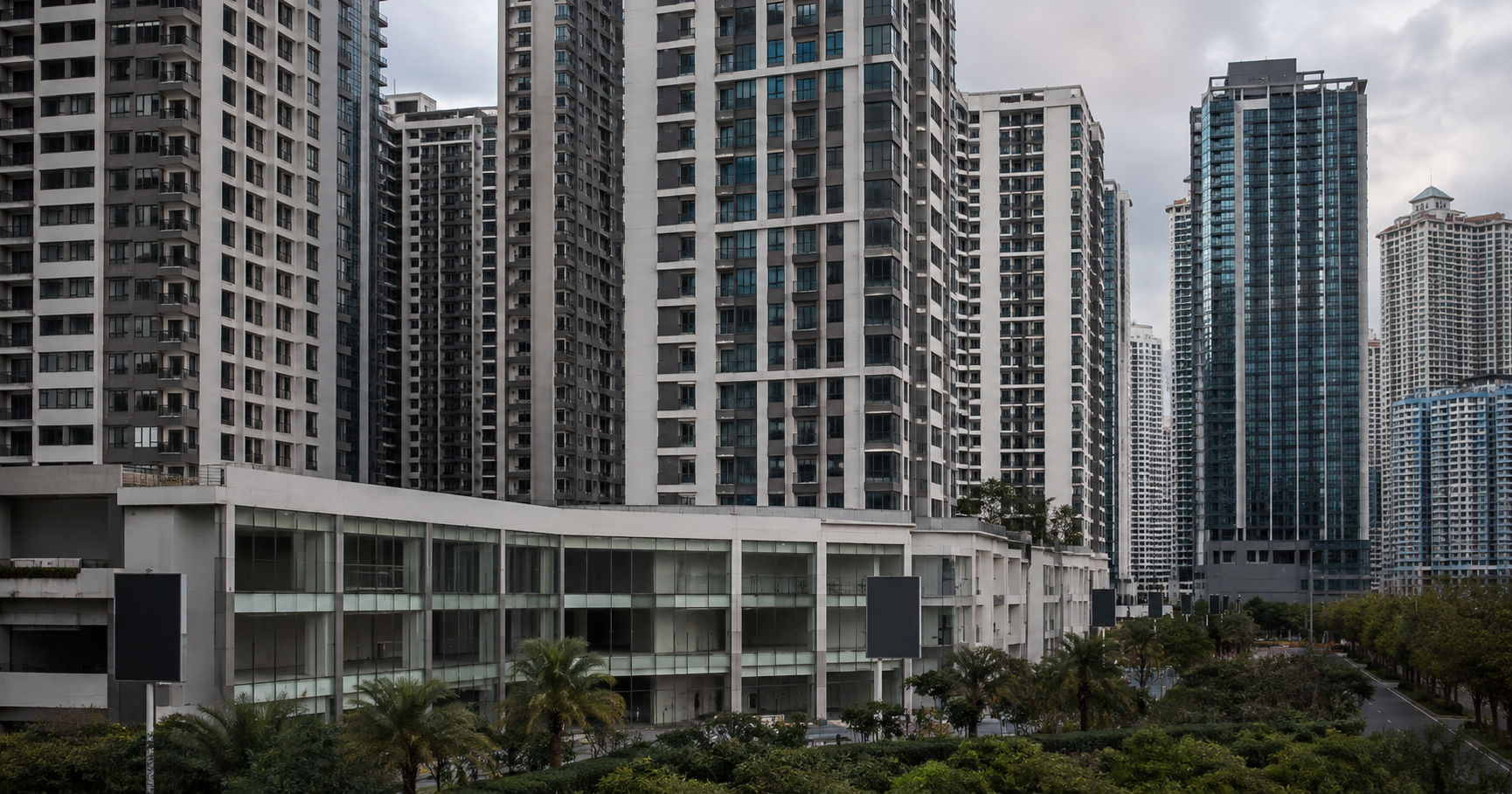
The era when condominiums sold as long as they were built passed with the pandemic. With the wars that began soon after in Central Asia and parts of the Middle East, together with the disappearance of Chinese demand for real estate following the Marcos administration’s total ban on online casinos, the real estate downturn remains stark.
In the Philippine real estate market, the oversupply of condominiums continues, while in the office market the disparity between areas has become even more pronounced.
On October 6, rating agency S&P reported that four major real estate developers have cut their combined 2026 capital expenditure budgets by 25% from their original plans.
Meanwhile, in the third-quarter office market survey released on October 7, the average rent in Metro Manila was 895 pesos per square meter per month, the lowest level in about ten years.
The residential market favors buyers, while in the office market the winners and losers are divided by location and by the competitiveness of individual buildings.
1. Condominium Market: Selling Down Inventory Is the Top Priority
About 80,000 Unsold Units, with Completed Inventory Also at a High Level
The most recent comprehensive housing market statistics are for the second quarter of 2026. There was a time when prime condominium pre-sale (pre-build) projects sold out around the start of construction, but that is no longer the case.
| Indicator | Latest published figure |
|---|---|
| Unsold condominiums in Metro Manila | About 80,000 units |
| Of which, ready-for-occupancy (RFO) inventory for sale | About 32,600 units |
| Residential vacancy rate | 24.9% |
| Projected vacancy rate at end-2026 | 25.6% |
| Unsold inventory per a separate survey | About 82,900 units |
New Launches and Sales
According to S&P’s analysis of October 6, real estate sales in the first half of 2026 fell 7% from the same period a year earlier. Although the decline narrowed from 11% in 2025, a recovery has not yet been achieved.
Developers are prioritizing sales of completed units, handovers under existing contracts, and collection of sales proceeds over launching new projects.
2. New Completions and Handovers
This week, we could not confirm any definite announcement, within the period covered, of new completions or handovers of large condominiums in Metro Manila by major developers.
A recent notable property is Ayala Land’s Gardencourt Residences (in Taguig City, on the former Food Terminal site).
At this property in Arca South, Taguig City, handovers of the first building, Molave, began in September.
Molave consists of 134 units; by the second week of September, handover of 4 units had been formally accepted, and occupancy had begun in 1 unit.
Ayala Land plans to hand over about 13,000 units in 2026 and completed about 6,000 in the first half. Progress in handovers through year-end is a key management indicator.
3. Condominium Sale and Rental Prices by Area
The following are guideline figures based on 2026 asking prices from brokers and market surveys. They do not indicate transaction prices for October 2–8.
| Area | Reference price level for sales (resale and new units combined) | Guideline monthly asking rent, one-bedroom |
|---|---|---|
| BGC | 160,000–270,000 pesos/sqm | 45,000–75,000 pesos |
| Makati CBD | 160,000–280,000 pesos/sqm | 25,000–60,000 pesos |
| Ortigas | 90,000–200,000 pesos/sqm | 20,000–40,000 pesos |
| Bay Area / Pasay | Large price differences between properties | 25,000–45,000 pesos |
| Alabang | Depends on the individual property | Needs to be confirmed property by property |
| Quezon City | 100,000–180,000 pesos/sqm | 20,000–40,000 pesos |
Points of Note by Area
BGC (Bonifacio Global City)
Housing demand from foreign expatriates and high-income groups is relatively strong. Rents for luxury residences are holding firm, but because new-build sale prices are high, caution is needed regarding investment yields.
Makati
There is a large price gap between older condominiums and luxury new builds. Price differences by area are also becoming distinct, as between Salcedo Village and Legaspi Village, and within Legaspi Village between the commercial center area and the rest.
Ortigas
Prices are lower than in BGC and Makati, which makes it competitive. Its main targets are end-users who value a balance between commuting convenience and purchase price.
Bay Area
This is the area most affected by oversupply. Since the withdrawal of Chinese-linked offshore gaming (online casino) operators, it has not recovered its former rental demand.
Colliers forecasts that the residential vacancy rate in this area could approach 60% by the end of 2026. For both sales and rentals, asking prices and actual contract terms should be compared carefully.
4. Office Leasing Market: Gap Between BGC and Makati Widens
On October 7, Prime Philippines’ third-quarter 2026 office market survey was reported.
New leasing demand in Metro Manila edged down from 53,300 square meters in the previous quarter to 53,200 square meters.
On the other hand, the average occupancy rate improved from 83% in the second quarter to 85%.
Office Rents by Area
| Area | Monthly rent (pesos/sqm) | Trend |
|---|---|---|
| BGC | 1,157 | Up from 1,110 a year earlier |
| Makati | 1,008 | Down from 1,150 a year earlier |
| Ortigas | 735 | Down about 3% |
| Bay Area | 710 | Up about 4% |
| Metro Manila average | 895 | Lowest level in about 10 years |
Notably, BGC continues to maintain rent levels clearly above those of Makati.
In addition, the expansion of PEZA accreditation could increase demand from BPO companies for space in Makati, the Bay Area, Alabang, and elsewhere.
Brokers need to compare factors such as whether a building has PEZA accreditation, floor area, power and telecommunications facilities, the building’s environmental performance, and rent-free periods.
5. Trends Among Major Developers
S&P Global Ratings’ analysis, reported on October 6, drew attention to the four major companies’ capital-expenditure cuts and shift in earnings structure.
| Company | Developments and key points confirmed this week |
|---|---|
| Ayala Land | Restraining new residential development and emphasizing handovers of existing properties and its leasing business |
| Megaworld | Emphasizing recurring income other than housing sales; plans to inject assets into MREIT |
| SM Prime Holdings | Emphasizing rental income from commercial facilities and the like, in addition to residential development |
| Robinsons Land | Promoting transfer of assets to a REIT and participation in home-purchase support programs |
The four companies’ combined 2026 capital expenditure budgets were cut by 25% from the original plans.
Transfers of assets to REITs are also important: Ayala Land has obtained regulatory approval to inject 19.5 billion pesos in assets into AREIT.
Megaworld plans to increase MREIT’s leasable floor area by 47% in 2026, and Robinsons Land is also proposing to inject 10.6 billion pesos in assets into RCR.

コメント