
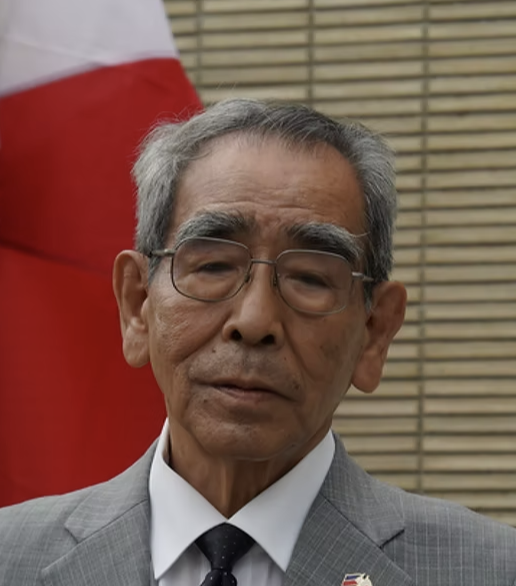
Pinoy-Hapon United Foundation (PHUF), a non-profit organization, Honorary Chairman Takeshi Asanuma
On August 15, Shōwa 20 (1945), it was clear from the morning — a hot day. NHK had announced that an important broadcast would be made at noon. Villagers gathered in front of the radio set up in the gatehouse of my grandparents’ house outside Nara City. Counting the children, there were perhaps thirty people. At noon, following the playing of “Kimigayo,” the Emperor’s Imperial Rescript announcing the end of the war was broadcast — what came to be known as the “Jewel Voice Broadcast.”
“Having pondered deeply the general trends of the world and the actual conditions obtaining in Our Empire today…” — it was difficult Japanese, far beyond my understanding. My grandfather murmured, “The war is over. Japan has lost.” The villagers stood there looking stunned, every one of them hanging their heads. The cicadas kept on singing.
In early September, my father — a former Army special reserve second lieutenant who had come up through the Class A Special Officer Cadet Course — was demobilized and returned home from Aomori Prefecture. He brought his military sword back wrapped in a blanket. He told us that, at the time of his discharge, his superior officer had told him, “You men are officers of the Empire. Orders may yet come down again from the authorities at any time, so take good care of your sword and your military service record book.” My father came home carrying three shō of rice on his back, and thanked my grandparents most courteously for looking after us in his absence.
September 1 — the new term began. No one called out for us to walk to school together in a group. There was no “weekly duty” pupil wearing the red sash at the school gate. We simply walked past the hōanden without a glance, and there was no bowing toward the Imperial Palace for the children gathered in the schoolyard. The principal simply said, in a voice with rather less energy than usual, “Regrettably, Japan has been defeated. A new era begins from here,” and the morning assembly ended there, briefly.
In the classroom, the same female teacher who used to shout “American and British beasts!” had lost her spirit too, and simply muttered a single line: “We lost the war.” The teachers themselves must have been at a loss over what, and how, to tell the children. I believe the roughly four years of war left some kind of wound in the heart of every single Japanese person.
Perhaps it is a national trait, but the switch happened quickly. In mid-September the hōanden was torn down. I heard that the Emperor’s official portrait and the Imperial Rescript on Education were burned. We were told to bring our Japanese-language textbooks along with ink and brush, and under the teachers’ direction, we blacked out every passage that had anything to do with the military or the war.
New textbooks were not issued until the spring of 1947, and even then only the teachers had copies at first — it was another half a year before every child could actually buy their own. This was the beginning of “democratic education.”
Our system of kana usage changed too — the “new kana orthography.” “Ikimaseu” became “ikimashō” (“let’s go”). Even now, I can still read and write in the old kana orthography. The rules for when to use “o” versus “wo” were complicated, as were those for “ji” versus “dji.” For example, “ojisan” (uncle) used to be written “odjisan.” “Oreuri” was how you wrote “oryōri” (cooking).
Digression aside, postwar Japan changed with dizzying speed. It was the age of the occupation forces. The moment they occupied Japan, they completely disarmed the Imperial Japanese Army and Navy. They must have wanted to strip the Japanese people of their very soul — “though in the end, that is not quite how things turned out…”
Signs reading “By order of the Occupation Forces, ___ is prohibited” began appearing everywhere you looked. Perhaps the Japanese government, having lost its authority in defeat, found it convenient to invoke the name of the Occupation Forces to enforce its own administrative directives. On the trains, a sign behind the driver’s seat read, “By order of the Occupation Forces, entry to the driver’s compartment is prohibited.” On both private and national railway lines, medium- and long-distance trains had carriages reserved exclusively for Occupation Forces personnel.
Jeeps drove down Osaka’s Midosuji Avenue, and American soldiers strode about the streets. English text was added to road signs. The Sogo department store in Shinsaibashi was requisitioned and turned into a PX (a store exclusively for American military personnel). On the other side of Midosuji, a row of shops sprang up with signboards written in English.
(Author’s note: The Japanese government used the euphemism “Occupation Forces” — literally “advancing and stationed troops” — in place of the more direct term “army of occupation.”)
コメント