

MANILA NEWS DAILY
The Current State of AIDS (HIV Infection) in the Philippines
HIV Infections Are Surging in the Philippines!
While HIV infections are declining worldwide, new infections in the Philippines are rising at an exceptional pace. Estimated new infections grew from about 4,400 in 2010 to about 29,600 in 2024, roughly 6.7 times as many. The Philippines is now the country with the fastest-growing epidemic in the Asia-Pacific region.
Thailand, by contrast, has cut new infections by about 66% since 2010. The difference between the two countries appears to owe less to sexual behavior itself than to a gap in the systems that “deliver testing, condoms, PrEP, and early treatment to the people who need them.”
1. Trends in New HIV Infections
The figures in the graph below are estimates from UNAIDS and other sources. They show not the number of people diagnosed, but the estimated number of people who were actually newly infected in a given year. Because Japan’s epidemic is small and UNAIDS estimates are limited, national notification statistics are also used as a supplement.
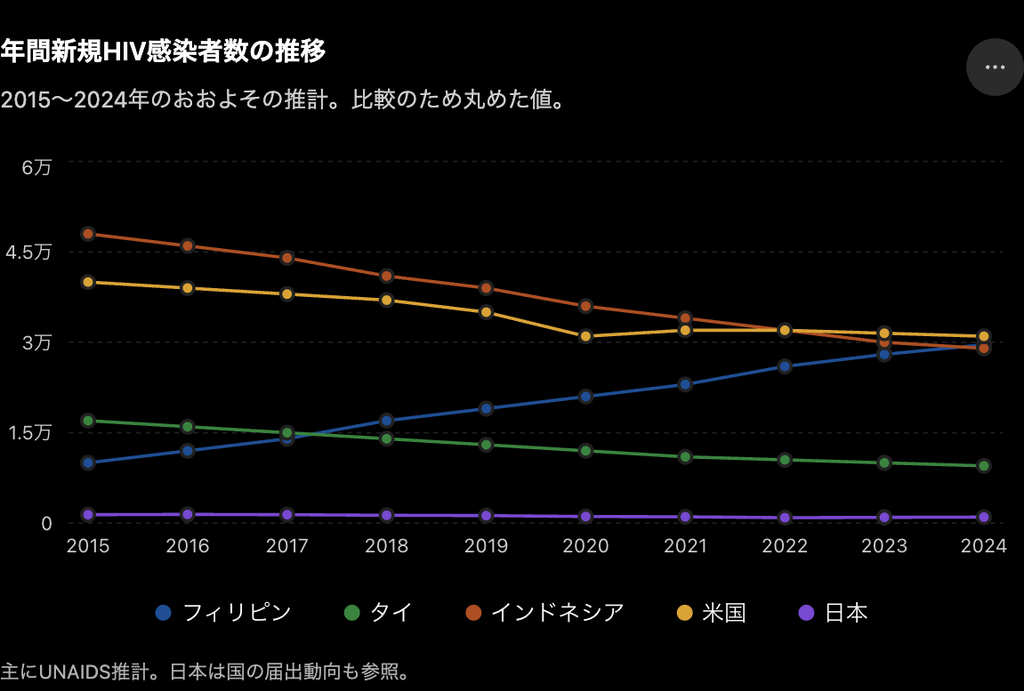
The graph shows the following:
- The Philippines is the only country with a consistent, sharp rise.
- The Philippines, which had fewer new infections than Thailand in 2015, now has about three times as many.
- Indonesia still has a large number of cases, but the long-term trend is downward.
- The United States has a population about three times that of the Philippines, so it must be viewed by population share as well as by total numbers.
- Japan’s epidemic is small, and the trend is roughly flat to gently declining.
2. Comparison by Population, Around 2024
Totals alone make countries with large populations look worse, but a rough calculation per 100,000 people makes the situation clear.
| Country | Estimated new infections per year (approx.) | Per 100,000 population (approx.) | Trend |
|---|---|---|---|
| Philippines | 29,600 | About 25 | Rapid increase |
| Thailand | About 9,500 | About 13 | Sharp decline |
| Indonesia | About 29,000 | About 10 | Gradual decline |
| United States | About 31,000 | About 9 | Gradual decline |
| Japan | About 1,000 | Under 1 | Low and flat |
The Philippines’ problem, therefore, is not just that “a large population means many infections”: even by population share, it has the highest level among the five countries.
3. The Treatment Situation
At present there is no general treatment that completely eliminates HIV from the body. However, if antiretroviral therapy (ART) is continued every day, the viral load can be suppressed below the detection limit, the onset of AIDS can be prevented, and a near-normal life expectancy can be achieved. When the virus remains continuously undetectable, it is not transmitted through sex.
In the Philippines, as of March 2025, of an estimated 252,800 people living with HIV, about 140,000 had been diagnosed. Of these, 92,712 were receiving ART. In other words:
- People who know their infection: about 55%
- Of those diagnosed, those on treatment: about 66%
- Of all estimated people living with HIV, those on treatment: about 37%
- Of those on ART, those confirmed to have viral suppression: about 40%
That is all.
In Thailand, meanwhile, about 82% of people living with HIV were receiving treatment in 2025, and the viral suppression rate among those on treatment is also high. (UNAIDS)
4. Why Are Infections Still Rising in the Philippines While Falling in Thailand?
① Prevention is not keeping pace with the spread among young men
The Philippine epidemic is concentrated among young gay men, men who have sex with men (MSM), and transgender women (that is, people assigned male at birth). In the first quarter of 2025, about one-third of newly diagnosed people were aged 15 to 24. UNAIDS points out that nearly half of the new infections in 2024 were among young people.
Sex between men is itself a cause, but the greater problem is that testing, condoms, PrEP, and early treatment are not reaching them sufficiently.
② Very many people have not been tested
In the Philippines, about 45% of the estimated people living with HIV still do not know they are infected. Without knowing, they cannot start treatment, and they are likely to pass the virus on to others while their viral load is high.
Young people may avoid testing out of fear that their families will find out. Prejudice against sexual minorities and fear of being identified as infected also delay testing. In an earlier survey in Quezon City, about two-thirds of MSM had never been tested for HIV.
③ Prevention spending is small
Of the Philippines’ 3.6 billion pesos in HIV-related spending in 2023, only 211 million pesos, a mere 6%, went to prevention. Increasing treatment funding is essential, but unless enough is invested in testing, condoms, sex education, and PrEP, the country will fall into a vicious circle in which new patients keep joining the treatment system and medical costs keep rising.
④ PrEP is spreading slowly
PrEP is a drug that people who are not infected take in advance to greatly reduce the risk of HIV infection. Thailand has built PrEP, HIV self-testing, same-day treatment initiation, and more into its universal health coverage and the work of community organizations.
PrEP has become available in the Philippines too, but it has not reached the scale needed to cover young people and MSM as a whole. The barriers are cost, distance to medical facilities, lack of information, and worry about others finding out.
⑤ Thailand used community organizations as formal health care providers
In Thailand, more than 100 community-led organizations are accredited as formal HIV service providers under the public health insurance system. These organizations provide testing, counseling, condoms, and PrEP even at night and in entertainment districts, reaching about 75% of priority populations with prevention services.
The Philippines also has excellent community organizations and clinics, but stable nationwide public funding and integration into the system are insufficient. Its many islands and the large differences in capacity among local governments also make nationwide rollout difficult.
⑥ Thailand built a cycle of “detect early, treat immediately”
Thailand incorporated ART into universal health coverage in 2006, and from 2014 adopted a policy of treating everyone diagnosed, regardless of CD4 count.
As a result, by making testing easy to access, it achieved early detection; by starting ART immediately and suppressing the viral load, it prevented sexual transmission; and new infections declined,
forming a virtuous cycle.
In the Philippines, the opposite cycle, “not noticing the infection → delayed diagnosis → delayed start of treatment → continued transmission,” has yet to be broken.
Overall Assessment
Thailand’s success is not because its people’s sexual behavior is especially different, but the result of integrating testing, PrEP, early treatment, community organizations, and public health insurance. In the Philippines, too, it will be difficult to reverse the upward trend unless, in addition to increasing treatment facilities, a nationwide system is put in place in which young people can receive testing, PrEP, and treatment in a near-anonymous manner.