

MANILA NEWS DAILY
Okinawa Governor Election: Newcomer Genta Koja Wins in a Landslide
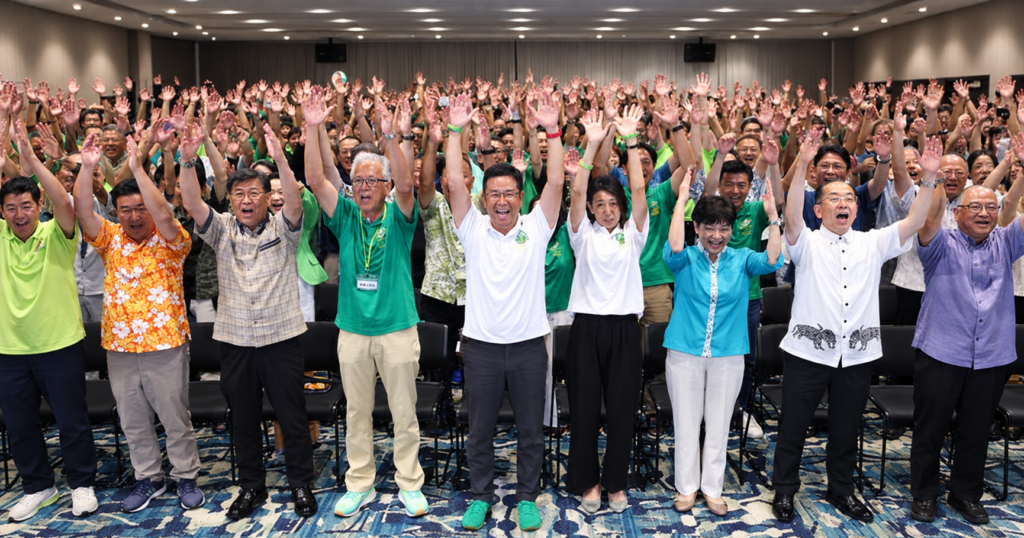
Voting and vote-counting for the Okinawa gubernatorial election, held upon the expiration of the incumbent’s term, took place on September 13. Genta Koja (42), an independent newcomer and former deputy mayor of Naha, won his first term with 423,124 votes. Incumbent Governor Denny Tamaki (66), who was seeking a third term, garnered only 276,060 votes, a gap of roughly 147,000 votes. Koja’s share of the vote was 59.42%, against Tamaki’s 38.77%.
The other candidates received the following totals: Shun Kaneshima, 4,657 votes; Takashi Higa, 3,542 votes; Chosuke Yara, 2,467 votes; and Masahiro Sueyoshi, 2,270 votes. Koja finished first in all 41 municipalities, making it a landslide victory in the truest sense. The total number of valid votes was 712,120. Voter turnout was 61.57%, up 3.65 points from 57.92% in the previous election in 2022.
Koja was endorsed by the Liberal Democratic Party, the Japan Innovation Party, the Democratic Party for the People, Sanseito, the Japan Conservative Party, and the Okinawa Prefectural chapter of Komeito. His victory was declared virtually the instant polls closed at 8:00 p.m. — a so-called “zero-count” call — settling the outcome before vote counting had even begun.
This election result went beyond a simple rebuke of the incumbent; it amounted to a clear verdict from Okinawan voters against the “All Okinawa” coalition government that had held power since 2014. It marks the first time in twelve years that a conservative-aligned candidate has taken the governorship, and signals a shift in Okinawan prefectural politics — away from a stance centered on confrontation with the national government, and toward a course of cooperation aimed at economic promotion and reducing the burden of U.S. military bases.
The first reason cited for Koja’s victory is that he successfully shifted the election’s focus from the base issue to daily life and the economy. Koja pledged to “double per-capita prefectural income within ten years” — income that currently ranks among the lowest in the nation — and put front and center policies such as industrial promotion in partnership with the business community, expanding tourism spending, fostering digital and AI industries, and doubling support for child-rearing.
Pre-election surveys conducted by the Ryukyu Shimpo and other outlets likewise found that 46.9% of voters ranked “the economy, employment, and measures against rising prices” as the policy area they cared most about, far outstripping the 16.6% who prioritized “the base issue and security.” It is believed that the demand for solutions to problems bearing directly on daily life — rising prices, low wages, child poverty, chronic traffic congestion — translated into support for Koja.
The second factor behind his win was the unification of the conservative vote. In the previous gubernatorial election in 2022, two conservative-aligned candidates, Atsushi Sakima and Mikio Shimoji, both ran, splitting the vote. This time, Shimoji withdrew from the race and threw his support behind Koja, allowing conservative and centrist forces to consolidate.
Mid-campaign polling by the Okinawa Times and others found that Koja had already secured roughly 80% of LDP-affiliated voters, and had made inroads among supporters of Komeito and Sanseito as well. A separate Okinawa Times survey of the mayors of all 41 municipalities in the prefecture found 29 in support of Koja and only 6 in support of Tamaki — evidence that a broad support network among local leaders and the business community had formed at an early stage.
Third, voters responded well to Koja’s youth and his administrative experience. After graduating from the University of Tokyo, Koja joined the Ministry of Internal Affairs and Communications, where he served in posts including chief of the finance division of Nagasaki Prefecture. Having also gained experience in local government as deputy mayor of Naha, he campaigned as a hands-on, practical candidate capable of bridging the national government, the prefecture, municipalities, and the business community, promising to reform prefectural governance. He made active use of social media, broadening his support beyond the traditional conservative base to include younger voters and independents as well.
Tamaki, for his part, campaigned on his eight years of experience across two terms and his name recognition, maintaining his firm opposition to the new base construction at Henoko. However, as construction work on the Henoko relocation has continued to advance, it has become increasingly difficult to unify Okinawan voters around the base issue alone. The capsizing accident involving a protest boat off Henoko in March, which prompted a reconsideration of how the anti-base movement should conduct itself, may also have affected Tamaki’s base of support.
The Ryukyu Shimpo reported that this was the first time the “All Okinawa” coalition, formed in 2014, had been defeated in a prefecture-wide election, including a gubernatorial race. The Yaeyama Nippo, framing the result as “conservative prefectural government reclaimed after twelve years” and “a landslide win by a margin of roughly 150,000 votes,” characterized the outcome as the end of the “All Okinawa” administration. Though the two papers differ in their political leanings, they agree that the framework of Okinawan politics that had persisted for twelve years has now fundamentally changed.
After his victory was confirmed, Koja declared his resolve “to take in the full range of feelings held by Okinawa’s 1.46 million residents, and to move Okinawa forward by overcoming conflict and division.” Going forward, he will need to advance the Okinawa promotion budget and the reuse of former base land through cooperation with the national government, while also remaining mindful of the roughly 280,000 voters who opposed the Henoko relocation.
Doubling prefectural income, the goal he campaigned on, is not an easy target that prefectural government can achieve on its own. Whether he can translate tourism revenue into household income, raise the productivity and wages of small and medium-sized enterprises, and narrow regional disparities, including those affecting the outlying islands, remains to be seen. Having won a substantial political mandate through his landslide victory, Governor-elect Koja now bears the responsibility of turning his campaign promises into concrete results.
That War and Me (10) When the Fighting Ended
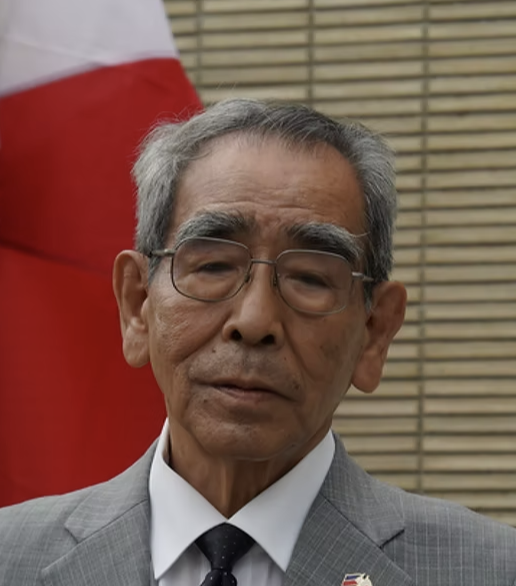
Pinoy-Hapon United Foundation (PHUF), a non-profit organization, Honorary Chairman Takeshi Asanuma
On August 15, Shōwa 20 (1945), it was clear from the morning — a hot day. NHK had announced that an important broadcast would be made at noon. Villagers gathered in front of the radio set up in the gatehouse of my grandparents’ house outside Nara City. Counting the children, there were perhaps thirty people. At noon, following the playing of “Kimigayo,” the Emperor’s Imperial Rescript announcing the end of the war was broadcast — what came to be known as the “Jewel Voice Broadcast.”
“Having pondered deeply the general trends of the world and the actual conditions obtaining in Our Empire today…” — it was difficult Japanese, far beyond my understanding. My grandfather murmured, “The war is over. Japan has lost.” The villagers stood there looking stunned, every one of them hanging their heads. The cicadas kept on singing.
In early September, my father — a former Army special reserve second lieutenant who had come up through the Class A Special Officer Cadet Course — was demobilized and returned home from Aomori Prefecture. He brought his military sword back wrapped in a blanket. He told us that, at the time of his discharge, his superior officer had told him, “You men are officers of the Empire. Orders may yet come down again from the authorities at any time, so take good care of your sword and your military service record book.” My father came home carrying three shō of rice on his back, and thanked my grandparents most courteously for looking after us in his absence.
September 1 — the new term began. No one called out for us to walk to school together in a group. There was no “weekly duty” pupil wearing the red sash at the school gate. We simply walked past the hōanden without a glance, and there was no bowing toward the Imperial Palace for the children gathered in the schoolyard. The principal simply said, in a voice with rather less energy than usual, “Regrettably, Japan has been defeated. A new era begins from here,” and the morning assembly ended there, briefly.
In the classroom, the same female teacher who used to shout “American and British beasts!” had lost her spirit too, and simply muttered a single line: “We lost the war.” The teachers themselves must have been at a loss over what, and how, to tell the children. I believe the roughly four years of war left some kind of wound in the heart of every single Japanese person.
Perhaps it is a national trait, but the switch happened quickly. In mid-September the hōanden was torn down. I heard that the Emperor’s official portrait and the Imperial Rescript on Education were burned. We were told to bring our Japanese-language textbooks along with ink and brush, and under the teachers’ direction, we blacked out every passage that had anything to do with the military or the war.
New textbooks were not issued until the spring of 1947, and even then only the teachers had copies at first — it was another half a year before every child could actually buy their own. This was the beginning of “democratic education.”
Our system of kana usage changed too — the “new kana orthography.” “Ikimaseu” became “ikimashō” (“let’s go”). Even now, I can still read and write in the old kana orthography. The rules for when to use “o” versus “wo” were complicated, as were those for “ji” versus “dji.” For example, “ojisan” (uncle) used to be written “odjisan.” “Oreuri” was how you wrote “oryōri” (cooking).
Digression aside, postwar Japan changed with dizzying speed. It was the age of the occupation forces. The moment they occupied Japan, they completely disarmed the Imperial Japanese Army and Navy. They must have wanted to strip the Japanese people of their very soul — “though in the end, that is not quite how things turned out…”
Signs reading “By order of the Occupation Forces, ___ is prohibited” began appearing everywhere you looked. Perhaps the Japanese government, having lost its authority in defeat, found it convenient to invoke the name of the Occupation Forces to enforce its own administrative directives. On the trains, a sign behind the driver’s seat read, “By order of the Occupation Forces, entry to the driver’s compartment is prohibited.” On both private and national railway lines, medium- and long-distance trains had carriages reserved exclusively for Occupation Forces personnel.
Jeeps drove down Osaka’s Midosuji Avenue, and American soldiers strode about the streets. English text was added to road signs. The Sogo department store in Shinsaibashi was requisitioned and turned into a PX (a store exclusively for American military personnel). On the other side of Midosuji, a row of shops sprang up with signboards written in English.
(Author’s note: The Japanese government used the euphemism “Occupation Forces” — literally “advancing and stationed troops” — in place of the more direct term “army of occupation.”)
“Great Men of the Philippines: José Rizal” (Part 28)
Yasotarō Mōri
The Death Sentence Is Handed Down
The court-martial immediately reconvened in a separate chamber, and
on the grounds that “Rizal organized an illegal society and incited and promoted revolution,” handed down a sentence condemning him to death. The Governor-General accordingly decreed that Rizal be executed by firing squad at seven o’clock on the morning of December 30, on the field of Bagumbayan (now Luneta Park). Rizal was not informed of the sentence until two days later, but to a man who had already resigned himself to death, the two-day delay can hardly have mattered. In the report recommending Rizal’s death sentence — drafted by the Judge Advocate General and signed by the Governor-General — there appears a passage to the following effect:
“That Rizal — favored by fortune to become the idol of a revolutionary faction, and now, crossed by fortune, facing a death devoid of glory or honor; that Rizal, a specialist in the natural sciences and physical chemistry, the single most diligent and learned scholar among Filipinos, one who traveled widely through Europe, spoke several modern languages, was beloved by his unlettered countrymen and revered as teacher and friend regardless of race — that same Rizal set his mind to the study of the mental and social sciences, a pursuit demanding vast preparation. Yet he began, in practice, to propagate among the inhabitants of Spanish territory ideas of disloyalty and sedition, principles contrary to national unity. ——— Rizal became synonymous with revolution itself, the most intellectual leader of the separatist cause, and, in short, the idol of the ignorant masses. The masses came to regard this energetic agitator as something superhuman, and honored him with the title of the ‘Supreme One.'”
One imagines that Rizal, had he known he was being so extravagantly praised by the very enemies who hated him most, could not have helped but smile a wry, faint smile.
On December 26, when he was first permitted visitors from outside, his sister Trinidad was the first to see him. Rizal told her then, “When I die, ask for my remains — there is something inside my right shoe.”
Early on the morning of December 29, Rizal was informed of the death sentence, and was then moved to the chapel within the fort, where he remained until the following morning, when he was taken to the execution ground. His mother, Josephine, and his sisters were permitted to visit him, but no men were allowed. Spanish records state that Rizal knelt and wept as he parted from his mother, but according to eyewitness accounts from the sisters who accompanied her, no one was actually allowed to come near him — he could not even take his mother’s hand — and, stamping the floor in fury, he is said to have shouted, “Cowards! Spain will lose the Philippines before long!” When his sister Trinidad saw him for the last time, he told her he was giving her an alcohol lamp as a keepsake, and, watching for a moment when the guards were not paying attention, he warned her in English, “There is something inside it.”
That night, wary of prying eyes, his mother and sisters left the lamp untouched, but on New Year’s Eve they gathered together and secretly searched inside it. At the bottom they found a single folded slip of paper, on which was written a poem titled “My Last Farewell.”
Among all his poems, this one is regarded as the most deeply moving expression of heartfelt emotion, and Filipinos continue to recite it to this day. It has been translated into many languages and is cherished everywhere, though the original was written in Spanish. (The present writer has three different English translations of this poem on hand; all of them seem to convey the sense of the original well, and one cannot help but be struck by the glimpse they offer of Rizal’s noble character — a man who, to his very last moment, harbored no grudge against heaven and blamed no one, burning only with love for his homeland and pouring out, until the end, the utmost sincerity of his patriotism.)
Josephine, too, was married to Rizal on this last day, and is said to have told him that she intended to support herself thereafter by teaching English. Rizal is also said to have whispered to her, “Look inside my right shoe — there is something in it,” the same thing he had told his sister Trinidad four days earlier. A book he sent to Josephine as a keepsake was found to have 53 pages torn out of it, and it is believed that something important must have been written on those pages. (A year and a half later, when his remains were cremated, his family examined the inside of his right shoe but found nothing there. It is thought that when Rizal spoke to his sister of the right shoe, the guards may have overheard and had its contents confiscated for official inspection.)
After Rizal’s execution, Josephine, in indignation, joined the revolutionary forces in Cavite and worked as a nurse to help her comrades in arms. She later went to Hong Kong and lived with her adoptive father, Taufer, but in the year of the Spanish-American War he passed away; she then remarried a Spaniard, returned to the Philippines, and taught English at schools in Manila and other cities. The first Speaker of the Philippine legislature was one of her students, and it is said that some Filipinos still living today once studied English under her. She died in 1908, though her descendants continue on. Because she was, by adoption, an American citizen, she received the protection of the American consul in Manila, and so, even after Rizal’s execution, the Spanish authorities left her at liberty.
In the final hours before his death, he wrote farewell letters to his elder friends and acquaintances, then calmly awaited the fate that awaited him. The farewell letters he wrote to Dr. Blumentritt and to his brother have a power that pierces the heart of anyone who reads them. It is especially striking that in every one of these letters, he insisted that he was entirely innocent of any charge of inciting revolution.
A certain high Spanish official, regretting the loss of Rizal’s extraordinary talent, launched a campaign for clemency and secured the Spanish Prime Minister’s agreement to commute the sentence by one degree — but the Queen Regent refused to consent, on the grounds that Rizal had defamed a senior official related to her by marriage (though this “defamation” amounted to nothing more than exposing a crime that official had actually committed). And so Rizal’s fate was sealed.