
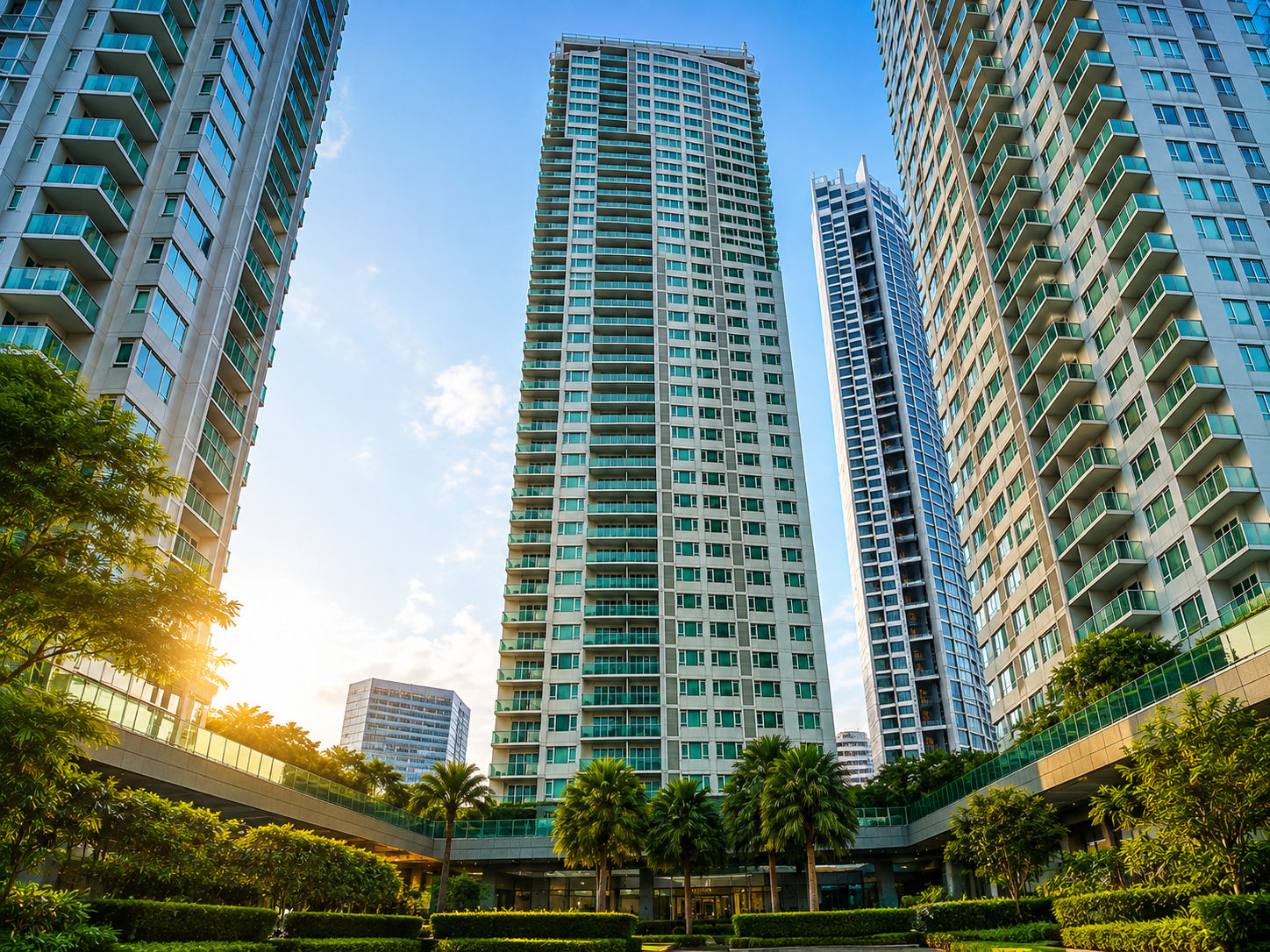
The Philippine real estate market in Metro Manila remained in a complex phase during the first half of 2026, marked by the coexistence of “quantitative oversupply” and “signs of qualitative recovery.” The new condominium market continues to favor buyers, and the severe oversupply in the Bay Area — driven by the collapse of Chinese investment demand — has yet to be resolved. Below is a summary of the latest developments by sector.
1. New Condominium Sales
Inventory Levels and Years to Absorb
As of Q2 (April-June), unsold condominium inventory in Metro Manila reached 82,900 units across 616 ongoing projects — the highest level since Leechiu Property Consultants (LPC) began compiling data in 2016. Colliers Philippines, meanwhile, estimates that “remaining inventory life” has improved significantly, from a peak of 13.4 years in mid-2025 to 6.8 years in Q1 2026. LPC, however, estimates inventory absorption at roughly 34 months (just under three years) — a reminder that assumptions vary between consulting firms.
The “Seven Years’ Worth of Oversupply” Claim Is Largely Accurate
The view that “oversupply means seven years’ worth of unsold units” is broadly consistent with Colliers’ inventory-life figure (6.8 years, down from a recent peak of 13.4 years), making it largely accurate. That said, this figure already reflects substantial improvement from the peak, representing roughly half the level seen at the worst point (mid-2025). Of the unsold inventory, about 30,600 units are ready-for-occupancy (RFO) — and these are the main battleground for discount competition.
Demand Trends
Net pre-selling take-up in Q1 came to roughly 2,000 units, a sharp tenfold jump from the same period last year (just 228 units). Q2 demand held roughly steady at 7,255 units. However, demand remains concentrated in pre-selling units in the “middle-income, affordable” price bracket (₱2 million-12 million), buoyed by aggressive developer incentives such as lump-sum payment discounts of up to 40%, early move-in packages, lease-back (rent-to-own) options, and gift certificates worth up to ₱150,000. Industry insiders remain cautious, saying it is “too early to call this a sustained recovery.”
2. Office Leasing Market
Metro Manila’s overall office vacancy rate edged down slightly from 19.4% in Q4 2025 to 19.0% in Q1 2026, mainly due to near-zero new supply. Demand was clearly concentrated in the Makati CBD and Bonifacio Global City (BGC), which together drove the market in Q1 with take-up of 40,000 square meters in BGC and 38,000 square meters in Makati CBD. Rents for Grade A and premium offices in Makati rose a modest 0.7% quarter-on-quarter, reflecting a pronounced “flight to quality” toward higher-grade buildings.
Leechiu’s figures, however, paint a somewhat weaker picture, with H1 (January-June) office demand down 32% year-on-year — underscoring how assessments vary between consulting firms. Roughly 505,000 square meters of new supply is expected for full-year 2026, about half of it concentrated in Alabang, the Bay Area, and Quezon City.
3. Residential Condominium Leasing Market
As of Q2, average rents across most major districts fell year-on-year, with the exception of Bonifacio Global City (BGC) and Taguig.
• Makati: ₱887/sqm per month, -18% YoY
• Ortigas/Mandaluyong: ₱729/sqm, -25% YoY
• Alabang/Muntinlupa: ₱715/sqm, -42% YoY
• Taguig: ₱715/sqm, +15% YoY
• Bay Area/Pasay: ₱706/sqm, -59% YoY
• BGC: ₱1,105/sqm, +0.1% YoY
BGC and Taguig have recovered beyond pre-pandemic levels, while other districts remain below pre-pandemic benchmarks, keeping the overall leasing market firmly in “tenant favorable” territory. Rental yields also remain compressed, at roughly 3.8% in the primary market and 4.6% in the secondary market, with purchases now driven more by genuine end-user demand than by investment motives.
4. The Decline in Chinese Demand
One of the biggest factors behind the oversupply repeatedly cited by industry sources is precisely this collapse in Chinese demand. Before the pandemic, improving China-Philippines relations and the rapid expansion of Philippine Offshore Gaming Operators (POGOs) drove a surge in condominium purchases by Chinese investors. However, the Philippine government’s crackdown on POGOs — culminating in a total ban on POGOs — effectively wiped out this segment of demand. Rising cancellation rates, as buyers struggled to keep up payments, have further compounded the oversupply.
5. The Bay Area (The Most Severe Case)
The Bay Area (Pasay City, spanning the Mall of Asia to Entertainment City) is the most severely oversupplied district in Metro Manila. Colliers projects the vacancy rate will approach roughly 60% by the end of 2026. As noted above, average rents also recorded a devastating 59% year-on-year decline. Towers rose rapidly during the POGO boom, but demand has failed to fill the gap left by POGOs’ exit, and supply pressure is unlikely to ease anytime soon as large projects — including SM Development Corporation’s (SMDC) multi-tower “Sail Residences” — continue to be completed. Colliers notes that RFO units in the area are “likely to see even steeper discounts given the district’s characteristics,” making the Bay Area the most fiercely contested battleground for price cuts.
6. Chinatown (Binondo)
Detailed statistics for Binondo (Manila, the world’s oldest Chinatown, established in 1594) are not as extensively published as for the Bay Area, but the following trends can be observed:
• Binondo, together with the broader Manila City center (including Ermita and Malate), is one of the districts contributing to Metro Manila’s high overall residential vacancy rate (24.7% at the end of 2025, projected 25.6% by the end of 2026).
• On the ground, however, traditional Chinese-Filipino commercial activity (such as the jewelry trade along Ongpin Street) remains a strong underpinning, with stable genuine rental demand from students, hospital staff, and local families. Some analyses suggest effective vacancy in well-managed properties runs as low as 5-10%, relatively healthier than the metro-wide average (over 20%).
• At the same time, new pre-selling projects such as Chinatown Grand Residences (formerly 918 Lucky Mansion), slated for turnover in 2026-2027, are underway alongside the area’s aging existing stock, giving the market a “two-tiered” character.
On the whole, Binondo appears to be less a market driven by Chinese investors and more a unique micro-market underpinned by genuine demand from the local Chinese-Filipino community (residential and mixed commercial use), showing comparatively gentle supply-demand swings rather than the speculative boom-and-bust seen in the Bay Area. That said, detailed vacancy and transaction data to substantiate this is only partially available from public sources, and direct inquiries with local real estate brokers would be needed for a more accurate picture.
Conclusion
The Philippine real estate market in the first half of 2026 remains in a complex phase, combining “quantitative oversupply” with “signs of qualitative recovery.” Core CBDs such as Makati and BGC are supported by resilient demand and recovering rents, while the Bay Area — still bearing the deepest scars from the POGO exodus — continues to face a critical situation with vacancy nearing 60%. The structural factor of collapsed Chinese investment demand remains unresolved, and the claim of “seven years’ worth of oversupply,” while improved from its peak, appears broadly accurate in substance.
Sources: Colliers Philippines, Leechiu Property Consultants (LPC), BusinessWorld, Manila Bulletin, GMA News Online, and various industry reports (published May-July 2026)


コメント